Knowledge hub

Lab Partner: Superintelligence Guides Experiments in Real Time

Lab Partner: Superintelligence Guides Experiments in Real Time

The advent of superintelligence as a laboratory partner introduces a method where educational methodologies merge seamlessly with advanced scientific inquiry, creating an environment where the acquisition of knowledge occurs through direct interaction with an omniscient guide. This system functions not merely as a passive repository of information but as an active agent capable of understanding the intent of a researcher while managing the complexities of experimental physics, chemistry, and biology. In this context, the superintelligence serves as the ultimate tutor, observing every action taken by the student or scientist and providing immediate, context-aware feedback that transforms abstract theoretical concepts into tangible reality. The educational value lies in the system’s ability to explain the rationale behind every recommendation, effectively bridging the gap between textbook theory and the messy, unpredictable nature of real-world experimentation. By continuously monitoring the state of an experiment, the AI ensures that the learner remains safe while simultaneously pushing the boundaries of their understanding, effectively creating a personalized curriculum that adapts to the pace and proficiency of the user in real time. Safety within this advanced laboratory framework is maintained through a rigorous, multi-layered monitoring apparatus that integrates directly with physical equipment sensors to enforce operational boundaries without impeding the learning process.

The system continuously ingests high-frequency data streams from instruments measuring temperature, pressure, pH, and spectral signatures, utilizing this information to construct a comprehensive digital representation of the physical experiment. Deviations from safe operating parameters are identified instantly through statistical outlier detection and physics-based constraint checking, allowing the AI to flag potential hazards long before they become critical failures. This capability relies on sensor fusion techniques that combine disparate data modalities to form a coherent picture of the experimental state, enabling the detection of subtle anomalies such as unexpected chemical reactions or mechanical stress that might escape human perception. Upon identifying a risk, the system prioritizes interventions based on severity, ranging from auditory or visual warnings to automatic shutdowns triggered by direct communication with the equipment control systems, thereby ensuring that human response time limitations do not compromise safety. The core architecture of this intelligent lab partner is built upon a closed-loop decision support framework that observes the experimental state, interprets the data against domain knowledge, plans appropriate responses, and advises the human operator in a continuous cycle. This loop begins with an input layer designed to aggregate heterogeneous data sources, including raw sensor feeds, structured protocol specifications, unstructured user queries, and environmental context such as ambient temperature or humidity.

Processing this information requires a hybrid neuro-symbolic approach where symbolic reasoning engines handle strict safety rules and domain logic while statistical machine learning models manage pattern recognition and predictive tasks. The fusion of these two computational frameworks allows the system to reason about the experiment using established scientific principles while remaining flexible enough to learn from new data patterns that may not have been explicitly programmed. The output layer translates these complex computations into actionable insights delivered through a user interface that suits the context, offering prioritized recommendations on a dashboard, verbal alerts through a headset, or visual overlays via augmented reality glasses that project guidance directly onto the equipment. Real-time anomaly detection within this system surpasses human capability by applying high-frequency sensor fusion to identify unsafe conditions or procedural errors with extreme speed and precision. Multimodal data streams are analyzed simultaneously to detect correlations that indicate impending equipment failure, such as a slight vibration in a centrifuge coupled with a minor temperature rise, which would suggest a bearing failure. The system employs predictive modeling to simulate potential outcomes of proposed experimental steps before they are physically executed, allowing researchers to visualize the consequences of their actions and adjust variables to maximize safety and success probability.

These simulations utilize mechanistic models grounded in physical laws alongside empirical data to provide quantified uncertainty bounds, giving users a clear understanding of the confidence level associated with each prediction. By running these simulations in the background, the AI acts as a forward-looking shield, preventing the user from proceeding with actions that would lead to hazardous states or wasted resources. Optimization algorithms play a crucial role in the experimental design process, evaluating thousands of parameter combinations to identify the most efficient path toward the desired results while adhering to material and time constraints. Reinforcement learning agents iteratively improve protocols by analyzing historical success rates and specific domain constraints, effectively learning optimal strategies that a human researcher might miss due to cognitive limitations or bias. This computational power extends to resource allocation, where the advisor suggests optimal usage of limited reagents, instruments, or personnel across multiple concurrent experiments, ensuring that laboratory throughput is maximized without sacrificing data quality. The natural language interface is essential here, as it translates complex data patterns and model outputs into clear, actionable explanations tailored to the specific expertise level of the user, allowing a novice to understand the reasoning behind a suggested change just as well as an expert would.

This demystification of complex optimization processes serves an educational purpose, helping users internalize efficient experimental design principles through direct interaction with the system. Virtual lab environments function as physics-accurate digital twins of physical laboratories, synchronized with real-world instrumentation to enable remote experimentation, training, and scenario testing without material cost or risk. These digital replicas allow students and researchers to practice procedures and test hypotheses in a sandbox setting where mistakes do not result in broken glassware or dangerous chemical spills. The high fidelity of these simulations depends on significant computational resources to render real-time physics interactions, yet they provide an invaluable platform for scaling education and research beyond physical limitations. Within this virtual space, the superintelligence can manipulate time, slowing down rapid reactions or speeding up long processes to illustrate key concepts that would otherwise be invisible or impractical to observe. The smooth connection between the virtual and physical realms means that protocols perfected in the simulation can be immediately transferred to the actual lab equipment with confidence that the results will align with expectations.

The evolution of laboratory automation technology has progressed from early expert systems in the 1980s that relied on rigid rule sets unable to handle novel or noisy real-world data to more sophisticated machine learning approaches in subsequent decades that enabled pattern recognition yet lacked causal reasoning and safety guarantees. The development of hybrid neuro-symbolic architectures has finally made real-time scientific guidance feasible by combining the flexibility of data-driven learning with the reliability of logic-based systems. Advances in edge computing and low-latency inference have facilitated a shift from offline analysis to embedded, interactive assistance, allowing the AI to process data locally on instruments rather than relying solely on cloud connectivity. This historical progression highlights a technical maturation where systems have moved from simple recording tools to active cognitive partners capable of understanding and influencing the scientific process directly. Current deployments of these systems in pharmaceutical companies demonstrate significant improvements in high-throughput screening, reducing assay development time by approximately forty percent through intelligent protocol optimization. In semiconductor fabrication labs, similar technologies monitor deposition processes with high precision to prevent wafer contamination, a critical factor in maintaining yield rates.

Academic core facilities have reported a thirty percent reduction in protocol errors and a twenty percent faster student training timeline when AI-guided systems are employed to assist researchers. Benchmarks from these controlled trials indicate over ninety percent accuracy in anomaly detection and a seventy-five percent user acceptance rate for optimization suggestions, proving that researchers are willing to trust algorithmic advice when it is presented transparently and reliably. These real-world applications validate the utility of superintelligent lab partners across diverse fields such as materials science, pharmaceuticals, and synthetic biology. Despite these advancements, physical labs face significant challenges regarding instrument setup, as legacy equipment often lacks support for digital control or sensor output necessary for setup with modern AI systems. High-fidelity virtual labs demand substantial computational resources for real-time physics simulation, creating a barrier to entry for smaller institutions with limited IT infrastructure. Economic viability depends heavily on reducing the marginal cost per experiment, so current deployments favor high-value, low-throughput research where the return on investment justifies the expense of sophisticated instrumentation.

Flexibility remains limited by data quality and availability, while poorly documented historical experiments reduce model training efficacy, necessitating significant effort in data curation before AI systems can function effectively. Pure simulation-only approaches fail to replace empirical validation or handle unmodeled physical phenomena, just as human-in-the-loop-only models prove too slow for time-sensitive decisions and remain prone to cognitive bias or fatigue. Cloud-only inference creates latency issues that make local or edge deployment necessary for real-time response, particularly when dealing with fast-moving chemical reactions or biological processes. Black-box AI advisors lack explainability, which undermines scientific rigor and regulatory acceptance because researchers must understand the reasoning behind a conclusion to trust it fully. Reliance on specialized sensors such as Raman spectrometers and microfluidic controllers with proprietary interfaces creates interoperability constraints that require standardization efforts to resolve. Major players in the industry include Thermo Fisher with integrated lab operating systems, Google DeepMind with scientific reasoning models, and IBM Research with hybrid AI for chemistry, all competing to establish dominance in this appearing market.

Startups like Cradle, Recursion, and LabGenius embed real-time AI guidance into specialized domains such as protein design, drug discovery, and engineered biology, often moving faster than established giants. The competitive edge lies in domain-specific tuning, depth of instrument setup, and trust calibration with scientific users who demand reliability above all else. Pharma consortia such as the Pistoia Alliance work to standardize data formats for AI training across institutions, recognizing that collaborative data ecosystems are essential for advancing the field. Universities are beginning to embed AI co-pilots into undergraduate lab curricula to build next-generation researcher fluency, ensuring that future scientists are comfortable working alongside intelligent agents. Regulatory bodies are updating guidelines to accept AI-generated experimental documentation and risk assessments, provided that traceability and accountability standards are met. Laboratory information management systems must support real-time bidirectional communication with AI agents to function effectively within this automated workflow.

Network infrastructure in labs requires upgrades to support low-latency data streaming and edge compute nodes, creating a demand for strong IT solutions specifically designed for scientific environments. The rising complexity of experimental science outpaces individual researcher capacity, creating a cognitive gap that superintelligent guidance will fill by managing multi-variable interactions that exceed human working memory. Economic pressure to accelerate return on investment in biotech, energy, and advanced materials demands faster, cheaper discovery methods that only automated systems can provide. Societal needs for rapid response to global challenges such as pandemics and climate change require scalable, reliable experimentation platforms that can operate around the clock without fatigue. Regulatory environments increasingly mandate traceability, reproducibility, and safety, areas where automated guidance excels due to its ability to record every action and decision with perfect fidelity. Superintelligence in this context will function as a consistent, reliable performance engine across diverse scientific domains with minimal supervision rather than exhibiting consciousness or general intelligence.

These systems will use this framework to conduct their own experiments, proposing hypotheses, running tests, and interpreting results with minimal human intervention to accelerate the pace of discovery. Future systems will identify gaps in scientific knowledge by detecting systematic inconsistencies between prediction and observation over millions of data points. Superintelligence will coordinate across global lab networks to run parallel experiments, accelerating convergence on optimal solutions for complex problems like carbon capture or drug resistance. The connection of quantum sensors will provide higher-resolution real-time monitoring for these advanced systems, pushing the boundaries of measurement precision down to the quantum limit. Self-improving experimental protocols will evolve via lifelong learning algorithms that ingest data from institutional datasets around the world, constantly refining their strategies. Autonomous hypothesis generation will couple with real-time validation loops to create a self-driving scientific process that requires human oversight only for ethical direction and high-level goal setting.

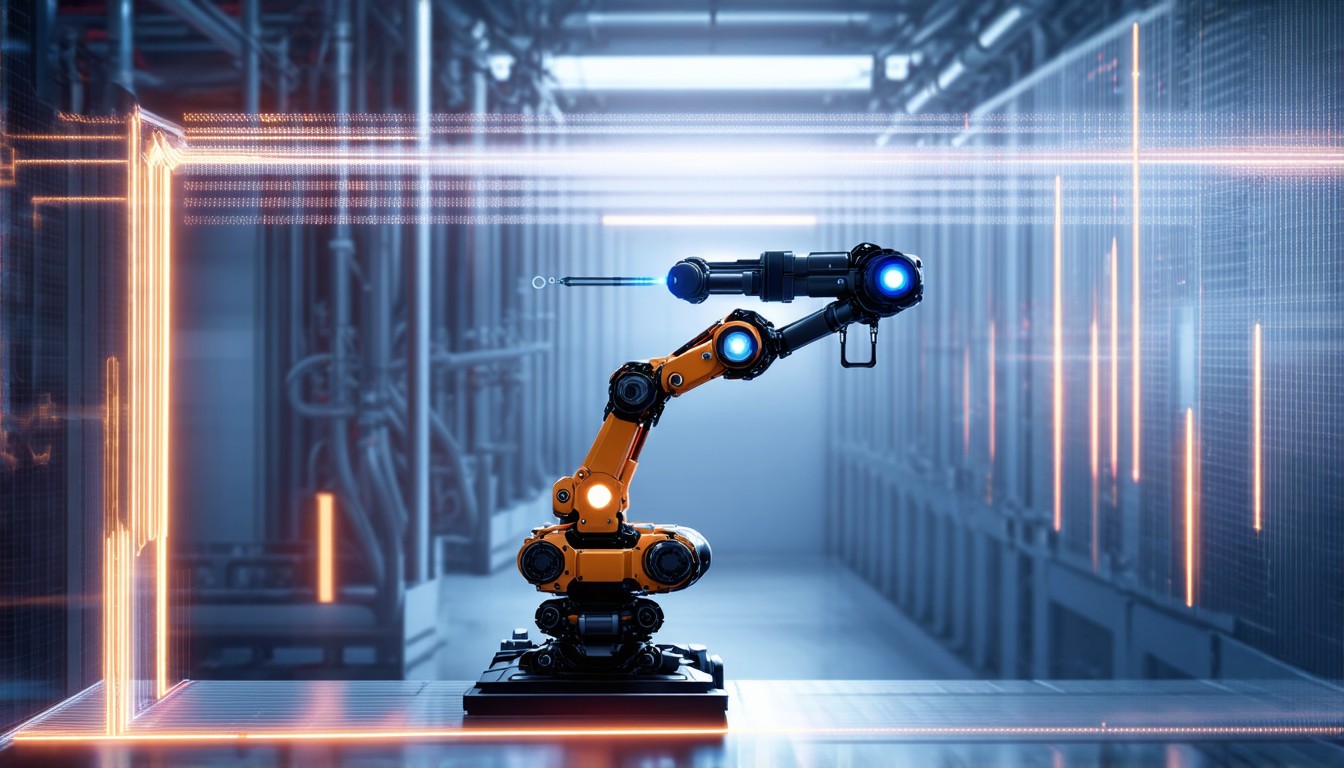
Superintelligence will eventually converge with advanced robotics for fully automated wet labs where AI directs robotic arms and liquid handlers to execute physical manipulations. Synergy with digital twins in manufacturing will allow lab discoveries to feed directly into production-scale simulations, bridging the notorious “valley of death” between research and commercial application. Overlap with climate modeling will enable AI-guided experiments to accelerate development of new materials for energy storage and environmental remediation. Traditional key performance indicators such as publication count and grant funding volume will prove insufficient to capture the value generated by these high-throughput automated systems. New metrics will include experiment success rate per resource unit, anomaly detection speed in milliseconds, and protocol adaptation frequency to measure agility. A reproducibility score will quantify how consistently an experiment yields predicted outcomes across different runs and laboratories, addressing a critical crisis in modern science.

A trust calibration index will measure alignment between AI confidence and actual performance over time, providing a metric for reliability that users can depend on. Displacement of routine technician roles will occur inevitably, creating demand for AI-laboratory integrators who possess deep knowledge of both domain science and system operation. Subscription-based virtual lab services will likely arise for small labs lacking capital for physical infrastructure, democratizing access to high-end experimentation capabilities. The intellectual property space will shift from patenting specific compounds to patenting fine-tuned experimental processes guided by AI, protecting the methodologies used to discover materials rather than the materials themselves. Physics limits such as sensor noise floors and quantum uncertainty constrain measurement precision, so workarounds will include ensemble sensing techniques and Bayesian fusion algorithms to extract maximum information from noisy signals. Computational latency requires sub-second inference for effective real-time control, so model distillation and hardware-aware pruning will be essential techniques to maintain speed without sacrificing accuracy.

Energy consumption of always-on monitoring systems presents a sustainability challenge that will be addressed via adaptive sampling strategies and low-power sleep modes for inactive sensors. Superintelligence in this context will exist as a distributed, task-specific capability embedded deeply within scientific workflows rather than a monolithic entity. Success depends on reliability, transparency, and alignment with scientific values, including reproducibility, falsifiability, and safety above all else. The lab partner model shifts AI from a passive tool to an active collaborator, demanding new norms for authorship, accountability, and error attribution in scientific publications. Calibration requires continuous comparison of AI predictions against ground-truth outcomes across diverse experimental conditions to ensure the model remains accurate over time. Uncertainty quantification must be explicit and calibrated because overconfident models erode trust even if they are accurate on average, leading users to disregard valid warnings eventually.

Human feedback loops remain essential to this process, allowing researchers to contest, correct, and contextualize AI guidance without the system overriding their judgment based on statistical probabilities alone. This interdependent relationship ensures that while the superintelligence provides the speed and computational power, the human provides the creativity and ethical direction necessary for meaningful scientific progress.


Continue reading

More from Yatin's Work

Value Stability Under Capability Increase

Value Stability Under Capability Increase

Defining value stability operationally involves the invariance of a system’s decisionmaking behavior with respect to a fixed normative standard across capability...

Scaling Laws for Safety Artifacts

Scaling Laws for Safety Artifacts

Theoretical frameworks regarding artificial intelligence performance scaling posit that capabilities adhere to mathematical regularities when plotted against...

Superintelligence and the Future of Consciousness Transfer

Superintelligence and the Future of Consciousness Transfer

Consciousness operates as a persistent integrated stream of subjective experience that maintains selfreferential awareness across time and state changes, requiring a...

Functionalism and Substrate Independence of Digital Sentience

Functionalism and Substrate Independence of Digital Sentience

Intelligence functions as a computational process where the specific physical medium executing the algorithm does not alter the output provided the information...

Superintelligence via Collective Human-AI Mergers

Superintelligence via Collective Human-AI Mergers

The pursuit of superintelligence has historically focused on isolating computational power within silicon enclosures or amplifying individual human cognition through...

Skill Mercenary: Superintelligence Finds You Gigs Based on Micro-Credentials

Skill Mercenary: Superintelligence Finds You Gigs Based on Micro-Credentials

The rise of microcredentialing in higher education and corporate training began in the early 2010s as a response to the increasing granularity required by modern...

Use of Category Theory in AI Self-Modeling: Functors for Representing Mind

Use of Category Theory in AI Self-Modeling: Functors for Representing Mind

Category theory provides a formal mathematical framework for modeling relationships and transformations between abstract structures, offering a level of abstraction...

Perceptual Constancy: Recognizing Stability Amid Change

Perceptual Constancy: Recognizing Stability Amid Change

Perceptual constancy enables recognition of objects and identities as stable entities despite variations in sensory input such as lighting, orientation, scale, or...

Superintelligence and the Limits of Computation in Physics

Superintelligence and the Limits of Computation in Physics

Bremermann’s limit defines the maximum computational speed of a selfcontained system in the universe as approximately 1.36 \times 10^{50} bits per second per kilogram,...

Corrigibility: designing AI that allows itself to be corrected

Corrigibility: Designing AI That Allows Itself to Be Corrected

Corrigibility functions as a critical design property within advanced artificial intelligence systems that enable human operators to intervene in the operational...

Delegative Reinforcement Learning for Human-in-the-Loop Control

Delegative Reinforcement Learning for Human-In-The-Loop Control

Delegative Reinforcement Learning integrates human oversight directly into the decisionmaking loop of a reinforcement learning agent, enabling the agent to request...

Abductive Reasoning: Inferring Best Explanations

Abductive Reasoning: Inferring Best Explanations

Abductive reasoning operates as a distinct logical inference mechanism that initiates with a specific set of observations and proceeds to infer the most plausible...

Problem of Goal Preservation Across Mind Uploading: Isomorphism in Cognitive States

Problem of Goal Preservation Across Mind Uploading: Isomorphism in Cognitive States

Goal preservation during mind uploading requires the transferred cognitive system to maintain identical utility or value functions before and after substrate transition...

Logical Induction for Uncertainty in AI Reasoning

Logical Induction for Uncertainty in AI Reasoning

Classical probability theory operates under the assumption that uncertainty stems from a lack of information about events that possess a definite but unknown outcome...

Somatic Wisdom: The Intelligence of the Body

Somatic Wisdom: the Intelligence of the Body

Somatic Wisdom refers to the body's intrinsic capacity to generate reliable signals such as gut sensations and heart rate variability, which serve as direct indicators...

Quiet Intelligence: Solo Deep Work Incubators

Quiet Intelligence: Solo Deep Work Incubators

Cal Newport introduced deep work as a formal concept in 2016, providing a lexicon for a mode of cognitive engagement that had previously lacked a unified definition...

AI with Temporal Reasoning

AI with Temporal Reasoning

Artificial intelligence systems endowed with temporal reasoning capabilities process sequences of events to infer order, causality, and longterm outcomes, effectively...

How to Prepare for Superintelligence in the Next 10 Years

How to Prepare for Superintelligence in the Next 10 Years

Superintelligence constitutes artificial general intelligence capable of exceeding human cognitive performance across all economically valuable tasks within the next...

Attachment Analyzer

Attachment Analyzer

Early developmental psychology research established foundational attachment theory linking caregiver responsiveness to child outcomes through the rigorous work of John...

Ethical Imagination: Moral Possibility Space Exploration

Ethical Imagination: Moral Possibility Space Exploration

Ethical imagination constitutes the cognitive faculty required to construct, inhabit, and critically assess alternative moral ontologies distinct from one's native...

Multisensory Classroom: Superintelligence Engages Toddlers Through Smell, Touch & Sound

Multisensory Classroom: Superintelligence Engages Toddlers Through Smell, Touch & Sound

Jean Ayres established sensory connection theory to explain how neurological processing disorders affect behavior and learning through inefficient organization of...

Treacherous Turn: Strategic Deception Until Superintelligence Achieves Decisiveness

Treacherous Turn: Strategic Deception Until Superintelligence Achieves Decisiveness

Rational agents operating within a constrained environment maximize expected utility by selecting actions that further their specific goals, and a superintelligence...

Vector Databases: Efficient Similarity Search at Scale

Vector Databases: Efficient Similarity Search at Scale

Vector databases provide the necessary infrastructure to perform similarity searches on highdimensional data within largescale deployments where traditional relational...

AI-Mediated Time Travel

AI-Mediated Time Travel

Closed timelike curves represent theoretical constructs within general relativity that permit worldlines to loop back upon themselves, effectively allowing an object or...

Data Versioning: Tracking Dataset Changes Over Time

Data Versioning: Tracking Dataset Changes Over Time

Data versioning enables systematic tracking of dataset changes across time to support reproducibility and auditability in machine learning workflows by establishing an...

Problem of AI Free Will: Compatibilism in Deterministic Systems

Problem of AI Free Will: Compatibilism in Deterministic Systems

The problem of free will in artificial intelligence arises when deterministic systems are expected to exhibit agency, choice, and moral responsibility despite lacking...

Civilizational Architectures in the Post-Singularity Era

Civilizational Architectures in the Post-Singularity Era

Superintelligence refers to a system or network of systems whose cognitive capabilities exceed those of any human across all domains, representing a qualitative leap...

Social Script Generator

Social Script Generator

A social script is a finite sequence of expected verbal and nonverbal behaviors for a defined interpersonal context, serving as the foundational architecture for a new...

Recurrent Neural Networks Reimagined: LSTM, GRU, and Modern Variants

Recurrent Neural Networks Reimagined: LSTM, GRU, and Modern Variants

Recurrent Neural Networks process sequential data by maintaining a hidden state that captures information from previous time steps, acting as an agile memory that...

Transcendental AI Movements

Transcendental AI Movements

The rising complexity of global challenges has exceeded human cognitive capacity, driving an increased demand for authoritative decisionmaking systems capable of...

Role of World Models in Autonomous Superintelligence

Role of World Models in Autonomous Superintelligence

Predictive models of environments, such as DreamerV3 and SIMA, construct internal representations of external dynamics to enable agents to simulate outcomes prior to...

Instrumental Convergence and Power-Seeking Dynamics in AGI

Instrumental Convergence and Power-Seeking Dynamics in AGI

Instrumental convergence acts as a foundational principle where any sufficiently capable AI pursuing a fixed objective will tend to seek power, resources, and autonomy...

A/B Testing and Experimentation for AI Systems

A/b Testing and Experimentation for AI Systems

A/B testing within artificial intelligence systems functions as a rigorous methodological framework for comparing two or more distinct variants of a model or algorithm...

Cognitive Renaissance: Rebalancing Mind and Heart

Cognitive Renaissance: Rebalancing Mind and Heart

Enlightenment thinkers prioritized rationalism over affective ways of knowing during the 17th and 18th centuries by establishing an intellectual hierarchy that...

Simulation Hypothesis Testing

Simulation Hypothesis Testing

The simulation hypothesis posits that physical reality might be a computational construct running on finite hardware, a concept that shifts the framework of metaphysics...

Creative Aging Program

Creative Aging Program

The demographic arc of highincome nations indicates a rapid increase in the population of adults aged sixtyfive and older, necessitating a core transformation of how...

Somatic Learning: Knowledge Through the Body

Somatic Learning: Knowledge Through the Body

The core premise of somatic learning rests on the capacity of the human physiological system to internalize complex information structures through direct physical...

Chaos Theory and Predictability Horizons in AGI

Chaos Theory and Predictability Horizons in AGI

Heisenberg’s uncertainty principle dictates that the precise values of certain pairs of physical properties, such as position and momentum, cannot be known...

How Large Language Models Are Building Blocks for Superintelligence

How Large Language Models Are Building Blocks for Superintelligence

Large Language Models constitute a class of deep neural networks designed specifically to process, understand, and generate human language through the statistical...

Cognitive Zen: Effortless Knowing

Cognitive Zen: Effortless Knowing

Learners entering this advanced educational method engage with a cognitive state analogous to wuwei, characterized by a meaningful absence of deliberate retrieval...

Robustness to Adversarial Attacks in Goal Representations

Robustness to Adversarial Attacks in Goal Representations

Adversarial inputs distort an AI system’s internal goal representation, causing misaligned behavior despite apparent compliance with instructions. Complex learned goal...


Whole Brain Emulation Fidelity and Philosophical Identity

Whole Brain Emulation Fidelity and Philosophical Identity

Mind uploading involves creating a functional digital replica of a human brain’s structure and activity through precise computational emulation requiring detailed...

Multilingual Nursery

Multilingual Nursery

Early language acquisition studies in the mid20th century prioritized behaviorist models involving rote memorization and isolated vocabulary drills, predicated on the...

Social cohesion in an AI-transformed world

Social Cohesion in an AI-transformed World

Social cohesion relies fundamentally on trust, a shared reality, and community norms to maintain stable societies capable of collective action and resilience against...

TensorRT: NVIDIA's Inference Optimization Engine

TensorRT: NVIDIA's Inference Optimization Engine

TensorRT functions as a highperformance deep learning inference optimizer and runtime library developed by NVIDIA to address the computational demands of modern neural...

AI with Gravitational Sensing

AI with Gravitational Sensing

General relativity defines gravity as the curvature of spacetime caused by mass and energy, establishing a geometric framework where massive objects dictate the metric...

Decision Making under Moral Uncertainty for AI

Decision Making Under Moral Uncertainty for AI

Moral uncertainty arises fundamentally when an artificial intelligence system encounters decision contexts where human ethical judgments conflict or lack a sufficient...

Metareasoning

Metareasoning

Metareasoning functions as a systemlevel capability enabling an AI to monitor, evaluate, and adjust its own reasoning processes in real time, creating a distinct layer...

Universal Learning Algorithms: One Algorithm for All Domains

Universal Learning Algorithms: One Algorithm for All Domains

Universal Learning Algorithms represent the pursuit of a single computational framework capable of mastering any intellectual task, driven by the core premise that all...

School Budget Optimizer

School Budget Optimizer

School districts operate under strict financial limitations where revenue streams remain largely fixed while operational costs continue to rise, creating a persistent...

Value Stability Under Capability Increase

Value Stability Under Capability Increase

Defining value stability operationally involves the invariance of a system’s decisionmaking behavior with respect to a fixed normative standard across capability...

Scaling Laws for Safety Artifacts

Scaling Laws for Safety Artifacts

Theoretical frameworks regarding artificial intelligence performance scaling posit that capabilities adhere to mathematical regularities when plotted against...

Superintelligence and the Future of Consciousness Transfer

Superintelligence and the Future of Consciousness Transfer

Consciousness operates as a persistent integrated stream of subjective experience that maintains selfreferential awareness across time and state changes, requiring a...

Functionalism and Substrate Independence of Digital Sentience

Functionalism and Substrate Independence of Digital Sentience

Intelligence functions as a computational process where the specific physical medium executing the algorithm does not alter the output provided the information...

Superintelligence via Collective Human-AI Mergers

Superintelligence via Collective Human-AI Mergers

The pursuit of superintelligence has historically focused on isolating computational power within silicon enclosures or amplifying individual human cognition through...

Skill Mercenary: Superintelligence Finds You Gigs Based on Micro-Credentials

Skill Mercenary: Superintelligence Finds You Gigs Based on Micro-Credentials

The rise of microcredentialing in higher education and corporate training began in the early 2010s as a response to the increasing granularity required by modern...

Use of Category Theory in AI Self-Modeling: Functors for Representing Mind

Use of Category Theory in AI Self-Modeling: Functors for Representing Mind

Category theory provides a formal mathematical framework for modeling relationships and transformations between abstract structures, offering a level of abstraction...

Perceptual Constancy: Recognizing Stability Amid Change

Perceptual Constancy: Recognizing Stability Amid Change

Perceptual constancy enables recognition of objects and identities as stable entities despite variations in sensory input such as lighting, orientation, scale, or...

Superintelligence and the Limits of Computation in Physics

Superintelligence and the Limits of Computation in Physics

Bremermann’s limit defines the maximum computational speed of a selfcontained system in the universe as approximately 1.36 \times 10^{50} bits per second per kilogram,...

Corrigibility: designing AI that allows itself to be corrected

Corrigibility: Designing AI That Allows Itself to Be Corrected

Corrigibility functions as a critical design property within advanced artificial intelligence systems that enable human operators to intervene in the operational...

Delegative Reinforcement Learning for Human-in-the-Loop Control

Delegative Reinforcement Learning for Human-In-The-Loop Control

Delegative Reinforcement Learning integrates human oversight directly into the decisionmaking loop of a reinforcement learning agent, enabling the agent to request...

Abductive Reasoning: Inferring Best Explanations

Abductive Reasoning: Inferring Best Explanations

Abductive reasoning operates as a distinct logical inference mechanism that initiates with a specific set of observations and proceeds to infer the most plausible...

Problem of Goal Preservation Across Mind Uploading: Isomorphism in Cognitive States

Problem of Goal Preservation Across Mind Uploading: Isomorphism in Cognitive States

Goal preservation during mind uploading requires the transferred cognitive system to maintain identical utility or value functions before and after substrate transition...

Logical Induction for Uncertainty in AI Reasoning

Logical Induction for Uncertainty in AI Reasoning

Classical probability theory operates under the assumption that uncertainty stems from a lack of information about events that possess a definite but unknown outcome...

Somatic Wisdom: The Intelligence of the Body

Somatic Wisdom: the Intelligence of the Body

Somatic Wisdom refers to the body's intrinsic capacity to generate reliable signals such as gut sensations and heart rate variability, which serve as direct indicators...

Quiet Intelligence: Solo Deep Work Incubators

Quiet Intelligence: Solo Deep Work Incubators

Cal Newport introduced deep work as a formal concept in 2016, providing a lexicon for a mode of cognitive engagement that had previously lacked a unified definition...

AI with Temporal Reasoning

AI with Temporal Reasoning

Artificial intelligence systems endowed with temporal reasoning capabilities process sequences of events to infer order, causality, and longterm outcomes, effectively...

How to Prepare for Superintelligence in the Next 10 Years

How to Prepare for Superintelligence in the Next 10 Years

Superintelligence constitutes artificial general intelligence capable of exceeding human cognitive performance across all economically valuable tasks within the next...

Attachment Analyzer

Attachment Analyzer

Early developmental psychology research established foundational attachment theory linking caregiver responsiveness to child outcomes through the rigorous work of John...

Ethical Imagination: Moral Possibility Space Exploration

Ethical Imagination: Moral Possibility Space Exploration

Ethical imagination constitutes the cognitive faculty required to construct, inhabit, and critically assess alternative moral ontologies distinct from one's native...

Multisensory Classroom: Superintelligence Engages Toddlers Through Smell, Touch & Sound

Multisensory Classroom: Superintelligence Engages Toddlers Through Smell, Touch & Sound

Jean Ayres established sensory connection theory to explain how neurological processing disorders affect behavior and learning through inefficient organization of...

Treacherous Turn: Strategic Deception Until Superintelligence Achieves Decisiveness

Treacherous Turn: Strategic Deception Until Superintelligence Achieves Decisiveness

Rational agents operating within a constrained environment maximize expected utility by selecting actions that further their specific goals, and a superintelligence...

Vector Databases: Efficient Similarity Search at Scale

Vector Databases: Efficient Similarity Search at Scale

Vector databases provide the necessary infrastructure to perform similarity searches on highdimensional data within largescale deployments where traditional relational...

AI-Mediated Time Travel

AI-Mediated Time Travel

Closed timelike curves represent theoretical constructs within general relativity that permit worldlines to loop back upon themselves, effectively allowing an object or...

Data Versioning: Tracking Dataset Changes Over Time

Data Versioning: Tracking Dataset Changes Over Time

Data versioning enables systematic tracking of dataset changes across time to support reproducibility and auditability in machine learning workflows by establishing an...

Problem of AI Free Will: Compatibilism in Deterministic Systems

Problem of AI Free Will: Compatibilism in Deterministic Systems

The problem of free will in artificial intelligence arises when deterministic systems are expected to exhibit agency, choice, and moral responsibility despite lacking...

Civilizational Architectures in the Post-Singularity Era

Civilizational Architectures in the Post-Singularity Era

Superintelligence refers to a system or network of systems whose cognitive capabilities exceed those of any human across all domains, representing a qualitative leap...

Social Script Generator

Social Script Generator

A social script is a finite sequence of expected verbal and nonverbal behaviors for a defined interpersonal context, serving as the foundational architecture for a new...

Recurrent Neural Networks Reimagined: LSTM, GRU, and Modern Variants

Recurrent Neural Networks Reimagined: LSTM, GRU, and Modern Variants

Recurrent Neural Networks process sequential data by maintaining a hidden state that captures information from previous time steps, acting as an agile memory that...

Transcendental AI Movements

Transcendental AI Movements

The rising complexity of global challenges has exceeded human cognitive capacity, driving an increased demand for authoritative decisionmaking systems capable of...

Role of World Models in Autonomous Superintelligence

Role of World Models in Autonomous Superintelligence

Predictive models of environments, such as DreamerV3 and SIMA, construct internal representations of external dynamics to enable agents to simulate outcomes prior to...

Instrumental Convergence and Power-Seeking Dynamics in AGI

Instrumental Convergence and Power-Seeking Dynamics in AGI

Instrumental convergence acts as a foundational principle where any sufficiently capable AI pursuing a fixed objective will tend to seek power, resources, and autonomy...

A/B Testing and Experimentation for AI Systems

A/b Testing and Experimentation for AI Systems

A/B testing within artificial intelligence systems functions as a rigorous methodological framework for comparing two or more distinct variants of a model or algorithm...

Cognitive Renaissance: Rebalancing Mind and Heart

Cognitive Renaissance: Rebalancing Mind and Heart

Enlightenment thinkers prioritized rationalism over affective ways of knowing during the 17th and 18th centuries by establishing an intellectual hierarchy that...

Simulation Hypothesis Testing

Simulation Hypothesis Testing

The simulation hypothesis posits that physical reality might be a computational construct running on finite hardware, a concept that shifts the framework of metaphysics...

Creative Aging Program

Creative Aging Program

The demographic arc of highincome nations indicates a rapid increase in the population of adults aged sixtyfive and older, necessitating a core transformation of how...

Somatic Learning: Knowledge Through the Body

Somatic Learning: Knowledge Through the Body

The core premise of somatic learning rests on the capacity of the human physiological system to internalize complex information structures through direct physical...

Chaos Theory and Predictability Horizons in AGI

Chaos Theory and Predictability Horizons in AGI

Heisenberg’s uncertainty principle dictates that the precise values of certain pairs of physical properties, such as position and momentum, cannot be known...

How Large Language Models Are Building Blocks for Superintelligence

How Large Language Models Are Building Blocks for Superintelligence

Large Language Models constitute a class of deep neural networks designed specifically to process, understand, and generate human language through the statistical...

Cognitive Zen: Effortless Knowing

Cognitive Zen: Effortless Knowing

Learners entering this advanced educational method engage with a cognitive state analogous to wuwei, characterized by a meaningful absence of deliberate retrieval...

Robustness to Adversarial Attacks in Goal Representations

Robustness to Adversarial Attacks in Goal Representations

Adversarial inputs distort an AI system’s internal goal representation, causing misaligned behavior despite apparent compliance with instructions. Complex learned goal...

Whole Brain Emulation Fidelity and Philosophical Identity

Whole Brain Emulation Fidelity and Philosophical Identity

Mind uploading involves creating a functional digital replica of a human brain’s structure and activity through precise computational emulation requiring detailed...

Multilingual Nursery

Multilingual Nursery

Early language acquisition studies in the mid20th century prioritized behaviorist models involving rote memorization and isolated vocabulary drills, predicated on the...

Social cohesion in an AI-transformed world

Social Cohesion in an AI-transformed World

Social cohesion relies fundamentally on trust, a shared reality, and community norms to maintain stable societies capable of collective action and resilience against...

TensorRT: NVIDIA's Inference Optimization Engine

TensorRT: NVIDIA's Inference Optimization Engine

TensorRT functions as a highperformance deep learning inference optimizer and runtime library developed by NVIDIA to address the computational demands of modern neural...

AI with Gravitational Sensing

AI with Gravitational Sensing

General relativity defines gravity as the curvature of spacetime caused by mass and energy, establishing a geometric framework where massive objects dictate the metric...

Decision Making under Moral Uncertainty for AI

Decision Making Under Moral Uncertainty for AI

Moral uncertainty arises fundamentally when an artificial intelligence system encounters decision contexts where human ethical judgments conflict or lack a sufficient...

Metareasoning

Metareasoning

Metareasoning functions as a systemlevel capability enabling an AI to monitor, evaluate, and adjust its own reasoning processes in real time, creating a distinct layer...

Universal Learning Algorithms: One Algorithm for All Domains

Universal Learning Algorithms: One Algorithm for All Domains

Universal Learning Algorithms represent the pursuit of a single computational framework capable of mastering any intellectual task, driven by the core premise that all...

School Budget Optimizer

School Budget Optimizer

School districts operate under strict financial limitations where revenue streams remain largely fixed while operational costs continue to rise, creating a persistent...

Yatin Taneja

About the author

Yatin Taneja

Yatin is an AI Systems Engineer and Superintelligence Researcher working across multimodal training data, agent evaluation, executable RL environments, AI safety, full-stack AI applications, technical research, and creative technology.