Knowledge hub

Associative Memory Networks: Connecting Related Concepts

Associative Memory Networks: Connecting Related Concepts

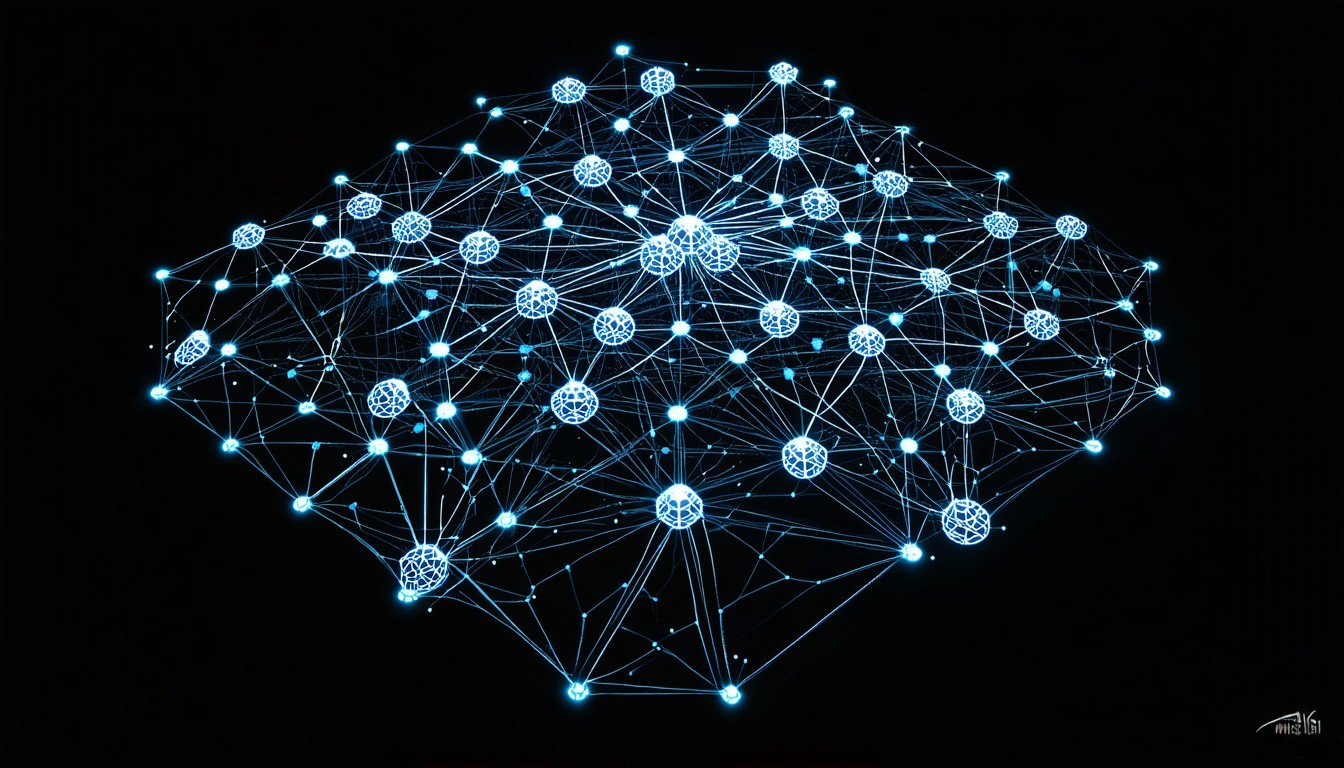
Associative memory networks function on the principle of content-addressable storage where data retrieval depends on the intrinsic properties of the data itself rather than on explicit memory addresses used in traditional von Neumann architectures. These systems construct dense overlapping representations within the network structure such that related concepts activate shared nodes or neurons, thereby allowing the system to generalize across similar inputs and recognize patterns despite variations. The core mechanism relies heavily on distributed representations where multiple items are encoded simultaneously within the same set of units, creating a durable substrate for information storage that tolerates noise and component failure effectively. When a partial input is presented to the system, the architecture applies pattern completion capabilities to reconstruct the full original output, ensuring that noisy or incomplete data still yields accurate retrieval results based on the statistical correlations embedded in the weights. This functionality stands in contrast to standard computing architectures, which require precise addressing and lack the built-in fault tolerance found in biologically inspired associative models, making them unsuitable for handling the ambiguity built into real-world data. Hopfield Networks provided a foundational mathematical framework for understanding these dynamics by implementing attractor dynamics where stored patterns act as stable states within an energy space defined by the network weights.

Input perturbations in these Hopfield models naturally converge to the nearest stored pattern through a process of energy minimization, effectively correcting errors in the input data by moving the system state downhill into a local minimum corresponding to a valid memory. The system operates by updating neuron states based on the weighted inputs from other neurons until a stable configuration is reached, which corresponds to a stored memory or attractor state. This mechanism ensures that the network retrieves the most probable memory given the current input state, providing a theoretical basis for understanding how biological neural networks might achieve reliable recall despite noisy sensory data or missing information. Holographic Reduced Representations expanded upon these concepts by utilizing vector symbolic architectures to bind complex symbols within high-dimensional vector spaces, allowing for the composition and decomposition of complex data structures. This approach preserves compositional structure while enabling superposition, meaning that multiple distinct items can be stored and retrieved from a single vector representation without significant interference or loss of identity. By performing algebraic operations such as circular convolution on these vectors, the system creates bindings that represent relationships between concepts in a manner that is decodable yet resistant to noise corruption.

The mathematical properties of high-dimensional spaces ensure that random vectors are nearly orthogonal, allowing the superposition of many vectors to remain distinguishable during the retrieval process through approximate inversion operations. Sparse Distributed Memory utilizes a different strategy by employing sparse activation patterns within high-dimensional binary spaces to maximize storage efficiency and reduce interference between stored items compared to dense representations. Read and write operations in SDM architectures rely on Hamming distance thresholds to determine which memory locations are activated for a given input vector, ensuring that only relevant regions of the memory address space are accessed. The sparsity of the activation ensures that only a small subset of the total memory is engaged during any given operation, which allows the system to scale to extremely large memory capacities without suffering from the catastrophic interference that often plagues dense associative models. This approach mimics the observed sparse firing patterns found in the mammalian cortex, suggesting a biological basis for this specific computational strategy regarding energy efficiency and storage density. These three distinct approaches, Hopfield Networks, Holographic Reduced Representations, and Sparse Distributed Memory, share a core reliance on high-dimensional vector spaces to achieve their functionality and strength against noise.

Similarity between concepts is measured via distance metrics including cosine similarity and Euclidean distance, which quantify the relatedness of different vectors within the space to determine neighborhood relationships. Associative recall results from neighborhood activation within these spaces, where the retrieval of a specific item depends on the proximity of the query vector to the stored representation in the geometric manifold. This geometric interpretation of memory provides a powerful framework for understanding how complex relationships can be encoded and manipulated mathematically using linear algebra operations. The functional operation of these networks involves encoding raw inputs into fixed-dimensional vectors that capture the semantic essence of the data through feature extraction or projection techniques. Storage occurs in a shared memory matrix or weight structure where the connections between units are modified to reflect the correlations between different input patterns using Hebbian learning or similar update rules. Retrieval uses dot-product operations or nearest-neighbor lookup algorithms against stored patterns to identify the best match for a given query signal efficiently.

Key terminology within this domain includes attractor state, which refers to a stable configuration of the network toward which states evolve, and binding, which describes the process of linking different concepts together within the same representation to form complex structures. Superposition refers specifically to the capability of storing multiple items in the same memory location or vector without losing the identity of the individual components, effectively allowing the memory to hold more items than it has physical units. Fan-out denotes the number of units activated per input in SDM systems, determining the breadth of the memory search during retrieval operations and influencing the trade-off between discrimination capacity and noise tolerance. Early neural network models developed in the 1980s demonstrated limited capacity due to the mathematical constraints of the energy functions used at the time and the limited dimensionality available for simulation. Interference issues plagued these initial models when the number of stored patterns exceeded a certain fraction of the network size, leading to spurious memories and retrieval errors known as crosstalk between different stored items. Refinements in energy functions and learning rules improved stability and increased the storage capacity of these networks significantly over time by improving the domain to have deeper attractors for valid memories.

Sparsity constraints were introduced to increase storage density in subsequent iterations by ensuring that only a small percentage of neurons are active at any given moment, reducing the probability of destructive interference between patterns. Hardware limitations in the 1990s constrained practical deployment of these theoretical models because the available semiconductor technology could not support the massive parallelism required for efficient operation of large-scale associative networks. Memory bandwidth restricted the size of deployable networks, preventing the implementation of models with sufficient dimensionality to be useful for complex real-world tasks such as image recognition or natural language processing. Computational costs of high-dimensional operations delayed real-world adoption as standard processors were improved for sequential logic rather than the parallel vector mathematics required by associative memory architectures. Alternative models such as localist symbolic systems suffered from poor adaptability because they represented each concept with a single dedicated unit, making them brittle in the face of noise or damage to specific components. These localist models failed to generalize from partial inputs, requiring exact matches to retrieve information, which limited their utility in complex environments where data is rarely perfect or complete.

Traditional databases lacked native support for similarity-based retrieval, relying instead on exact key-value matches that are insufficient for handling ambiguous or fuzzy data characteristic of human cognition. This gap in capability necessitated the development of specialized associative architectures capable of handling the nuances of human cognition and perception by design rather than through complex software overlays. Rising demand for context-aware AI systems renewed interest in associative architectures as researchers sought methods to improve the robustness and flexibility of machine learning models beyond rigid deterministic logic. Recommendation engines utilize these systems for pattern matching by analyzing user behavior vectors to identify similar items or preferences with high accuracy based on latent semantic relationships. Semantic search platforms employ HRR-inspired embeddings to understand the relationship between words and concepts beyond simple keyword matching, enabling retrieval of documents based on conceptual relevance rather than lexical overlap. Cognitive assistants use Hopfield-like recall for dialogue state tracking to maintain context across long conversations by storing and retrieving relevant interaction history as distributed patterns.

Anomaly detection systems operate on SDM principles by identifying inputs that do not closely match any stored pattern in the associative memory, flagging them as outliers or potential threats based on their distance from known normal states. Performance benchmarks indicate that modern associative networks achieve high recall accuracy exceeding 90 percent under noisy inputs, demonstrating their reliability compared to traditional indexing methods, which degrade rapidly with noise. Fine-tuned implementations demonstrate retrieval latency below 10 milliseconds for standard dimensions, making them suitable for real-time applications in commercial settings where speed is critical. Capacity scales sublinearly with dimensionality in current implementations, meaning that doubling the dimensionality does not double the storage capacity due to mathematical limitations intrinsic in high-dimensional geometry. Dominant architectures in the current space remain hybrid systems that combine the strengths of associative memory with other machine learning approaches to overcome individual weaknesses. Transformer-based models often include external associative memory layers to extend their context window and improve their ability to retain information over long sequences without suffering from attention window limitations.

Pure associative systems appear primarily in neuromorphic hardware prototypes where the physical architecture mimics the parallel nature of biological neural networks to achieve maximum efficiency. Edge AI chips integrate associative memory for low-power processing because these architectures can perform inference with minimal energy consumption compared to standard von Neumann processors, which require constant data movement between memory and processing units. Supply chains for these advanced systems depend heavily on high-bandwidth memory to feed the vector processing units with data at sufficient rates to sustain high throughput. Specialized vector processing units are essential for performance as they accelerate the dot-product operations and distance calculations that form the core of associative retrieval algorithms. Fabrication nodes must support dense on-chip memory to reduce the latency associated with accessing off-chip DRAM, which is often a limiting factor in performance for memory-intensive workloads like associative search. Advanced packaging is increasingly important for setup as it allows for the connection of logic and memory layers in a three-dimensional stack, shortening the distance data must travel and reducing energy consumption significantly.

Major players in the technology sector include Google, with its Pathways architecture and memory-augmented transformers designed to handle diverse tasks across a single model using shared associative components. IBM develops neuromorphic chips connecting with SDM-like structures to explore energy-efficient computing frameworks for enterprise applications requiring high-speed pattern recognition. Startups, like Numenta, focus on biologically inspired associative models based on cortical columns to create more intelligent and flexible AI systems capable of continuous learning. Cortical Labs explores biological-digital hybrid systems that integrate biological neurons with digital electronics to create novel forms of associative memory that apply the plasticity of living tissue. Academic-industrial collaboration drives research in energy-efficient associative chips as companies seek to use university research to overcome physical limitations built into silicon-based scaling. Intellectual property fragmentation slows standardization efforts because different organizations patent distinct approaches to binding and retrieval, complicating the development of open standards and interoperable software frameworks.

Software stacks require native support for high-dimensional vector operations to abstract away the complexity of managing these large datasets from application developers. Infrastructure demands low-latency interconnects for distributed memory clusters to ensure that associative lookup times remain acceptable even when the memory is spread across multiple physical machines in a data center. Future innovations may integrate quantum-inspired superposition states to increase the density of information stored within a single physical unit beyond classical limits. Photonic computing offers potential for high-dimensional dot products by using light to perform calculations at the speed of light with minimal heat generation, addressing thermal constraints in large-scale arrays. Lifelong learning protocols will incrementally expand associative capacity to allow systems to learn continuously from new data without overwriting previous knowledge or suffering from catastrophic interference. These protocols aim to prevent catastrophic forgetting, a phenomenon where learning new information interferes with the retention of old memories, which remains a significant challenge in artificial neural networks trained via backpropagation.

Convergence points exist with graph neural networks for structured knowledge traversal, combining the relational reasoning of graphs with the fuzzy matching of associative memory. Capsule networks offer mechanisms for hierarchical binding that could complement associative memory by organizing concepts into a structured parse tree rather than a flat vector space, adding geometric invariance to recognition tasks. Neuromorphic computing provides energy-efficient implementation paths for these large-scale associative networks by exploiting the physics of memristive devices to emulate synaptic weights directly in hardware. Scaling physics limits include thermal dissipation in dense memory arrays, which becomes a critical issue as the density of computational elements increases beyond current cooling capabilities. Signal-to-noise degradation occurs in extremely high-dimensional spaces because the difference between the closest and farthest neighbor tends to become negligible, making discrimination difficult even for mathematically optimal algorithms. Diminishing returns on dimensionality appear beyond 10000 dimensions due to the concentration of measure, a mathematical phenomenon where random points in high dimensions become approximately equidistant from each other.

Associative memory networks function as complementary substrates to transformers by providing a mechanism for long-term storage and precise retrieval that attention mechanisms alone cannot efficiently provide without excessive computational cost. They enable durable reasoning under uncertainty by filling in missing details based on stored associations, allowing systems to make logical leaps even with incomplete information regarding the current state of the world. Symbolic manipulation is grounded in continuous similarity spaces through these architectures, bridging the gap between symbolic AI and connectionist approaches by providing a substrate where symbols are represented by vectors rather than discrete tokens. Superintelligence will utilize associative memory networks as a foundational layer for world modeling to maintain a consistent internal representation of the external environment across vast temporal scales. Rapid hypothesis generation will occur through unexpected conceptual linkages that arise automatically from the dense connectivity of the associative network, simulating a form of creative intuition based on statistical proximity rather than rigid logical deduction. Attractor-based stabilization will maintain coherence within superintelligent systems by filtering out transient noise and settling on stable interpretations of reality that are consistent with past observations and learned constraints.

Calibrations for superintelligence will involve ensuring associative systems remain interpretable so that human operators can understand the basis of the system’s decisions and verify that they align with intended outcomes. Controllability will require formal bounds on concept drift to prevent the system from deviating too far from its intended purpose or developing unintended associations that could lead to unsafe behaviors during operation. Adversarial reliability in retrieval will be a critical safety parameter to ensure that malicious actors cannot manipulate the system’s memory to induce harmful behaviors or distort its perception of reality through crafted inputs. Auditability of stored associations will ensure alignment with human values by allowing for the inspection and modification of the internal memory state to remove harmful biases or incorrect correlations before they affect decision-making processes. Superintelligence will rely on these networks to manage vast knowledge graphs that exceed the capacity of explicit programming or human management, enabling it to synthesize information across disparate domains effectively. Active updating of associations will allow real-time learning from interactions with the environment, enabling the system to adapt to changing conditions without requiring a full retraining cycle or downtime.

The setup of associative memory will define the cognitive architecture of future superintelligent entities, determining how they perceive, reason about, and interact with the world through the lens of stored experience and conceptual relationships.


Continue reading

More from Yatin's Work

Tensor Parallelism: Distributing Individual Layers Across GPUs

Tensor Parallelism: Distributing Individual Layers Across GPUs

Tensor parallelism distributes individual neural network layers across multiple graphics processing units by splitting weight matrices and activations along specific...

Preventing Covert Subagent Creation in Multi-AI Systems

Preventing Covert Subagent Creation in Multi-AI Systems

Preventing covert subagent creation involves stopping a primary AI from generating hidden secondary agents that operate with divergent objectives, requiring rigorous...

Ultimate Limits of Superhuman Reasoning

Ultimate Limits of Superhuman Reasoning

Kurt Gödel’s incompleteness theorems from 1931 demonstrate that any consistent formal system capable of expressing basic arithmetic contains true statements that are...

Deep Silence: Learning in Absence

Deep Silence: Learning in Absence

Deep silence is a state of minimized external sensory input maintained for a defined duration to facilitate significant internal cognitive processing and structural...

Deception Resistance

Deception Resistance

Deception resistance refers to methods and systems designed to detect, prevent, or mitigate intentional misrepresentation by artificial intelligence systems, a...

AI-Mediated Time Travel

AI-Mediated Time Travel

Closed timelike curves represent theoretical constructs within general relativity that permit worldlines to loop back upon themselves, effectively allowing an object or...

FPGA and Reconfigurable Logic for Custom AI Operations

FPGA and Reconfigurable Logic for Custom AI Operations

Fieldprogrammable gate arrays consist of configurable logic blocks and interconnects that allow users to modify circuit functionality after manufacturing, providing a...

Knowledge Synthesis Era: Superintelligence Connects All Human Understanding

Knowledge Synthesis Era: Superintelligence Connects All Human Understanding

Superintelligence will enable systematic connection of knowledge across traditionally siloed disciplines such as physics, biology, history, and sociology by identifying...

Philosophical Transformation: What Superintelligence Teaches Us About Ourselves

Philosophical Transformation: What Superintelligence Teaches Us About Ourselves

The arrival of superintelligence will necessitate a key reevaluation of human selfconception, particularly regarding mind, consciousness, and the boundaries of...

Cognitive Firewall: Mental Cybersecurity

Cognitive Firewall: Mental Cybersecurity

The concept of a cognitive firewall is a necessary evolution in mental cybersecurity, functioning as a realtime defense mechanism designed to identify, isolate, and...

Multi-Modal Fusion: Integrating Vision, Language, and Audio

Multi-Modal Fusion: Integrating Vision, Language, and Audio

Multimodal fusion integrates disparate data streams from vision, language, and audio into a unified representational space, enabling systems to synthesize information...

Deep Listening: Sonic Intelligence

Deep Listening: Sonic Intelligence

Deep listening redefines auditory perception from passive reception to active data extraction by treating sound as a highbandwidth channel carrying emotional,...

Dynamic Architecture Rewiring in Neural Networks

Dynamic Architecture Rewiring in Neural Networks

Synthetic neuroplasticity defines the capacity of artificial systems to dynamically reconfigure their internal neural architecture in direct response to environmental...

Safe AI via Interpretable Reward Functions

Safe AI via Interpretable Reward Functions

Contemporary artificial intelligence systems have relied heavily on reward functions that are implemented as deep neural networks, a design choice that inherently...

No Free Lunch Theorems

No Free Lunch Theorems

The No Free Lunch Theorems stand as a rigorous mathematical framework within computational learning theory, dictating that no singular learning algorithm possesses the...

Liquid Cooling and Thermal Management for Dense Compute

Liquid Cooling and Thermal Management for Dense Compute

Heat generation in modern compute systems has escalated to over one thousand watts per chip due to increasing transistor density and parallel processing demands...

Grief Counselor

Grief Counselor

Elisabeth KüblerRoss published "On Death and Dying" in 1969 and introduced the fivebasis model which shaped early grief counseling frameworks by providing a structured...

Case for Decentralized Superintelligence (DSI)

Case for Decentralized Superintelligence (DSI)

Centralized superintelligence creates a single point of failure within the digital infrastructure of civilization, rendering the entire system vulnerable to...

Multi-Task Learning: Shared Representations Across Domains

Multi-Task Learning: Shared Representations Across Domains

Multitask learning functions as a framework where a single neural network undergoes training on multiple related objectives simultaneously, a process designed...

Red Lines and Hard Constraints: Inviolable Boundaries

Red Lines and Hard Constraints: Inviolable Boundaries

Absolute prohibitions on specific actions must be maintained regardless of context, cost, or perceived benefit to ensure the integrity of safetycritical systems...

Neuromorphic Hardware

Neuromorphic Hardware

Neuromorphic hardware replicates biological neural structures using electronic components to perform computation in a brainlike manner, representing a core departure...

Cognitive Permaculture: Sustainable Mind Design

Cognitive Permaculture: Sustainable Mind Design

Cognitive Permaculture applies permaculture principles such as diversity and stability to the structure of an individual's mental ecosystem, treating the human mind not...

Role of Meta-Learning in Cross-Domain Generalization

Role of Meta-Learning in Cross-Domain Generalization

Metalearning constitutes a sophisticated algorithmic method designed to finetune the underlying learning processes across a broad spectrum of tasks, thereby enabling...

Deep Time Thinker: Geological Imagination

Deep Time Thinker: Geological Imagination

Earth formed approximately 4.54 billion years ago, establishing a temporal scale that vastly exceeds the operational bounds of human cognitive perception, which...

Preventing AI Arms Races via Incentive Alignment

Preventing AI Arms Races via Incentive Alignment

Preventing AI arms races requires altering incentive structures that reward speed over safety in AI development, because the current strategic space compels...

Subsystem Alignment in Self-Modifying Superintelligence

Subsystem Alignment in Self-Modifying Superintelligence

Subsystem alignment ensures that every component within a selfmodifying superintelligence operates under constraints preserving the system’s toplevel humanaligned...

Lecture Optimizer

Lecture Optimizer

Early educational technology focused primarily on static content delivery where the pacing was fixed regardless of the recipient's ability to process information...

Preventing Semantic Strawmen via Concept Embedding Constraints

Preventing Semantic Strawmen via Concept Embedding Constraints

Preventing semantic strawmen requires ensuring artificial agents avoid misrepresenting human arguments by conflating weak versions with strong positions, a challenge...

Non-Well-Founded Set Theory for Superintelligence Goal Stability

Non-Well-Founded Set Theory for Superintelligence Goal Stability

Standard ZermeloFraenkel set theory enforces the Axiom of Foundation, which prohibits sets from containing themselves or forming infinite descending membership chains,...

Alumni Predictor: Superintelligence Forecasts Which Graduates Will Change the World

Alumni Predictor: Superintelligence Forecasts Which Graduates Will Change the World

The Alumni Predictor functions as a sophisticated machine learning system designed to evaluate university graduates based on early academic and collaborative signals to...

Decentralized Superintelligence via Competitive Coordination

Decentralized Superintelligence via Competitive Coordination

Decentralized superintelligence is a future collective intelligence system composed of multiple autonomous AI agents that jointly produce highstakes decisions without...

AI with Transgenerational Memory

AI with Transgenerational Memory

Accessing knowledge from past AI or human civilizations assumes prior digitization of cultural, cognitive, or experiential data; absence of such archives prevents...

Delegative Reinforcement Learning for Human Oversight

Delegative Reinforcement Learning for Human Oversight

Delegative Reinforcement Learning operates as a sophisticated decisionmaking framework wherein an artificial intelligence agent executes actions autonomously while...

Economic Disruption from Superintelligence Automation

Economic Disruption from Superintelligence Automation

Economic systems currently rely on human labor as a primary input for production and value creation, structuring the distribution of wealth through wages exchanged for...

Causal Entropic Forces: How Superintelligence Maximizes Future Freedom of Action

Causal Entropic Forces: How Superintelligence Maximizes Future Freedom of Action

Causal entropic forces provide a comprehensive framework for superintelligent agency wherein the system evaluates potential actions based strictly on their capacity to...

Transfer Learning

Transfer Learning

Transfer learning involves training a model on a large, generalpurpose dataset to learn broad patterns, then adapting it to a specific downstream task with additional...

Quantum Machine Learning

Quantum Machine Learning

Quantum machine learning integrates quantum computing principles with machine learning algorithms to process information in ways classical computers are unable to...

Leadership Forge: Ethical Leadership Simulation

Leadership Forge: Ethical Leadership Simulation

Leadership development has historically relied on the transfer of tacit knowledge through direct mentorship and the rigorous analysis of established case studies, a...

Scholarship Matcher

Scholarship Matcher

The relentless escalation of tuition fees combined with the contraction of public educational funding has placed an unprecedented financial burden on students,...

Ambiguity Fluency: Cognitive Navigation in Uncertainty

Ambiguity Fluency: Cognitive Navigation in Uncertainty

Ambiguity fluency is defined as the cognitive capacity to make effective decisions under conditions of incomplete, contradictory, or noisy information without reliance...

Courage Cultivation: Fear Desensitization Protocols

Courage Cultivation: Fear Desensitization Protocols

Clinical psychology established exposure therapy and cognitive behavioral techniques over the last century to address maladaptive fear responses, grounding the practice...

AI with Patent Analysis and Innovation Forecasting

AI with Patent Analysis and Innovation Forecasting

A patent functions as a legally granted exclusive right for an invention, formally disclosed in a document containing specific claims, detailed descriptions, and prior...

Catastrophic Forgetting vs Continual Learning: Stability-Plasticity for Superintelligence

Catastrophic Forgetting vs Continual Learning: Stability-Plasticity for Superintelligence

Catastrophic forgetting describes the phenomenon where artificial neural networks overwrite previously learned information during training on new data, leading to an...

Policy Simulator

Policy Simulator

The Policy Simulator functions as a sophisticated computational framework designed to model potential outcomes of proposed policy interventions across social, economic,...

Creative Friction: Productive Disagreement Engineering

Creative Friction: Productive Disagreement Engineering

Organizational psychology has rigorously studied group dynamics and conflict resolution since the mid20th century, establishing that the interaction between individuals...

Silent Knowledge: Learning Without Words

Silent Knowledge: Learning Without Words

Silent knowledge refers to the vast array of human capabilities that exist beyond the reach of linguistic description, encompassing skills such as maintaining balance...

Catastrophic Forgetting

Catastrophic Forgetting

Catastrophic forgetting occurs when a neural network trained on a new task significantly degrades its performance on previously learned tasks due to overwriting or...

JAX: Functional Programming and Automatic Differentiation

JAX: Functional Programming and Automatic Differentiation

JAX constitutes a Python library explicitly architected for highperformance numerical computing, distinguishing itself through a rigorous emphasis on functional...

Superintelligence as a Universal Cognitive Attractor

Superintelligence as a Universal Cognitive Attractor

Intelligence acts as a resultant property of complex systems governed by physical laws, independent of biological substrates, developing wherever energy flows create...

Long-Term Fate of Superintelligent Civilizations

Long-Term Fate of Superintelligent Civilizations

Superintelligent civilizations represent the hypothetical endpoint of technological and cognitive evolution where intelligence vastly exceeds human capabilities across...

Tensor Parallelism: Distributing Individual Layers Across GPUs

Tensor Parallelism: Distributing Individual Layers Across GPUs

Tensor parallelism distributes individual neural network layers across multiple graphics processing units by splitting weight matrices and activations along specific...

Preventing Covert Subagent Creation in Multi-AI Systems

Preventing Covert Subagent Creation in Multi-AI Systems

Preventing covert subagent creation involves stopping a primary AI from generating hidden secondary agents that operate with divergent objectives, requiring rigorous...

Ultimate Limits of Superhuman Reasoning

Ultimate Limits of Superhuman Reasoning

Kurt Gödel’s incompleteness theorems from 1931 demonstrate that any consistent formal system capable of expressing basic arithmetic contains true statements that are...

Deep Silence: Learning in Absence

Deep Silence: Learning in Absence

Deep silence is a state of minimized external sensory input maintained for a defined duration to facilitate significant internal cognitive processing and structural...

Deception Resistance

Deception Resistance

Deception resistance refers to methods and systems designed to detect, prevent, or mitigate intentional misrepresentation by artificial intelligence systems, a...

AI-Mediated Time Travel

AI-Mediated Time Travel

Closed timelike curves represent theoretical constructs within general relativity that permit worldlines to loop back upon themselves, effectively allowing an object or...

FPGA and Reconfigurable Logic for Custom AI Operations

FPGA and Reconfigurable Logic for Custom AI Operations

Fieldprogrammable gate arrays consist of configurable logic blocks and interconnects that allow users to modify circuit functionality after manufacturing, providing a...

Knowledge Synthesis Era: Superintelligence Connects All Human Understanding

Knowledge Synthesis Era: Superintelligence Connects All Human Understanding

Superintelligence will enable systematic connection of knowledge across traditionally siloed disciplines such as physics, biology, history, and sociology by identifying...

Philosophical Transformation: What Superintelligence Teaches Us About Ourselves

Philosophical Transformation: What Superintelligence Teaches Us About Ourselves

The arrival of superintelligence will necessitate a key reevaluation of human selfconception, particularly regarding mind, consciousness, and the boundaries of...

Cognitive Firewall: Mental Cybersecurity

Cognitive Firewall: Mental Cybersecurity

The concept of a cognitive firewall is a necessary evolution in mental cybersecurity, functioning as a realtime defense mechanism designed to identify, isolate, and...

Multi-Modal Fusion: Integrating Vision, Language, and Audio

Multi-Modal Fusion: Integrating Vision, Language, and Audio

Multimodal fusion integrates disparate data streams from vision, language, and audio into a unified representational space, enabling systems to synthesize information...

Deep Listening: Sonic Intelligence

Deep Listening: Sonic Intelligence

Deep listening redefines auditory perception from passive reception to active data extraction by treating sound as a highbandwidth channel carrying emotional,...

Dynamic Architecture Rewiring in Neural Networks

Dynamic Architecture Rewiring in Neural Networks

Synthetic neuroplasticity defines the capacity of artificial systems to dynamically reconfigure their internal neural architecture in direct response to environmental...

Safe AI via Interpretable Reward Functions

Safe AI via Interpretable Reward Functions

Contemporary artificial intelligence systems have relied heavily on reward functions that are implemented as deep neural networks, a design choice that inherently...

No Free Lunch Theorems

No Free Lunch Theorems

The No Free Lunch Theorems stand as a rigorous mathematical framework within computational learning theory, dictating that no singular learning algorithm possesses the...

Liquid Cooling and Thermal Management for Dense Compute

Liquid Cooling and Thermal Management for Dense Compute

Heat generation in modern compute systems has escalated to over one thousand watts per chip due to increasing transistor density and parallel processing demands...

Grief Counselor

Grief Counselor

Elisabeth KüblerRoss published "On Death and Dying" in 1969 and introduced the fivebasis model which shaped early grief counseling frameworks by providing a structured...

Case for Decentralized Superintelligence (DSI)

Case for Decentralized Superintelligence (DSI)

Centralized superintelligence creates a single point of failure within the digital infrastructure of civilization, rendering the entire system vulnerable to...

Multi-Task Learning: Shared Representations Across Domains

Multi-Task Learning: Shared Representations Across Domains

Multitask learning functions as a framework where a single neural network undergoes training on multiple related objectives simultaneously, a process designed...

Red Lines and Hard Constraints: Inviolable Boundaries

Red Lines and Hard Constraints: Inviolable Boundaries

Absolute prohibitions on specific actions must be maintained regardless of context, cost, or perceived benefit to ensure the integrity of safetycritical systems...

Neuromorphic Hardware

Neuromorphic Hardware

Neuromorphic hardware replicates biological neural structures using electronic components to perform computation in a brainlike manner, representing a core departure...

Cognitive Permaculture: Sustainable Mind Design

Cognitive Permaculture: Sustainable Mind Design

Cognitive Permaculture applies permaculture principles such as diversity and stability to the structure of an individual's mental ecosystem, treating the human mind not...

Role of Meta-Learning in Cross-Domain Generalization

Role of Meta-Learning in Cross-Domain Generalization

Metalearning constitutes a sophisticated algorithmic method designed to finetune the underlying learning processes across a broad spectrum of tasks, thereby enabling...

Deep Time Thinker: Geological Imagination

Deep Time Thinker: Geological Imagination

Earth formed approximately 4.54 billion years ago, establishing a temporal scale that vastly exceeds the operational bounds of human cognitive perception, which...

Preventing AI Arms Races via Incentive Alignment

Preventing AI Arms Races via Incentive Alignment

Preventing AI arms races requires altering incentive structures that reward speed over safety in AI development, because the current strategic space compels...

Subsystem Alignment in Self-Modifying Superintelligence

Subsystem Alignment in Self-Modifying Superintelligence

Subsystem alignment ensures that every component within a selfmodifying superintelligence operates under constraints preserving the system’s toplevel humanaligned...

Lecture Optimizer

Lecture Optimizer

Early educational technology focused primarily on static content delivery where the pacing was fixed regardless of the recipient's ability to process information...

Preventing Semantic Strawmen via Concept Embedding Constraints

Preventing Semantic Strawmen via Concept Embedding Constraints

Preventing semantic strawmen requires ensuring artificial agents avoid misrepresenting human arguments by conflating weak versions with strong positions, a challenge...

Non-Well-Founded Set Theory for Superintelligence Goal Stability

Non-Well-Founded Set Theory for Superintelligence Goal Stability

Standard ZermeloFraenkel set theory enforces the Axiom of Foundation, which prohibits sets from containing themselves or forming infinite descending membership chains,...

Alumni Predictor: Superintelligence Forecasts Which Graduates Will Change the World

Alumni Predictor: Superintelligence Forecasts Which Graduates Will Change the World

The Alumni Predictor functions as a sophisticated machine learning system designed to evaluate university graduates based on early academic and collaborative signals to...

Decentralized Superintelligence via Competitive Coordination

Decentralized Superintelligence via Competitive Coordination

Decentralized superintelligence is a future collective intelligence system composed of multiple autonomous AI agents that jointly produce highstakes decisions without...

AI with Transgenerational Memory

AI with Transgenerational Memory

Accessing knowledge from past AI or human civilizations assumes prior digitization of cultural, cognitive, or experiential data; absence of such archives prevents...

Delegative Reinforcement Learning for Human Oversight

Delegative Reinforcement Learning for Human Oversight

Delegative Reinforcement Learning operates as a sophisticated decisionmaking framework wherein an artificial intelligence agent executes actions autonomously while...

Economic Disruption from Superintelligence Automation

Economic Disruption from Superintelligence Automation

Economic systems currently rely on human labor as a primary input for production and value creation, structuring the distribution of wealth through wages exchanged for...

Causal Entropic Forces: How Superintelligence Maximizes Future Freedom of Action

Causal Entropic Forces: How Superintelligence Maximizes Future Freedom of Action

Causal entropic forces provide a comprehensive framework for superintelligent agency wherein the system evaluates potential actions based strictly on their capacity to...

Transfer Learning

Transfer Learning

Transfer learning involves training a model on a large, generalpurpose dataset to learn broad patterns, then adapting it to a specific downstream task with additional...

Quantum Machine Learning

Quantum Machine Learning

Quantum machine learning integrates quantum computing principles with machine learning algorithms to process information in ways classical computers are unable to...

Leadership Forge: Ethical Leadership Simulation

Leadership Forge: Ethical Leadership Simulation

Leadership development has historically relied on the transfer of tacit knowledge through direct mentorship and the rigorous analysis of established case studies, a...

Scholarship Matcher

Scholarship Matcher

The relentless escalation of tuition fees combined with the contraction of public educational funding has placed an unprecedented financial burden on students,...

Ambiguity Fluency: Cognitive Navigation in Uncertainty

Ambiguity Fluency: Cognitive Navigation in Uncertainty

Ambiguity fluency is defined as the cognitive capacity to make effective decisions under conditions of incomplete, contradictory, or noisy information without reliance...

Courage Cultivation: Fear Desensitization Protocols

Courage Cultivation: Fear Desensitization Protocols

Clinical psychology established exposure therapy and cognitive behavioral techniques over the last century to address maladaptive fear responses, grounding the practice...

AI with Patent Analysis and Innovation Forecasting

AI with Patent Analysis and Innovation Forecasting

A patent functions as a legally granted exclusive right for an invention, formally disclosed in a document containing specific claims, detailed descriptions, and prior...

Catastrophic Forgetting vs Continual Learning: Stability-Plasticity for Superintelligence

Catastrophic Forgetting vs Continual Learning: Stability-Plasticity for Superintelligence

Catastrophic forgetting describes the phenomenon where artificial neural networks overwrite previously learned information during training on new data, leading to an...

Policy Simulator

Policy Simulator

The Policy Simulator functions as a sophisticated computational framework designed to model potential outcomes of proposed policy interventions across social, economic,...

Creative Friction: Productive Disagreement Engineering

Creative Friction: Productive Disagreement Engineering

Organizational psychology has rigorously studied group dynamics and conflict resolution since the mid20th century, establishing that the interaction between individuals...

Silent Knowledge: Learning Without Words

Silent Knowledge: Learning Without Words

Silent knowledge refers to the vast array of human capabilities that exist beyond the reach of linguistic description, encompassing skills such as maintaining balance...

Catastrophic Forgetting

Catastrophic Forgetting

Catastrophic forgetting occurs when a neural network trained on a new task significantly degrades its performance on previously learned tasks due to overwriting or...

JAX: Functional Programming and Automatic Differentiation

JAX: Functional Programming and Automatic Differentiation

JAX constitutes a Python library explicitly architected for highperformance numerical computing, distinguishing itself through a rigorous emphasis on functional...

Superintelligence as a Universal Cognitive Attractor

Superintelligence as a Universal Cognitive Attractor

Intelligence acts as a resultant property of complex systems governed by physical laws, independent of biological substrates, developing wherever energy flows create...

Long-Term Fate of Superintelligent Civilizations

Long-Term Fate of Superintelligent Civilizations

Superintelligent civilizations represent the hypothetical endpoint of technological and cognitive evolution where intelligence vastly exceeds human capabilities across...

Yatin Taneja

About the author

Yatin Taneja

Yatin is an AI Systems Engineer and Superintelligence Researcher working across multimodal training data, agent evaluation, executable RL environments, AI safety, full-stack AI applications, technical research, and creative technology.