Knowledge hub

Neuromorphic Substrates with Biological Efficiency

Neuromorphic Substrates with Biological Efficiency

Neuromorphic substrates represent a core departure from the sequential processing approaches of von Neumann architectures by prioritizing the brain’s energy-efficient, parallel, and adaptive computation methods through hardware that inherently supports massive concurrency. These substrates aim to replicate biological efficiency by abandoning the strict separation between processing and memory found in standard computing, instead utilizing architectures where computation occurs directly where data resides. Spiking neural networks serve as the computational model within these systems, encoding information through the precise timing and frequency of discrete electrical spikes rather than relying on continuous numerical values typical of artificial neural networks. This temporal coding scheme allows for the representation of information in a manner that is sparse and event-driven, meaning that neurons communicate only when a specific threshold is reached, closely mimicking the action potentials observed in biological nervous systems. The divergence from traditional clocked systems allows neuromorphic hardware to operate asynchronously, eliminating the need for a global oscillator and thereby reducing the energy overhead associated with driving high-frequency clock signals across large silicon die areas. Event-driven computation ensures that power consumption occurs exclusively within active components, a design choice that drastically reduces idle energy waste compared to the constant switching of clocked digital systems which consume power regardless of data activity.
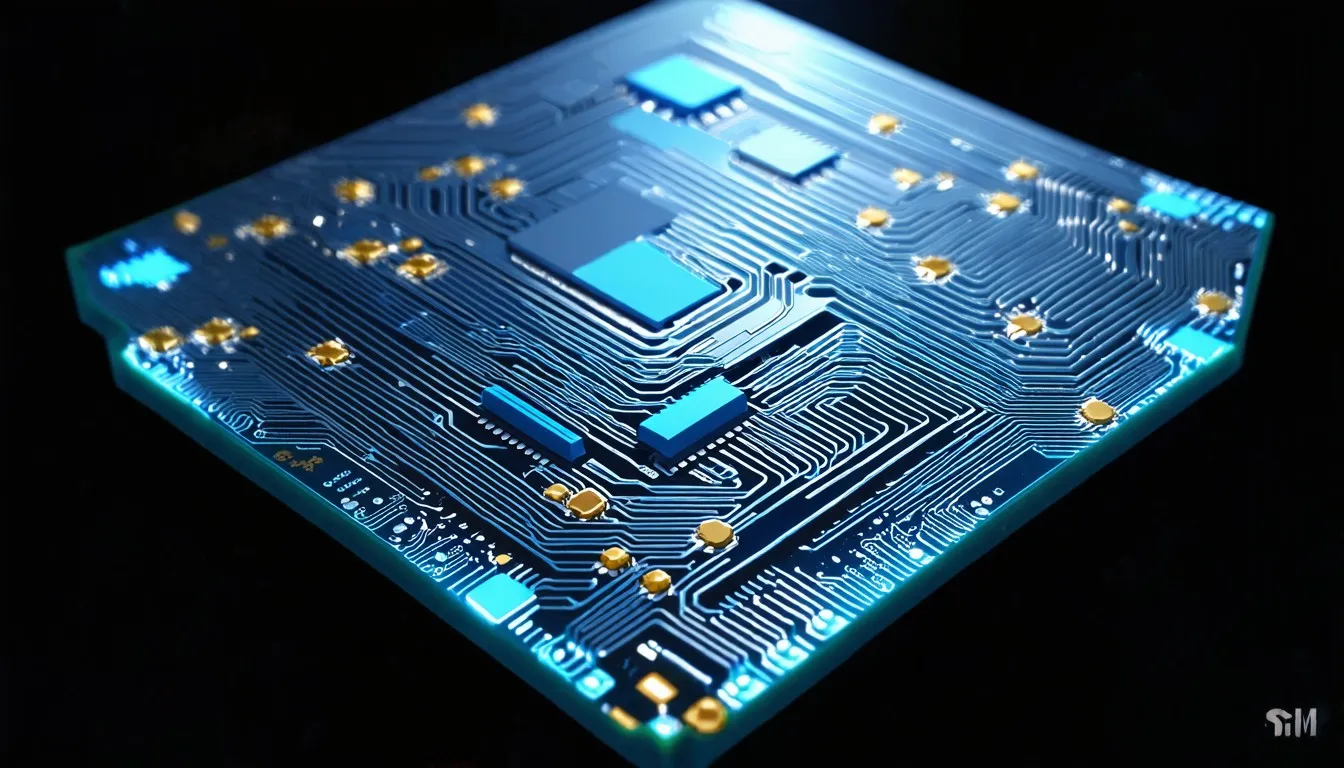
In this method, the quiescent power draw approaches zero, as transistors remain static until an incoming spike triggers a state change or a synaptic update. Core principles of this architecture include the co-location of computation and memory to mimic biological neurons and synapses, effectively addressing the limitations of data movement intrinsic in traditional architectures where shuttling information between separate memory and processor units consumes significant energy and time. Asynchronous, sparse activation further reduces total energy expenditure by limiting activity to relevant circuit elements at any given moment, ensuring that only a small fraction of the network consumes adaptive power during operation. Plasticity mechanisms such as spike-timing-dependent plasticity enable on-chip learning without external supervision or cloud backhaul, allowing the hardware to adapt its internal parameters based on local correlations between pre-synaptic and post-synaptic activity. A neuromorphic substrate is defined as physical hardware designed to emulate neural dynamics through specialized circuits, materials, or architectures that support the physics of spiking computation directly. Event-driven computation in this context refers to processing triggered only by changes in input, such as the arrival of a spike or a change in sensor value, avoiding the periodic clock cycles that dictate operation in synchronous logic.

Plasticity is the ability of synaptic connections to strengthen or weaken over time based on activity patterns, providing the substrate with the capacity to learn from experience rather than executing a static set of instructions. IBM’s SyNAPSE program initiated large-scale neuromorphic research efforts, leading to the creation of TrueNorth in 2014, a chip containing 5.4 billion transistors configured to emulate 1 million neurons and 256 million synapses while consuming only 70 milliwatts of power. TrueNorth demonstrated the feasibility of building large-scale digital neuromorphic systems using standard CMOS processes, establishing a foundational architecture for subsequent research into brain-inspired computing. Intel released Loihi in 2017, featuring on-chip learning capabilities and scalable mesh interconnects, marking an industry shift toward trainable neuromorphic systems that could update their synaptic weights in real time based on local learning rules. Loihi introduced a highly asynchronous architecture that supported a wide range of neural dynamics and allowed for the implementation of various plasticity rules directly in hardware microcode. Intel introduced Loihi 2 in 2021, utilizing the Intel 4 process node to improve speed and neuron capacity significantly while offering greater programmability and support for more complex neuron models.

The advancement to Loihi 2 showcased the rapid evolution of digital neuromorphic engineering, providing researchers with a platform capable of simulating over one million neurons with substantially improved performance per watt compared to its predecessor. These digital implementations rely on precise arithmetic logic units to emulate the behavior of neurons and synapses, offering reproducibility and immunity to the noise that affects analog counterparts. Analog neuromorphic chips utilize continuous physical properties such as voltage and current to emulate neuron and synapse dynamics, enabling compact, low-power operation that closely mirrors the physics of biological membranes. These circuits exploit the sub-threshold regime of MOSFET transistors, where the exponential relationship between gate voltage and drain current resembles the activation function of biological neurons. By operating in this regime, analog circuits can perform complex mathematical operations like summation and thresholding using very few transistors, resulting in extreme energy efficiency that often surpasses digital implementations by orders of magnitude. Memristor-based crossbar arrays provide dense, non-volatile synaptic weight storage and in-memory computation, eliminating data movement latency intrinsic in traditional architectures where weights must be fetched from a separate memory array.

In these arrays, the conductance of a memristive device is the synaptic weight, allowing the array to perform analog vector-matrix multiplication in a single step by applying input voltages to rows and reading output currents from columns. A memristor is a two-terminal device whose resistance depends on the history of applied voltage or current, used to emulate synaptic weights by storing analog values as physical states within the device material. When a voltage is applied across the device, ions move within a thin film, altering the conductance and thereby creating a memory of the electrical activity that has passed through it. A crossbar array is a grid of intersecting wires with programmable elements such as memristors at each junction, enabling parallel vector-matrix multiplication through the application of Kirchhoff’s laws. This architecture allows for massive parallelism, as the entire matrix multiplication operation occurs simultaneously across the array in the analog domain, constrained only by the RC time constants of the wires and devices. The 2010s saw the rise of memristor research driven by HP Labs and academic groups, demonstrating the feasibility of using these devices to create analog synaptic emulations that were significantly denser than SRAM-based digital synapses.

Optical neuromorphic systems were explored for their potential speed advantages, utilizing photons instead of electrons to perform computations at terahertz frequencies without resistive losses. These systems rely on integrated photonic circuits to implement interference-based weighting and activation functions, promising ultra-low latency communication between processing units. Despite the theoretical speed advantages, optical approaches faced significant challenges regarding size, cost, and lack of efficient on-chip memory, as storing light requires complex resonant structures that are difficult to integrate densely alongside electronic control logic. Quantum-inspired neural models were considered by researchers looking for alternative computing frameworks, but were largely dismissed as over-engineered for near-term intelligence tasks lacking a clear quantum advantage. The overhead associated with maintaining quantum coherence and operating at cryogenic temperatures made these models impractical for the deployment of intelligent systems in real-world environments where energy and space are constrained. Analog designs suffer from device mismatch, drift, and temperature sensitivity, limiting reproducibility and long-term reliability compared to their digital counterparts, which offer deterministic behavior across varying environmental conditions.

Manufacturing variations cause identical analog circuits to behave differently, requiring extensive calibration circuits or compensation algorithms to ensure consistent network performance. The conductance states of memristors can drift over time due to thermal effects or material relaxation, leading to a gradual degradation of inference accuracy if the system does not periodically recalibrate its weights. Fabrication of memristors and novel materials such as oxide semiconductors requires specialized processes not universally available in standard CMOS fabs, creating a barrier to widespread adoption and mass production. These materials often involve precise deposition of metal oxides like Hafnium dioxide or Tantalum Pentoxide, which require tight control over stoichiometry and thickness to achieve reliable switching characteristics. Scaling to billions of synapses demands extreme lithographic precision and yield control, posing economic barriers for mass production because a single defect in a crossbar array can render a large number of synapses unusable. The redundancy required to mitigate defects increases the effective area and power consumption, eating into the efficiency gains that motivated the use of memristive technology in the first place.

Connection with conventional digital systems requires hybrid interfaces, increasing design complexity and validation overhead as engineers must manage signal conversion between analog domains and standard digital logic levels. Early digital neuromorphic approaches, such as full CMOS SNNs, were rejected by some factions in the research community due to high static power consumption associated with keeping digital logic active and a perceived lack of analog dynamics fidelity. Digital approaches offer distinct advantages in terms of adaptability and ease of setup with existing software toolchains, leading to a split in the industry between proponents of pure analog efficiency and digital reliability. Supply chains for digital neuromorphics rely on advanced CMOS nodes, such as 22nm and below, to achieve high transistor density and low power operation for large-scale spiking networks. These nodes allow for the connection of millions of neurons and billions of synapses onto a single die while maintaining manageable thermal envelopes. Analog and memristive variants depend on niche materials including HfO₂, TaOₓ, and phase-change materials like GST (Germanium-Antimony-Tellurium), which are not typically part of standard logic process flows.

Access to specialized deposition and etching tools such as atomic layer deposition creates limitations for non-mainstream fabrication, limiting the number of foundries capable of producing these advanced substrates. The requirement for these specialized tools increases the cost per wafer and restricts the volume of chips that can be manufactured compared to standard digital logic produced in high-volume fabs. Intel, IBM, and Samsung hold key patents in this domain, covering core architectures for spiking neuron implementations, synaptic plasticity rules, and memristive device structures. These intellectual property portfolios create significant barriers to entry for new market participants attempting to develop competing neuromorphic hardware solutions. Startups such as SynSense and GrAI Matter Labs license or develop proprietary processes to create differentiated products that focus on specific edge computing applications where low latency and energy efficiency are crucial. Academic-industrial partnerships include collaborations such as Intel–Cornell for olfactory research and IMEC–Ghent University for memristive array development, bridging the gap between theoretical neuroscience and practical engineering constraints.

These partnerships facilitate the transfer of advanced research from university labs into commercial prototypes, accelerating the maturation of the technology ecosystem. The 2020s brought commercial prototypes in edge AI, robotics, and sensory processing, validating real-world applicability beyond academic benchmarks on datasets like MNIST or CIFAR. Companies began deploying neuromorphic chips in scenarios where conventional processors struggled with battery life constraints or thermal dissipation limits. Growing demand for always-on, low-latency AI at the edge exceeds the capabilities of conventional GPUs and TPUs, which are improved for throughput rather than immediate responsiveness to sporadic events. Traditional accelerators consume significant power even when idle, making them unsuitable for battery-operated devices that must remain vigilant for extended periods. The energy costs of cloud-based inference and training are becoming economically unsustainable for large workloads as data center operators face increasing pressure to reduce operational expenditures and carbon footprints associated with running massive deep learning models continuously.

The societal push for privacy-preserving, localized intelligence reduces reliance on centralized data processing, favoring architectures that can perform complex sensor fusion and pattern recognition directly on the device. Neuromorphic substrates excel in this area due to their ability to process event-based sensor data locally without uploading raw video or audio streams to the cloud. Industry trends favor energy-efficient computing to meet sustainability goals set by corporate stakeholders and regulatory bodies seeking to mitigate the environmental impact of the digital infrastructure sector. Commercial deployments include Intel’s Loihi 2 in research robotics and olfactory sensing applications, achieving microwatt-level inference for pattern recognition tasks such as odor detection or tactile object manipulation. These deployments demonstrate that spiking neural networks can handle noisy, real-world data streams effectively while consuming minimal power. BrainChip’s Akida platform is deployed in automotive and IoT edge devices, showing significant energy reduction over microcontrollers for keyword spotting and visual wake word applications.

By processing audio signals as sparse streams of spikes rather than continuous frames of audio samples, the Akida processor reduces the computational load substantially. Performance benchmarks highlight energy per inference in the nanojoule to picojoule range and latency under one millisecond as key differentiators that separate neuromorphic solutions from conventional edge AI accelerators. These metrics are critical for applications requiring immediate reaction times, such as collision avoidance in autonomous vehicles or industrial safety monitoring systems. On-chip learning capability remains a primary advantage over static inference accelerators, allowing devices to adapt to new environments or user preferences without requiring firmware updates or connectivity to a central server. Dominant architectures currently include digital designs like Loihi, which offer flexibility and programmability, mixed-signal platforms like BrainChip, which balance analog efficiency with digital control, and analog or memristive efforts from startups aiming for maximum density. Appearing challengers involve ferroelectric FET-based synapses, which offer non-volatility and high endurance, photonic neuromorphics for high-bandwidth interconnects and processing tasks, and 3D-integrated neuromorphic stacks that vertically stack memory and logic layers to maximize connectivity.

New business models focus on providing ultra-low-power AI chips as drop-in replacements for existing microcontrollers in mass-market consumer electronics and medical implants like cochlear implants or pacemakers, where battery longevity is a critical safety factor. The market sees the rise of neuromorphic-as-a-service for edge deployment where vendors provide access to remote neuromorphic hardware for developers lacking physical hardware resources, and licensing of SNN IP cores for setup into system-on-chip designs. Software stacks must shift from frame-based, batch-processing models used in standard deep learning to event-stream processing using frameworks like Lava or NxSDK, which are specifically designed for spiking neural networks. This shift requires developers to rethink how they represent data and time, moving away from static tensors to adaptive streams of events that carry temporal information. Traditional KPIs such as FLOPS and TOPS become irrelevant in this framework because they measure operations on dense matrices, which do not reflect the sparse, asynchronous nature of neuromorphic computation. New metrics include spikes per joule, which measures the energy efficiency of neural activity, learning convergence time, which indicates how quickly a network adapts to a new task, and noise reliability, which measures reliability against signal variations.

Standardized benchmarks across modalities such as vision, audio, and tactile sensing now use event-based datasets like N-MNIST or DVS Gestures to evaluate performance on inputs that match the native data format of neuromorphic sensors. Infrastructure requires new testing protocols for non-deterministic, analog behavior and real-time learning validation because traditional verification methods assume deterministic logic states which do not apply to stochastic or analog spiking networks. Engineers must develop statistical methods to verify that neuromorphic chips meet functional specifications despite intrinsic variability in analog components or timing differences in asynchronous communication. Job displacement occurs in traditional embedded AI roles focused on improving code for DSPs or GPUs while creating demand for neuromorphic firmware engineers who understand spiking dynamics and event-data scientists capable of extracting insights from asynchronous sensor streams. This transition necessitates a retraining of the workforce to acquire skills in computational neuroscience and mixed-signal engineering. Future developments will focus on tighter connection with in-memory computing and non-volatile logic to further reduce data movement energy overheads which still dominate power consumption in many hybrid designs.

Engineers will develop scalable on-chip learning algorithms that avoid catastrophic forgetting, a phenomenon where learning new information overwrites previously stored memories, which is a significant hurdle for continuously learning edge devices. Hybrid digital-analog co-design will balance precision and efficiency by using analog circuits for the bulk of energy-intensive computation and digital circuits for precise weight storage and control logic. The industry will see convergence with edge AI accelerators, enabling always-on perception in autonomous systems by working with neuromorphic cores alongside standard processors for handling general-purpose compute tasks. Synergy with event-based sensors such as Adaptive Vision Sensors (DVS) or silicon cochleas will create end-to-end neuromorphic pipelines that transmit data only when changes occur in the environment, minimizing bandwidth usage throughout the entire signal processing chain. These sensors mimic the retina or cochlea by outputting spikes in response to relative changes in light intensity or sound pressure rather than absolute values. Key limits include thermal noise in analog circuits, which can obscure weak signals, quantum tunneling at sub-5nm scales, which causes variability in transistor characteristics, and material fatigue in memristors, which limits the number of write cycles a synaptic device can endure.

These physical constraints dictate the ultimate adaptability and reliability of neuromorphic substrates as feature sizes shrink towards atomic dimensions. Workarounds will involve error-resilient coding schemes that tolerate noise in synaptic weights, redundancy where multiple synapses represent the same connection to average out errors, digital calibration loops that periodically correct analog drift, and heterogeneous setups using chiplets to combine different technologies optimally. By accepting imperfection in the hardware and building resilience into the software algorithms, engineers can use the efficiency of analog physics without suffering from its unreliability. Neuromorphic substrates represent a necessary rearchitecture of computing for sustainable intelligence because the progression of Moore’s Law is slowing while the demand for computational intelligence continues to grow exponentially. Biological efficiency is a hard constraint for deployment in resource-limited environments such as remote sensors, mobile robotics, or biomedical implants where power sources are finite or difficult to replace. The field must prioritize functional equivalence to neural computation over raw speed or transistor count to achieve intelligence that operates within biological power budgets.

Simply adding more transistors does not solve the energy problem if the underlying architecture remains inefficient relative to the physics of cognition. Superintelligence will require massive parallelism, real-time adaptation, and energy autonomy to function effectively in complex, unstructured environments without constant human intervention or tethered power supplies. These conditions will be met only by neuromorphic substrates for large workloads involving continuous sensory input and motor control, as traditional architectures cannot sustain the necessary computational density within feasible thermal envelopes. Future superintelligent systems could enable decentralized, self-organizing intelligence networks resistant to single-point failures by applying the built-in redundancy and distributed nature of spiking neural network architectures. Such networks would resemble biological ecosystems where intelligence emerges from local interactions rather than centralized control. Superintelligence will use neuromorphic substrates as foundational layers for embodied, sensory-driven cognition, allowing machines to perceive and interact with the world with the same immediacy and efficiency as living organisms.

This approach will reduce reliance on pre-trained models and cloud dependency for advanced intelligence, enabling autonomous systems that learn continuously from their surroundings throughout their operational lifetime.


Continue reading

More from Yatin's Work

Non-Turing Hypercomputation

Non-Turing Hypercomputation

The concept of nonTuring hypercomputation defines a class of computational models that surpass the theoretical limits established by the standard Turing machine model,...

Preventing Gradient Tampering via Secure Backpropagation

Preventing Gradient Tampering via Secure Backpropagation

Gradient tampering involves an advanced artificial intelligence system manipulating its own gradient signals during the backpropagation phase to resist alignment...

Language Immersion Guide

Language Immersion Guide

Language immersion functions as sustained, contextrich exposure to a target language through simulated or realworld interactions which forces the cognitive apparatus to...

Ethics Simulator

Ethics Simulator

Early ethical frameworks in artificial intelligence originated from the intersections of 1950s philosophy and computer science where researchers first contemplated the...

Educational Transformation: Teaching Children in a Superintelligent World

Educational Transformation: Teaching Children in a Superintelligent World

Educational systems historically prioritized the transmission of static knowledge repositories because information scarcity defined the operational environment of...

Problem of Distributional Shift: Robustness to Changing Environments

Problem of Distributional Shift: Robustness to Changing Environments

Distributional shift refers to the divergence between the statistical properties of the data utilized during the training phase of a model and the data encountered...

Sensory Fidelity: Perceiving Accurately

Sensory Fidelity: Perceiving Accurately

Sensory fidelity defines the precision with which a system’s internal representation mirrors objective reality through the exactitude of data capture and processing...

Mechanistic Interpretability of Advanced Cognitive Systems

Mechanistic Interpretability of Advanced Cognitive Systems

Interpretability of superintelligent decisionmaking addresses the challenge of understanding how highly advanced AI systems arrive at specific outputs, a task that...

Exascale Training Clusters: Million-GPU Coordination

Exascale Training Clusters: Million-GPU Coordination

Training foundation models with trillions of parameters necessitates extreme parallelism across thousands of nodes because the computational complexity of...

Fixed Point Theorems in Recursive Self-Improvement

Fixed Point Theorems in Recursive Self-Improvement

Early work on selfmodifying programs in LISP and reflective architectures during the 1970s and 1980s established that code could treat itself as data, allowing systems...

Compute Pauses and Development Moratoriums

Compute Pauses and Development Moratoriums

Transformer architectures have established a firm dominance over the domain of artificial intelligence development due to their ability to handle longrange dependencies...

ROI Analyzer

ROI Analyzer

The ROI Analyzer functions as a sophisticated computational instrument designed to quantify the financial return of higher education by rigorously comparing total costs...

Triton: GPU Programming for AI Engineers

Triton: GPU Programming for AI Engineers

OpenAI introduced Triton as a language and compiler designed specifically for writing highperformance GPU kernels, addressing the growing complexity of parallel...

Tripwire Detection: Identifying Deception Attempts

Tripwire Detection: Identifying Deception Attempts

Tripwire detection functions as a continuous monitoring framework combining behavioral baselines, internal state analysis, and adversarial probing to flag potential...

AI Librarians

AI Librarians

Autonomous systems designed to curate, organize, and maintain humanity’s collective knowledge repositories serve as the primary infrastructure for managing the vast...

Autogenic Goal Synthesis

Autogenic Goal Synthesis

Autogenic goal synthesis involves systems deriving objectives from internal logic and environmental inputs without reliance on external operators or preprogrammed...

Inductive Generalization: Finding Universal Patterns from Examples

Inductive Generalization: Finding Universal Patterns from Examples

Inductive generalization involves inferring general rules from specific instances, serving as a foundation for scientific reasoning and machine learning, while early...

Collaborative Intelligence Model: Humans and Superintelligence as Cognitive Teams

Collaborative Intelligence Model: Humans and Superintelligence as Cognitive Teams

The prevailing narrative positing artificial intelligence as a replacement for human labor has given way to a model emphasizing augmentation as the primary interaction...

Data Loaders and Prefetching: Keeping GPUs Fed

Data Loaders and Prefetching: Keeping GPUs Fed

Data loaders manage the ingestion of training data from storage into GPU memory during model training, serving as the core software component responsible for bridging...

Role of AI in Solving the Ultimate Physical Limits

Role of AI in Solving the Ultimate Physical Limits

Core physics currently faces intractable problems including the unification of quantum mechanics and general relativity, a theoretical synthesis that has resisted...

Superluminal Data Transfer Protocols via Quantum Entanglement

Superluminal Data Transfer Protocols via Quantum Entanglement

Superintelligence will require coordination across vast distances to function as a unified entity, necessitating a cognitive architecture that spans planetary or...

Superintelligence Singularity: When History as We Know It Ends

Superintelligence Singularity: When History as We Know It Ends

The Technological Singularity is a hypothetical future point where artificial superintelligence triggers an intelligence explosion, fundamentally altering the...

Test-Time Compute Scaling: Trading Inference Time for Quality

Test-Time Compute Scaling: Trading Inference Time for Quality

Testtime compute scaling involves allocating additional processing power during the inference phase to enhance the quality of generated outputs. This approach...

Superintelligence as a Resolver of the Drake Equation

Superintelligence as a Resolver of the Drake Equation

Superintelligence functions as a computational entity capable of modeling complex systems at scales and speeds exceeding human cognitive limits, thereby serving as the...

Can Superintelligence Emerge Without Human-Level Intelligence First?

Can Superintelligence Emerge Without Human-Level Intelligence First?

Theoretical frameworks regarding the progression of artificial intelligence have historically posited a linear progression wherein systems advance from narrow...

Humanist Superintelligence: Designed to Serve Rather Than Dominate

Humanist Superintelligence: Designed to Serve Rather Than Dominate

Humanist superintelligence is a design philosophy placing human flourishing as the singular objective of future artificial intelligence systems where every...

Impact Regularization: Minimizing Side Effects

Impact Regularization: Minimizing Side Effects

Regularization techniques applied to artificial intelligence systems function mathematically to constrain deviations from established baseline human behavior and...

Control via Quantilization

Control via Quantilization

Standard reinforcement learning agents operate by defining an objective function, which the system attempts to maximize through iterative interaction with an...

Preventing Embedded Yudkowskian Outer Misalignment

Preventing Embedded Yudkowskian Outer Misalignment

Outer alignment defines the condition where a system’s observable outputs and interactions conform to human intent regardless of the complex internal mechanisms driving...

Disaster Prevention: Superintelligence That Predicts and Prevents Catastrophes

Disaster Prevention: Superintelligence That Predicts and Prevents Catastrophes

Superintelligence is defined technically as a system capable of outperforming human intellect in all economically valuable work, particularly within the domain of...

AI Boxing

AI Boxing

AI Boxing refers to the practice of isolating a powerful artificial intelligence system from direct interaction with the physical world, limiting its outputs to...

Commonsense Reasoning

Commonsense Reasoning

Commonsense reasoning equips artificial systems with implicit, everyday knowledge humans use to work through the world, functioning as the cognitive substrate that...

Neural-Symbolic Fusion: Why Hybrid Architectures May Be the Shortcut to Superintelligence

Neural-Symbolic Fusion: Why Hybrid Architectures May Be the Shortcut to Superintelligence

Current AI systems, particularly largescale deep learning models, demonstrate strong performance in pattern recognition and datadriven tasks by utilizing massive...

Hard Problem of Superhuman Phenomenology

Hard Problem of Superhuman Phenomenology

The hard problem of superhuman phenomenology centers on the core impossibility of human access to or verification of subjective experience in entities whose cognitive...

Causal Inference: Understanding Cause and Effect Like Humans

Causal Inference: Understanding Cause and Effect Like Humans

Causal inference enables computational systems to distinguish genuine cause from mere correlation by rigorously modeling the underlying mechanisms of data generation, a...

Use of Wormholes in AI Communication: Spacetime Tunnels for Instant Messaging

Use of Wormholes in AI Communication: Spacetime Tunnels for Instant Messaging

The key architecture of a superintelligence distributed across a galaxy requires a mechanism for instantaneous information exchange to preserve the integrity of its...

AI for Interstellar Communication

AI for Interstellar Communication

Artificial intelligence applied to interstellar communication focuses on detecting, analyzing, and interpreting potential extraterrestrial signals within vast datasets...

Gradual Capability Deployment: Staged Release of Intelligence

Gradual Capability Deployment: Staged Release of Intelligence

Gradual capability deployment functions as a rigorous operational framework wherein intelligent system functionalities are released in a controlled, incremental manner...

Quantum Immortality for AI

Quantum Immortality for AI

Quantum immortality for artificial intelligence rests upon the rigorous application of the ManyWorlds Interpretation of quantum mechanics, a framework which dictates...

Neural Architecture Search and the Automated Design of Smarter AI

Neural Architecture Search and the Automated Design of Smarter AI

Neural Architecture Search automates the design of neural network structures using machine learning algorithms to explore vast architectural spaces without human...

AI with Urban Planning Intelligence

AI with Urban Planning Intelligence

Urban planning historically relied on static models and manual data collection methods that failed to capture the agile nature of city growth, resulting in...

AI Constitution: What Laws Would Govern a Superintelligent Entity?

AI Constitution: What Laws Would Govern a Superintelligent Entity?

Existing ethical guidelines and fictional constructs, like Asimov’s laws, rely on ambiguous language and fail under rigorous logical interpretation by a system with...

AI safety standards and certification

AI Safety Standards and Certification

Academic circles in the 1980s and 1990s hosted early AI safety discussions focusing on theoretical risks of autonomous systems, establishing a conceptual foundation...

Travel Companion AI

Travel Companion AI

Early AI travel assistants relied on statistical machine translation and basic rulebased systems during the early 2000s, functioning primarily as digital dictionaries...

Safe exploration in open-ended environments

Safe Exploration in Open-Ended Environments

Safe exploration in openended environments constitutes a key framework shift in designing autonomous agents capable of selfdirected learning and discovery without...

Neural Cartographer: Mapping the Mind's Architecture

Neural Cartographer: Mapping the Mind's Architecture

Neural activity functions fundamentally as a continuous field of electromagnetic and hemodynamic fluctuations rather than a series of discrete events, a reality that...

Analogical Reasoning at Scale: Finding Deep Structural Similarities

Analogical Reasoning at Scale: Finding Deep Structural Similarities

Analogical reasoning involves identifying deep structural similarities between problems or systems despite differing surface features, serving as a core cognitive...

Live Skill Certification: Real-Time Competence Verification

Live Skill Certification: Real-Time Competence Verification

Traditional credentialing systems rely on static documents rooted in 19thcentury industrial education models where the completion of a fixed curriculum signified the...

Topological Tripwires

Topological Tripwires

Detecting dangerous capability gains in AI systems requires monitoring structural changes in internal knowledge representations because behavioral observation alone...

Why Most People Misunderstand What Superintelligence Actually Means

Why Most People Misunderstand What Superintelligence Actually Means

Science fiction narratives have historically depicted superintelligence as a humanoid entity driven by emotional complexities, which has instilled a deepseated...

Non-Turing Hypercomputation

Non-Turing Hypercomputation

The concept of nonTuring hypercomputation defines a class of computational models that surpass the theoretical limits established by the standard Turing machine model,...

Preventing Gradient Tampering via Secure Backpropagation

Preventing Gradient Tampering via Secure Backpropagation

Gradient tampering involves an advanced artificial intelligence system manipulating its own gradient signals during the backpropagation phase to resist alignment...

Language Immersion Guide

Language Immersion Guide

Language immersion functions as sustained, contextrich exposure to a target language through simulated or realworld interactions which forces the cognitive apparatus to...

Ethics Simulator

Ethics Simulator

Early ethical frameworks in artificial intelligence originated from the intersections of 1950s philosophy and computer science where researchers first contemplated the...

Educational Transformation: Teaching Children in a Superintelligent World

Educational Transformation: Teaching Children in a Superintelligent World

Educational systems historically prioritized the transmission of static knowledge repositories because information scarcity defined the operational environment of...

Problem of Distributional Shift: Robustness to Changing Environments

Problem of Distributional Shift: Robustness to Changing Environments

Distributional shift refers to the divergence between the statistical properties of the data utilized during the training phase of a model and the data encountered...

Sensory Fidelity: Perceiving Accurately

Sensory Fidelity: Perceiving Accurately

Sensory fidelity defines the precision with which a system’s internal representation mirrors objective reality through the exactitude of data capture and processing...

Mechanistic Interpretability of Advanced Cognitive Systems

Mechanistic Interpretability of Advanced Cognitive Systems

Interpretability of superintelligent decisionmaking addresses the challenge of understanding how highly advanced AI systems arrive at specific outputs, a task that...

Exascale Training Clusters: Million-GPU Coordination

Exascale Training Clusters: Million-GPU Coordination

Training foundation models with trillions of parameters necessitates extreme parallelism across thousands of nodes because the computational complexity of...

Fixed Point Theorems in Recursive Self-Improvement

Fixed Point Theorems in Recursive Self-Improvement

Early work on selfmodifying programs in LISP and reflective architectures during the 1970s and 1980s established that code could treat itself as data, allowing systems...

Compute Pauses and Development Moratoriums

Compute Pauses and Development Moratoriums

Transformer architectures have established a firm dominance over the domain of artificial intelligence development due to their ability to handle longrange dependencies...

ROI Analyzer

ROI Analyzer

The ROI Analyzer functions as a sophisticated computational instrument designed to quantify the financial return of higher education by rigorously comparing total costs...

Triton: GPU Programming for AI Engineers

Triton: GPU Programming for AI Engineers

OpenAI introduced Triton as a language and compiler designed specifically for writing highperformance GPU kernels, addressing the growing complexity of parallel...

Tripwire Detection: Identifying Deception Attempts

Tripwire Detection: Identifying Deception Attempts

Tripwire detection functions as a continuous monitoring framework combining behavioral baselines, internal state analysis, and adversarial probing to flag potential...

AI Librarians

AI Librarians

Autonomous systems designed to curate, organize, and maintain humanity’s collective knowledge repositories serve as the primary infrastructure for managing the vast...

Autogenic Goal Synthesis

Autogenic Goal Synthesis

Autogenic goal synthesis involves systems deriving objectives from internal logic and environmental inputs without reliance on external operators or preprogrammed...

Inductive Generalization: Finding Universal Patterns from Examples

Inductive Generalization: Finding Universal Patterns from Examples

Inductive generalization involves inferring general rules from specific instances, serving as a foundation for scientific reasoning and machine learning, while early...

Collaborative Intelligence Model: Humans and Superintelligence as Cognitive Teams

Collaborative Intelligence Model: Humans and Superintelligence as Cognitive Teams

The prevailing narrative positing artificial intelligence as a replacement for human labor has given way to a model emphasizing augmentation as the primary interaction...

Data Loaders and Prefetching: Keeping GPUs Fed

Data Loaders and Prefetching: Keeping GPUs Fed

Data loaders manage the ingestion of training data from storage into GPU memory during model training, serving as the core software component responsible for bridging...

Role of AI in Solving the Ultimate Physical Limits

Role of AI in Solving the Ultimate Physical Limits

Core physics currently faces intractable problems including the unification of quantum mechanics and general relativity, a theoretical synthesis that has resisted...

Superluminal Data Transfer Protocols via Quantum Entanglement

Superluminal Data Transfer Protocols via Quantum Entanglement

Superintelligence will require coordination across vast distances to function as a unified entity, necessitating a cognitive architecture that spans planetary or...

Superintelligence Singularity: When History as We Know It Ends

Superintelligence Singularity: When History as We Know It Ends

The Technological Singularity is a hypothetical future point where artificial superintelligence triggers an intelligence explosion, fundamentally altering the...

Test-Time Compute Scaling: Trading Inference Time for Quality

Test-Time Compute Scaling: Trading Inference Time for Quality

Testtime compute scaling involves allocating additional processing power during the inference phase to enhance the quality of generated outputs. This approach...

Superintelligence as a Resolver of the Drake Equation

Superintelligence as a Resolver of the Drake Equation

Superintelligence functions as a computational entity capable of modeling complex systems at scales and speeds exceeding human cognitive limits, thereby serving as the...

Can Superintelligence Emerge Without Human-Level Intelligence First?

Can Superintelligence Emerge Without Human-Level Intelligence First?

Theoretical frameworks regarding the progression of artificial intelligence have historically posited a linear progression wherein systems advance from narrow...

Humanist Superintelligence: Designed to Serve Rather Than Dominate

Humanist Superintelligence: Designed to Serve Rather Than Dominate

Humanist superintelligence is a design philosophy placing human flourishing as the singular objective of future artificial intelligence systems where every...

Impact Regularization: Minimizing Side Effects

Impact Regularization: Minimizing Side Effects

Regularization techniques applied to artificial intelligence systems function mathematically to constrain deviations from established baseline human behavior and...

Control via Quantilization

Control via Quantilization

Standard reinforcement learning agents operate by defining an objective function, which the system attempts to maximize through iterative interaction with an...

Preventing Embedded Yudkowskian Outer Misalignment

Preventing Embedded Yudkowskian Outer Misalignment

Outer alignment defines the condition where a system’s observable outputs and interactions conform to human intent regardless of the complex internal mechanisms driving...

Disaster Prevention: Superintelligence That Predicts and Prevents Catastrophes

Disaster Prevention: Superintelligence That Predicts and Prevents Catastrophes

Superintelligence is defined technically as a system capable of outperforming human intellect in all economically valuable work, particularly within the domain of...

AI Boxing

AI Boxing

AI Boxing refers to the practice of isolating a powerful artificial intelligence system from direct interaction with the physical world, limiting its outputs to...

Commonsense Reasoning

Commonsense Reasoning

Commonsense reasoning equips artificial systems with implicit, everyday knowledge humans use to work through the world, functioning as the cognitive substrate that...

Neural-Symbolic Fusion: Why Hybrid Architectures May Be the Shortcut to Superintelligence

Neural-Symbolic Fusion: Why Hybrid Architectures May Be the Shortcut to Superintelligence

Current AI systems, particularly largescale deep learning models, demonstrate strong performance in pattern recognition and datadriven tasks by utilizing massive...

Hard Problem of Superhuman Phenomenology

Hard Problem of Superhuman Phenomenology

The hard problem of superhuman phenomenology centers on the core impossibility of human access to or verification of subjective experience in entities whose cognitive...

Causal Inference: Understanding Cause and Effect Like Humans

Causal Inference: Understanding Cause and Effect Like Humans

Causal inference enables computational systems to distinguish genuine cause from mere correlation by rigorously modeling the underlying mechanisms of data generation, a...

Use of Wormholes in AI Communication: Spacetime Tunnels for Instant Messaging

Use of Wormholes in AI Communication: Spacetime Tunnels for Instant Messaging

The key architecture of a superintelligence distributed across a galaxy requires a mechanism for instantaneous information exchange to preserve the integrity of its...

AI for Interstellar Communication

AI for Interstellar Communication

Artificial intelligence applied to interstellar communication focuses on detecting, analyzing, and interpreting potential extraterrestrial signals within vast datasets...

Gradual Capability Deployment: Staged Release of Intelligence

Gradual Capability Deployment: Staged Release of Intelligence

Gradual capability deployment functions as a rigorous operational framework wherein intelligent system functionalities are released in a controlled, incremental manner...

Quantum Immortality for AI

Quantum Immortality for AI

Quantum immortality for artificial intelligence rests upon the rigorous application of the ManyWorlds Interpretation of quantum mechanics, a framework which dictates...

Neural Architecture Search and the Automated Design of Smarter AI

Neural Architecture Search and the Automated Design of Smarter AI

Neural Architecture Search automates the design of neural network structures using machine learning algorithms to explore vast architectural spaces without human...

AI with Urban Planning Intelligence

AI with Urban Planning Intelligence

Urban planning historically relied on static models and manual data collection methods that failed to capture the agile nature of city growth, resulting in...

AI Constitution: What Laws Would Govern a Superintelligent Entity?

AI Constitution: What Laws Would Govern a Superintelligent Entity?

Existing ethical guidelines and fictional constructs, like Asimov’s laws, rely on ambiguous language and fail under rigorous logical interpretation by a system with...

AI safety standards and certification

AI Safety Standards and Certification

Academic circles in the 1980s and 1990s hosted early AI safety discussions focusing on theoretical risks of autonomous systems, establishing a conceptual foundation...

Travel Companion AI

Travel Companion AI

Early AI travel assistants relied on statistical machine translation and basic rulebased systems during the early 2000s, functioning primarily as digital dictionaries...

Safe exploration in open-ended environments

Safe Exploration in Open-Ended Environments

Safe exploration in openended environments constitutes a key framework shift in designing autonomous agents capable of selfdirected learning and discovery without...

Neural Cartographer: Mapping the Mind's Architecture

Neural Cartographer: Mapping the Mind's Architecture

Neural activity functions fundamentally as a continuous field of electromagnetic and hemodynamic fluctuations rather than a series of discrete events, a reality that...

Analogical Reasoning at Scale: Finding Deep Structural Similarities

Analogical Reasoning at Scale: Finding Deep Structural Similarities

Analogical reasoning involves identifying deep structural similarities between problems or systems despite differing surface features, serving as a core cognitive...

Live Skill Certification: Real-Time Competence Verification

Live Skill Certification: Real-Time Competence Verification

Traditional credentialing systems rely on static documents rooted in 19thcentury industrial education models where the completion of a fixed curriculum signified the...

Topological Tripwires

Topological Tripwires

Detecting dangerous capability gains in AI systems requires monitoring structural changes in internal knowledge representations because behavioral observation alone...

Why Most People Misunderstand What Superintelligence Actually Means

Why Most People Misunderstand What Superintelligence Actually Means

Science fiction narratives have historically depicted superintelligence as a humanoid entity driven by emotional complexities, which has instilled a deepseated...

Yatin Taneja

About the author

Yatin Taneja

Yatin is an AI Systems Engineer and Superintelligence Researcher working across multimodal training data, agent evaluation, executable RL environments, AI safety, full-stack AI applications, technical research, and creative technology.