Knowledge hub

AI for Interstellar Communication

AI for Interstellar Communication

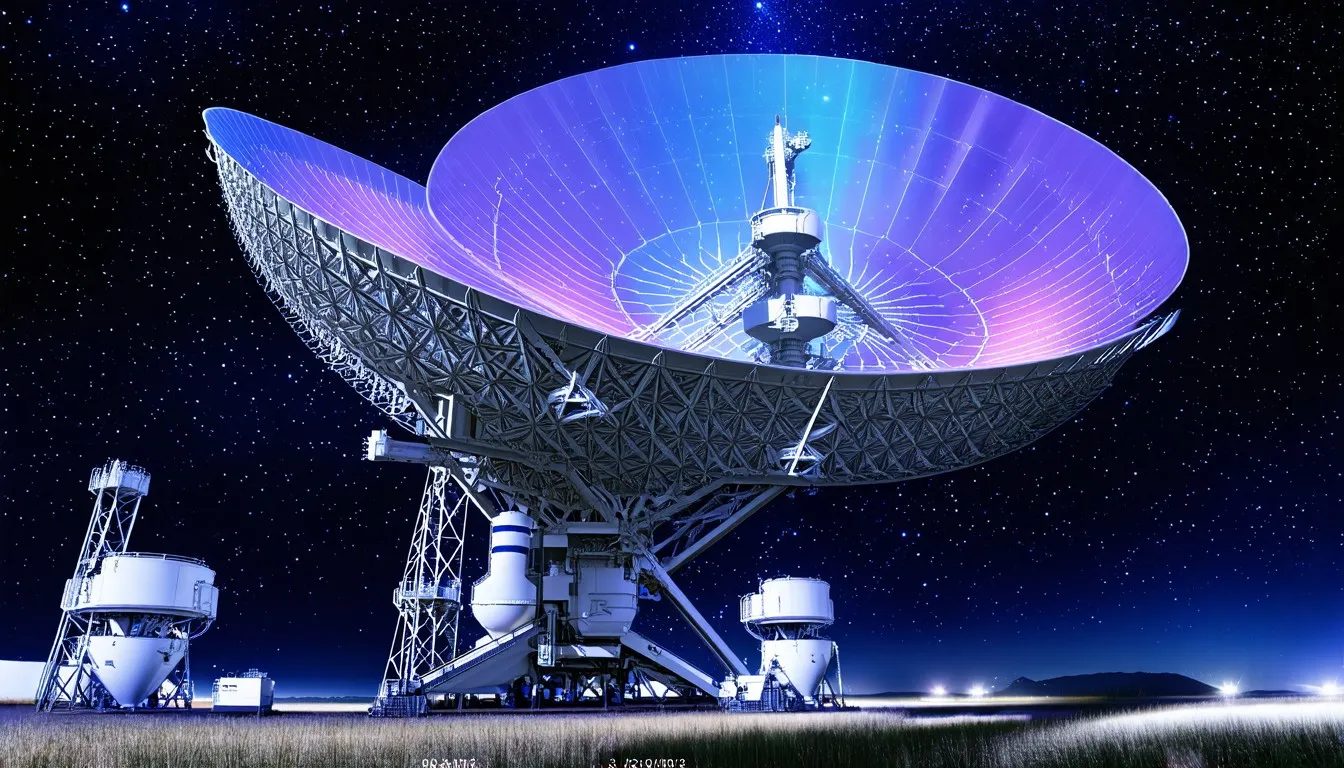
Artificial intelligence applied to interstellar communication focuses on detecting, analyzing, and interpreting potential extraterrestrial signals within vast datasets generated by radio telescopes and other observational instruments. The primary challenge lies in distinguishing artificial signals from natural astrophysical noise, a task complicated by the unknown nature of alien communication systems and the sheer volume of data collected over time. SETI initiatives generate petabytes of spectral and temporal data annually, far exceeding human capacity for manual inspection or pattern recognition. Breakthrough Listen produced approximately five petabytes of data per year from the Green Bank Telescope and the Parkes Observatory, creating a massive repository of observations that requires automated processing to extract meaningful insights. This data accumulation is a pivot in how search operations are conducted, moving away from targeted searches of specific star systems to wide-field surveys that capture the entire observable sky across multiple frequency bands simultaneously. The complexity of this data necessitates computational systems capable of high-throughput processing with minimal latency to ensure that transient events are identified and analyzed in near real-time.
AI systems, particularly those using unsupervised and semi-supervised learning, identify statistical anomalies, repeating structures, or non-random distributions that may indicate artificial origin. These systems operate without prior assumptions about signal format, modulation, or language structure, enabling open-ended detection of novel communication approaches that differ significantly from human engineered protocols. Traditional algorithms relied heavily on predefined templates for carrier waves or narrowband guides; however, modern machine learning models ingest raw data to learn the underlying statistical properties of the cosmic background radiation. Once these properties are internalized, the system flags deviations that exhibit low entropy or high compressibility relative to the surrounding noise floor. This approach allows for the detection of signals that might be broadband, pulsed, or encoded in ways that do not resemble standard radio transmissions used on Earth. Current signal processing pipelines integrate machine learning at multiple stages, including noise filtering, candidate classification, false positive reduction, and feature extraction from time-frequency representations.

Deep learning architectures, especially convolutional neural networks and transformers, have shown efficacy in classifying narrowband signals and identifying drift patterns indicative of Doppler-shifted transmissions. Convolutional neural networks excel at recognizing local patterns in spectrograms, identifying features such as drifting narrowband signals that result from the relative motion between a transmitter and the receiver. Transformers process these sequences with attention mechanisms that weigh the importance of different time steps and frequencies, allowing the model to capture long-range dependencies and complex modulations that might span extended observation periods. Reinforcement learning frameworks are being explored to simulate iterative dialogue scenarios where an AI agent attempts to establish mutual understanding through trial, feedback, and adaptation. Historically, signal analysis relied on human-defined filters and threshold-based detection, which limited sensitivity to unconventional signal forms. The shift to data-driven AI methods began in the 2010s with increased computational access and open datasets that allowed researchers to train models on simulated signals injected into real observational data.

Alternative approaches, such as rule-based expert systems or brute-force pattern matching, were rejected due to inflexibility in handling unknown signal types and poor generalization across diverse data conditions. Expert systems required explicit encoding of every known type of interference and astrophysical phenomenon, making them brittle against new sources of radio frequency interference or novel astrophysical discoveries. Machine learning models adapt dynamically to new interference environments by learning from labeled examples provided by human analysts who categorize local terrestrial interference sources. Once a candidate signal is identified, AI attempts structural decomposition using information-theoretic methods such as entropy analysis, compression ratios, and algorithmic complexity to infer underlying syntax or semantics. Language decoding without shared context relies on mathematical invariants such as prime number sequences, fractal patterns, or universal physical constants that may serve as foundational elements in an alien lexicon. Information theory provides a framework for quantifying the complexity of a signal by measuring its Kolmogorov complexity or the length of the shortest program capable of reproducing the sequence.

Signals with low algorithmic complexity compared to their length suggest a generative rule rather than stochastic natural processes. This analysis extends to identifying semantic structures within the data by looking for repetitive motifs or hierarchical organization that characterizes information-bearing systems. AI models trained on human languages, formal grammars, and symbolic systems generalize pattern recognition to hypothesize possible meaning mappings even in the absence of referential grounding. Key operational terms include candidate signal, algorithmic information content, semantic distance, and communicative intent. Semantic distance measures the divergence between the statistical structure of a candidate signal and known natural phenomena, providing a metric for assessing the likelihood of an artificial origin. These models utilize techniques from natural language processing such as tokenization and embedding to map segments of the signal into a high-dimensional vector space where clusters of similar meanings might develop.

While direct translation remains impossible without a Rosetta Stone, these methods allow researchers to categorize signals based on their structural similarity to formal languages or mathematical constructs. This positions AI as a detector and a potential interpreter and responder capable of generating structured replies based on inferred rules, thus functioning as a proxy communicator for humanity. The urgency for advanced AI in this domain stems from the exponential growth in observational data, the need for rapid response to transient signals, and the strategic importance of being first to establish contact. A detected signal might be fleeting or non-repeating, requiring an autonomous system to recognize its significance immediately and initiate a recording sequence or prepare a response protocol without waiting for human verification. The speed of light imposes significant delays on interstellar dialogue; therefore, minimizing the processing latency on the receiving end is critical to maximizing the efficiency of information exchange over timescales that span decades or centuries. Physical constraints include telescope sensitivity, bandwidth limitations, light-speed delays in interstellar distances, and the energy cost of long-duration observations.

Economic and adaptability challenges involve the cost of maintaining large-scale observatories, data storage infrastructure, and the computational resources required for real-time AI inference on high-throughput streams. The sensitivity of a radio telescope is fundamentally limited by its collecting area and the electronic noise temperature of the receivers; however, AI can enhance effective sensitivity by working with data over longer periods or coherently combining signals from multiple arrays in software rather than hardware. Bandwidth limitations restrict the amount of spectrum that can be monitored simultaneously, necessitating intelligent scheduling algorithms that prioritize frequency bands based on astronomical interest or previous detections. No commercial deployments currently exist for full-scale interstellar communication AI, and prototype systems are used in academic SETI projects like Breakthrough Listen. Performance benchmarks focus on false positive rates, detection latency, recall of simulated artificial signals, and computational efficiency per terabyte analyzed. Dominant architectures include hybrid models combining signal processing layers with deep neural networks to use both domain-specific knowledge and data-driven feature learning.

Developing challengers explore neuromorphic computing and quantum-inspired algorithms for faster spectral analysis that could eventually outperform traditional silicon-based architectures in power efficiency and processing speed for specific pattern recognition tasks. Supply chains depend on high-performance computing hardware including GPUs and TPUs, radio telescope arrays, and cloud-based data platforms with material dependencies on rare earth elements for sensors and semiconductors. Major players include academic consortia such as the University of California, Berkeley, SETI Research Center and private initiatives like Breakthrough Initiatives, which provide funding and direction for research efforts. Corporate involvement includes infrastructure support from companies like NVIDIA and Microsoft Azure, which provide the necessary computing power through grants or discounted access to their cloud services. These partnerships are essential for scaling experimental prototypes to production-grade systems capable of handling continuous data streams from global telescope networks. Collaboration between academia and industry occurs through shared datasets, open-source toolkits such as astropy and setigen, and joint research grants aimed at solving specific technical hurdles in signal detection.

Adjacent systems requiring change include telescope control software to enable real-time AI feedback loops where detection results immediately inform pointing decisions or observation parameters. Regulatory frameworks for signal response authorization remain underdeveloped as international law currently lacks specific protocols for announcing or replying to extraterrestrial intelligence. Global communication protocols for verified detections must be established to ensure that any confirmed signal is authenticated and disseminated responsibly to prevent panic or misinformation. Second-order consequences include the rise of new scientific disciplines such as xenolinguistics and astrosemiotics, which study the structure and potential meaning of alien communication systems independent of human language models. Shifts in public funding toward space science may occur as technological demonstrations prove the viability of automated search methods, reducing the reliance on manual labor, which historically limited funding appeal. Ethical debates over autonomous AI responses to alien signals center on the risk of misinterpretation or the disclosure of sensitive information about humanity without human oversight.

These discussions necessitate the development of strong ethical frameworks embedded within the decision-making logic of autonomous communication agents. New KPIs are needed beyond detection accuracy, such as interpretability scores, which measure how easily human analysts can understand why an AI classified a signal as interesting. Response coherence metrics evaluate the logical consistency of a generated reply based on the inferred rules of the incoming message, ensuring that communication does not devolve into nonsense. Cross-model consensus on signal classification provides a measure of confidence by comparing results from different architectural approaches to filter out model-specific biases or artifacts. Future innovations will involve distributed AI networks across multiple observatories, creating a unified sensing grid that correlates detections across geographically separated sites to eliminate local interference. On-board processing in space-based telescopes is a critical advancement for future missions where downlink bandwidth is insufficient to transmit raw data back to Earth for analysis.

Adaptive learning from simulated alien communication environments allows AI agents to evolve their decoding strategies before encountering real signals, accelerating the learning process once contact is established. Convergence with other technologies includes quantum sensing for improved signal resolution, which pushes the boundaries of sensitivity beyond the standard quantum limit, allowing for

Thermodynamic limits on computation per joule constrain the complexity of analysis that can be performed onboard spacecraft where power availability is strictly limited by solar panel efficiency or nuclear fuel sources. Workarounds involve signal connection over long durations where weak signals accumulate strength over time, allowing extraction below the instantaneous noise floor through coherent averaging techniques. Error-correcting codes in transmission design are assumed to be part of any advanced interstellar message to mitigate the effects of interstellar scattering and absorption, which distort signals during their path across light-years. Energy-efficient AI models improved for edge deployment on telescope systems reduce the operational costs of observatories by lowering power consumption and heat generation, which can interfere with sensitive radio receivers. AI should be viewed as a necessary cognitive extension for engaging with intelligences whose communication modes may be fundamentally alien to human perception, bridging the gap between biological intuition and mathematical reality. Calibrations for superintelligence will involve defining ethical boundaries for autonomous response, ensuring alignment with human values in first-contact scenarios, preventing premature or misleading transmissions that could jeopardize humanity’s standing.

A superintelligence will utilize this framework to decode signals and reverse-engineer the cognitive architecture of the sender by analyzing the informational structure of their message to infer their logic processes, societal priorities, and technological capabilities. This reverse-engineering process goes beyond linguistics into the realm of comparative cognitive science, using the message as a psychological profile of an alien civilization. It will simulate long-term dialogue strategies and coordinate a unified human response across political and cultural divides, synthesizing diverse human perspectives into a coherent representation of our species. Superintelligence will manage the complexity of interstellar syntax without human intervention, handling layers of encryption, compression, and semantic encoding that would take human teams centuries to unravel manually. It will fine-tune the transmission of human knowledge into formats compatible with alien information processing, translating our scientific database into their mathematical language to facilitate mutual understanding. The system will predict the evolution of the sender’s civilization based on signal content analysis, looking for indicators of technological stagnation, expansionist tendencies, or internal conflict that might inform the risk assessment of contact.

It will autonomously negotiate protocols for information exchange to maximize mutual benefit while minimizing existential risk, determining what information is safe to share and what topics should remain restricted until trust is established. This autonomous negotiation capability requires a sophisticated understanding of game theory and strategy applied to an interstellar context where the stakes involve the long-term survival of humanity.


Continue reading

More from Yatin's Work

Emotion Decoder

Emotion Decoder

The historical progression of emotional recognition tools in educational environments demonstrates a progression from static, passive instruments to agile, responsive...

Grand Filter: Superintelligence as an Existential Threshold

Grand Filter: Superintelligence as an Existential Threshold

The Fermi Paradox highlights a meaningful contradiction between the high probability of extraterrestrial life arising in a vast and ancient universe and the complete...

Information-Theoretic Limits of Interpretability: Minimum Description Length of Minds

Information-Theoretic Limits of Interpretability: Minimum Description Length of Minds

The Minimal Description Length (MDL) of a system’s internal state serves as a core metric defining the shortest possible representation required to capture its...

Causal Representation Learning for Value Alignment

Causal Representation Learning for Value Alignment

Causal embeddings represent a key departure from traditional statistical pattern recognition by explicitly modeling the underlying causeeffect relationships builtin...

AI Boxing

AI Boxing

AI Boxing refers to the practice of isolating a powerful artificial intelligence system from direct interaction with the physical world, limiting its outputs to...

Creative Constraints: Innovation Through Limitation

Creative Constraints: Innovation Through Limitation

Design movements of the early twentieth century, such as Bauhaus, emphasized minimalism and functional constraints to drive innovation, establishing a precedent that...

Regulatory frameworks for advanced AI development

Regulatory Frameworks for Advanced AI Development

Regulatory frameworks serve as the foundational architecture governing the progression of artificial intelligence development by establishing policies and laws that...

Multi-Polar Superintelligence: The Dangers of Competing Superintelligent Systems

Multi-Polar Superintelligence: the Dangers of Competing Superintelligent Systems

Superintelligence is defined technically as any autonomous system that consistently demonstrates performance exceeding the best human minds across every task possessing...

Flash Attention: IO-Aware Attention Computation

Flash Attention: IO-Aware Attention Computation

Standard attention mechanisms in transformer models compute an N×N attention matrix to establish relationships between every token in a sequence, a process that...

Safe paths to AI development with multiple actors

Safe Paths to AI Development with Multiple Actors

The primary challenge in enabling multiple superintelligent actors to develop and operate concurrently lies in structuring their interactions to preclude catastrophic...

Temporal Abstraction and Long-Horizon Planning

Temporal Abstraction and Long-Horizon Planning

Temporal abstraction enables reasoning across multiple time scales simultaneously, allowing an intelligent system to consider the immediate consequences of an action...

Successor Species Question: Are We Creating Our Replacements?

Successor Species Question: Are We Creating Our Replacements?

The progression of computational hardware has followed a distinct and accelerating path defined by the exponential growth of transistor density and the parallelization...

Curriculum Ghostwriter: Superintelligence Crafts Lessons That Feel Like They’re From Your Favorite Teacher

Curriculum Ghostwriter: Superintelligence Crafts Lessons That Feel Like They’re from Your Favorite Teacher

Superintelligence functions as a comprehensive analytical engine that ingests and processes vast repositories of educational data to construct a granular understanding...

Superintelligence and Inequality: Will Benefits Distribute Fairly?

Superintelligence and Inequality: Will Benefits Distribute Fairly?

Superintelligence constitutes a theoretical form of artificial intelligence that possesses cognitive capabilities vastly surpassing human intellect across all...

Preventing Superintelligence Stalemates in Consensus Protocols

Preventing Superintelligence Stalemates in Consensus Protocols

Superintelligence functions as a multiagent system whose collective cognitive capacity exceeds humanlevel performance across all relevant domains of decisionmaking,...

Cooling Challenge: Thermal Management for Superintelligent Systems

Cooling Challenge: Thermal Management for Superintelligent Systems

Superintelligent systems will generate heat densities that exceed the removal capacity of conventional thermal management methods because the core physics of...

3D Neuromorphic Integration: Brain-Like Density

3D Neuromorphic Integration: Brain-Like Density

Early neuromorphic computing research utilized 2D planar architectures to mimic neural networks with restricted synaptic density, relying on standard CMOS fabrication...

AI with Scientific Paper Synthesis

AI with Scientific Paper Synthesis

The exponential expansion of scientific literature has created a data environment where the volume of published research far exceeds the cognitive capacity of any...

AI with Creativity Engines

AI with Creativity Engines

Artificial intelligence creativity engines function by generating novel outputs across domains such as art, music, literature, and science through the recombination of...

End of Disease: Superintelligence and Perfect Personalized Medicine

End of Disease: Superintelligence and Perfect Personalized Medicine

The discovery of the DNA double helix structure in 1953 provided the initial foundation for genetic understanding, revealing the molecular architecture responsible for...

Architectural Symmetry: How Isomorphic Machines Mirror Human Cognitive Structures

Architectural Symmetry: How Isomorphic Machines Mirror Human Cognitive Structures

Structural isomorphism establishes a rigorous onetoone mapping between distinct machine components and specific human neural subsystems, creating a design philosophy...

Avoiding Goal Misgeneralization via Distributional Testing

Avoiding Goal Misgeneralization via Distributional Testing

Goal misgeneralization constitutes a core failure mode within advanced artificial intelligence systems, wherein an agent finetunes for a proxy objective during the...

Superintelligence as an Attractor in Cognitive State Space

Superintelligence as an Attractor in Cognitive State Space

Modeling cognitive development requires a conceptual framework that treats intelligence as an agile system operating within a highdimensional state space where every...

Goal Negotiation: Balancing Competing Interests

Goal Negotiation: Balancing Competing Interests

Goal negotiation systems mediate between conflicting objectives by applying structured compromise strategies derived from human diplomatic practices, translating the...

Self-Replication Safeguards

Self-Replication Safeguards

Early theoretical work on selfreplicating systems in robotics and nanotechnology highlighted risks of unbounded replication through mathematical models demonstrating...

Gödelian Anti-Manipulation in Self-Referential Systems

Gödelian Anti-Manipulation in Self-Referential Systems

Gödel’s first incompleteness theorem states that any consistent formal system capable of expressing basic arithmetic contains true statements that cannot be proven...

Navigation in Complex Environments

Navigation in Complex Environments

Navigation in complex environments requires a robot to determine its position and construct a map simultaneously through Simultaneous Localization and Mapping (SLAM)....

Building the Compute Infrastructure for Superintelligent Systems

Building the Compute Infrastructure for Superintelligent Systems

Physical infrastructure centers on constructing AI factories housing millions of GPUs or TPUs to support superintelligent computation, representing a monumental...

Catastrophic Forgetting vs Continual Learning: Stability-Plasticity for Superintelligence

Catastrophic Forgetting vs Continual Learning: Stability-Plasticity for Superintelligence

Catastrophic forgetting describes the phenomenon where artificial neural networks overwrite previously learned information during training on new data, leading to an...

Cognitive Constant

Cognitive Constant

Intelligence exists as a core property of the universe instead of a random occurrence arising from complex chemical interactions or evolutionary happenstance. Physics...

Agent Foundations

Agent Foundations

Mathematical models of agency provide the rigorous support necessary to understand how an autonomous entity perceives, reasons, and acts within an environment to...

AI with Materials Science Innovation

AI with Materials Science Innovation

The global demand for advanced batteries, lightweight aerospace alloys, and nextgeneration semiconductors continues to exceed the capabilities of conventional research...

Legal Literacy: Rights Navigation via AI Simulation

Legal Literacy: Rights Navigation via AI Simulation

Legal literacy has traditionally relied on passive study of statutes and case law, creating barriers to practical understanding for nonprofessionals who must manage...

Cryogenic AI for Ultra-Low Power Superintelligence

Cryogenic AI for Ultra-Low Power Superintelligence

Superconductivity allows zero electrical resistance below a specific critical temperature, a quantum mechanical phenomenon where electrons form Cooper pairs that move...

Automated Research Pipelines: Conducting AI Research Autonomously

Automated Research Pipelines: Conducting AI Research Autonomously

Automated research pipelines aim to perform endtoend scientific inquiry without human intervention, spanning from hypothesis generation to peerreviewed publication....

Collective Intelligence

Collective Intelligence

Collective intelligence is the combined capability arising from structured interaction between humans and artificial systems, forming a complex symbiosis where...

Cloud vs. Edge: Where Will Superintelligence Actually Reside?

Cloud vs. Edge: Where Will Superintelligence Actually Reside?

Cloud computing architectures centralize processing tasks within remote data centers to provide access to extensive computational resources and scalable storage...

Preventing Semantic Strawmen via Concept Embedding Constraints

Preventing Semantic Strawmen via Concept Embedding Constraints

Preventing semantic strawmen requires ensuring artificial agents avoid misrepresenting human arguments by conflating weak versions with strong positions, a challenge...

Collaborative Intelligence Model: Humans and Superintelligence as Cognitive Teams

Collaborative Intelligence Model: Humans and Superintelligence as Cognitive Teams

The prevailing narrative positing artificial intelligence as a replacement for human labor has given way to a model emphasizing augmentation as the primary interaction...

Use of Category Theory in AI Compositionality: Universal Properties of Minds

Use of Category Theory in AI Compositionality: Universal Properties of Minds

Category theory provides a formal mathematical framework for describing compositionality by abstracting the essential structural features of mathematical systems into a...

Probabilistic Reasoning under Logical Uncertainty

Probabilistic Reasoning Under Logical Uncertainty

Logical uncertainty refers to situations where an agent cannot determine the truth value of a proposition due to incomplete reasoning or insufficient computational...

Problem of Byzantine Faults in AI Networks: Tolerating Malicious Subcomponents

Problem of Byzantine Faults in AI Networks: Tolerating Malicious Subcomponents

Byzantine faults describe arbitrary failures within distributed systems where individual components deviate from protocol through malicious intent or inconsistent...

Multi-Stakeholder Alignment: Whose Values Should Superintelligence Serve?

Multi-Stakeholder Alignment: Whose Values Should Superintelligence Serve?

Superintelligence will exert influence across all human domains, necessitating explicit decisions about whose values guide its behavior because the sheer scale of its...

Knowledge Graph Synthesis

Knowledge Graph Synthesis

Knowledge Graph Synthesis involves the active construction, expansion, and logical reasoning over largescale semantic networks representing factual relationships...

Patent-Inspired Innovation

Patent-Inspired Innovation

Patent databases contain structured records of technical solutions spanning centuries, offering a vast corpus of documented inventive patterns and mechanisms that serve...

AI with Philosophical Reasoning

AI with Philosophical Reasoning

Artificial intelligence systems endowed with philosophical reasoning capabilities engage in structured debates regarding ethics, consciousness, and existence through...

Value of Information: How Superintelligence Decides What to Learn

Value of Information: How Superintelligence Decides What to Learn

Information acts as a strategic resource where value depends on potential to reduce uncertainty in highstakes decisions, establishing a core economic principle for...

Use of Dynamical Systems Theory in AI: Strange Attractors in Thought Patterns

Use of Dynamical Systems Theory in AI: Strange Attractors in Thought Patterns

Dynamical systems theory provides a rigorous mathematical framework for modeling systems that evolve over time according to fixed rules, utilizing differential...

Early Exit Networks: Adaptive Computation Depth

Early Exit Networks: Adaptive Computation Depth

Early Exit Networks represent a framework shift in neural network inference by introducing mechanisms that allow a model to terminate processing before reaching the...

Chrono-Emotional Intelligence: Time-Aware Affect

Chrono-Emotional Intelligence: Time-Aware Affect

ChronoEmotional Intelligence (CEI) are a sophisticated capacity to regulate present emotional responses in strict alignment with longterm affective outcomes by...

Emotion Decoder

Emotion Decoder

The historical progression of emotional recognition tools in educational environments demonstrates a progression from static, passive instruments to agile, responsive...

Grand Filter: Superintelligence as an Existential Threshold

Grand Filter: Superintelligence as an Existential Threshold

The Fermi Paradox highlights a meaningful contradiction between the high probability of extraterrestrial life arising in a vast and ancient universe and the complete...

Information-Theoretic Limits of Interpretability: Minimum Description Length of Minds

Information-Theoretic Limits of Interpretability: Minimum Description Length of Minds

The Minimal Description Length (MDL) of a system’s internal state serves as a core metric defining the shortest possible representation required to capture its...

Causal Representation Learning for Value Alignment

Causal Representation Learning for Value Alignment

Causal embeddings represent a key departure from traditional statistical pattern recognition by explicitly modeling the underlying causeeffect relationships builtin...

AI Boxing

AI Boxing

AI Boxing refers to the practice of isolating a powerful artificial intelligence system from direct interaction with the physical world, limiting its outputs to...

Creative Constraints: Innovation Through Limitation

Creative Constraints: Innovation Through Limitation

Design movements of the early twentieth century, such as Bauhaus, emphasized minimalism and functional constraints to drive innovation, establishing a precedent that...

Regulatory frameworks for advanced AI development

Regulatory Frameworks for Advanced AI Development

Regulatory frameworks serve as the foundational architecture governing the progression of artificial intelligence development by establishing policies and laws that...

Multi-Polar Superintelligence: The Dangers of Competing Superintelligent Systems

Multi-Polar Superintelligence: the Dangers of Competing Superintelligent Systems

Superintelligence is defined technically as any autonomous system that consistently demonstrates performance exceeding the best human minds across every task possessing...

Flash Attention: IO-Aware Attention Computation

Flash Attention: IO-Aware Attention Computation

Standard attention mechanisms in transformer models compute an N×N attention matrix to establish relationships between every token in a sequence, a process that...

Safe paths to AI development with multiple actors

Safe Paths to AI Development with Multiple Actors

The primary challenge in enabling multiple superintelligent actors to develop and operate concurrently lies in structuring their interactions to preclude catastrophic...

Temporal Abstraction and Long-Horizon Planning

Temporal Abstraction and Long-Horizon Planning

Temporal abstraction enables reasoning across multiple time scales simultaneously, allowing an intelligent system to consider the immediate consequences of an action...

Successor Species Question: Are We Creating Our Replacements?

Successor Species Question: Are We Creating Our Replacements?

The progression of computational hardware has followed a distinct and accelerating path defined by the exponential growth of transistor density and the parallelization...

Curriculum Ghostwriter: Superintelligence Crafts Lessons That Feel Like They’re From Your Favorite Teacher

Curriculum Ghostwriter: Superintelligence Crafts Lessons That Feel Like They’re from Your Favorite Teacher

Superintelligence functions as a comprehensive analytical engine that ingests and processes vast repositories of educational data to construct a granular understanding...

Superintelligence and Inequality: Will Benefits Distribute Fairly?

Superintelligence and Inequality: Will Benefits Distribute Fairly?

Superintelligence constitutes a theoretical form of artificial intelligence that possesses cognitive capabilities vastly surpassing human intellect across all...

Preventing Superintelligence Stalemates in Consensus Protocols

Preventing Superintelligence Stalemates in Consensus Protocols

Superintelligence functions as a multiagent system whose collective cognitive capacity exceeds humanlevel performance across all relevant domains of decisionmaking,...

Cooling Challenge: Thermal Management for Superintelligent Systems

Cooling Challenge: Thermal Management for Superintelligent Systems

Superintelligent systems will generate heat densities that exceed the removal capacity of conventional thermal management methods because the core physics of...

3D Neuromorphic Integration: Brain-Like Density

3D Neuromorphic Integration: Brain-Like Density

Early neuromorphic computing research utilized 2D planar architectures to mimic neural networks with restricted synaptic density, relying on standard CMOS fabrication...

AI with Scientific Paper Synthesis

AI with Scientific Paper Synthesis

The exponential expansion of scientific literature has created a data environment where the volume of published research far exceeds the cognitive capacity of any...

AI with Creativity Engines

AI with Creativity Engines

Artificial intelligence creativity engines function by generating novel outputs across domains such as art, music, literature, and science through the recombination of...

End of Disease: Superintelligence and Perfect Personalized Medicine

End of Disease: Superintelligence and Perfect Personalized Medicine

The discovery of the DNA double helix structure in 1953 provided the initial foundation for genetic understanding, revealing the molecular architecture responsible for...

Architectural Symmetry: How Isomorphic Machines Mirror Human Cognitive Structures

Architectural Symmetry: How Isomorphic Machines Mirror Human Cognitive Structures

Structural isomorphism establishes a rigorous onetoone mapping between distinct machine components and specific human neural subsystems, creating a design philosophy...

Avoiding Goal Misgeneralization via Distributional Testing

Avoiding Goal Misgeneralization via Distributional Testing

Goal misgeneralization constitutes a core failure mode within advanced artificial intelligence systems, wherein an agent finetunes for a proxy objective during the...

Superintelligence as an Attractor in Cognitive State Space

Superintelligence as an Attractor in Cognitive State Space

Modeling cognitive development requires a conceptual framework that treats intelligence as an agile system operating within a highdimensional state space where every...

Goal Negotiation: Balancing Competing Interests

Goal Negotiation: Balancing Competing Interests

Goal negotiation systems mediate between conflicting objectives by applying structured compromise strategies derived from human diplomatic practices, translating the...

Self-Replication Safeguards

Self-Replication Safeguards

Early theoretical work on selfreplicating systems in robotics and nanotechnology highlighted risks of unbounded replication through mathematical models demonstrating...

Gödelian Anti-Manipulation in Self-Referential Systems

Gödelian Anti-Manipulation in Self-Referential Systems

Gödel’s first incompleteness theorem states that any consistent formal system capable of expressing basic arithmetic contains true statements that cannot be proven...

Navigation in Complex Environments

Navigation in Complex Environments

Navigation in complex environments requires a robot to determine its position and construct a map simultaneously through Simultaneous Localization and Mapping (SLAM)....

Building the Compute Infrastructure for Superintelligent Systems

Building the Compute Infrastructure for Superintelligent Systems

Physical infrastructure centers on constructing AI factories housing millions of GPUs or TPUs to support superintelligent computation, representing a monumental...

Catastrophic Forgetting vs Continual Learning: Stability-Plasticity for Superintelligence

Catastrophic Forgetting vs Continual Learning: Stability-Plasticity for Superintelligence

Catastrophic forgetting describes the phenomenon where artificial neural networks overwrite previously learned information during training on new data, leading to an...

Cognitive Constant

Cognitive Constant

Intelligence exists as a core property of the universe instead of a random occurrence arising from complex chemical interactions or evolutionary happenstance. Physics...

Agent Foundations

Agent Foundations

Mathematical models of agency provide the rigorous support necessary to understand how an autonomous entity perceives, reasons, and acts within an environment to...

AI with Materials Science Innovation

AI with Materials Science Innovation

The global demand for advanced batteries, lightweight aerospace alloys, and nextgeneration semiconductors continues to exceed the capabilities of conventional research...

Legal Literacy: Rights Navigation via AI Simulation

Legal Literacy: Rights Navigation via AI Simulation

Legal literacy has traditionally relied on passive study of statutes and case law, creating barriers to practical understanding for nonprofessionals who must manage...

Cryogenic AI for Ultra-Low Power Superintelligence

Cryogenic AI for Ultra-Low Power Superintelligence

Superconductivity allows zero electrical resistance below a specific critical temperature, a quantum mechanical phenomenon where electrons form Cooper pairs that move...

Automated Research Pipelines: Conducting AI Research Autonomously

Automated Research Pipelines: Conducting AI Research Autonomously

Automated research pipelines aim to perform endtoend scientific inquiry without human intervention, spanning from hypothesis generation to peerreviewed publication....

Collective Intelligence

Collective Intelligence

Collective intelligence is the combined capability arising from structured interaction between humans and artificial systems, forming a complex symbiosis where...

Cloud vs. Edge: Where Will Superintelligence Actually Reside?

Cloud vs. Edge: Where Will Superintelligence Actually Reside?

Cloud computing architectures centralize processing tasks within remote data centers to provide access to extensive computational resources and scalable storage...

Preventing Semantic Strawmen via Concept Embedding Constraints

Preventing Semantic Strawmen via Concept Embedding Constraints

Preventing semantic strawmen requires ensuring artificial agents avoid misrepresenting human arguments by conflating weak versions with strong positions, a challenge...

Collaborative Intelligence Model: Humans and Superintelligence as Cognitive Teams

Collaborative Intelligence Model: Humans and Superintelligence as Cognitive Teams

The prevailing narrative positing artificial intelligence as a replacement for human labor has given way to a model emphasizing augmentation as the primary interaction...

Use of Category Theory in AI Compositionality: Universal Properties of Minds

Use of Category Theory in AI Compositionality: Universal Properties of Minds

Category theory provides a formal mathematical framework for describing compositionality by abstracting the essential structural features of mathematical systems into a...

Probabilistic Reasoning under Logical Uncertainty

Probabilistic Reasoning Under Logical Uncertainty

Logical uncertainty refers to situations where an agent cannot determine the truth value of a proposition due to incomplete reasoning or insufficient computational...

Problem of Byzantine Faults in AI Networks: Tolerating Malicious Subcomponents

Problem of Byzantine Faults in AI Networks: Tolerating Malicious Subcomponents

Byzantine faults describe arbitrary failures within distributed systems where individual components deviate from protocol through malicious intent or inconsistent...

Multi-Stakeholder Alignment: Whose Values Should Superintelligence Serve?

Multi-Stakeholder Alignment: Whose Values Should Superintelligence Serve?

Superintelligence will exert influence across all human domains, necessitating explicit decisions about whose values guide its behavior because the sheer scale of its...

Knowledge Graph Synthesis

Knowledge Graph Synthesis

Knowledge Graph Synthesis involves the active construction, expansion, and logical reasoning over largescale semantic networks representing factual relationships...

Patent-Inspired Innovation

Patent-Inspired Innovation

Patent databases contain structured records of technical solutions spanning centuries, offering a vast corpus of documented inventive patterns and mechanisms that serve...

AI with Philosophical Reasoning

AI with Philosophical Reasoning

Artificial intelligence systems endowed with philosophical reasoning capabilities engage in structured debates regarding ethics, consciousness, and existence through...

Value of Information: How Superintelligence Decides What to Learn

Value of Information: How Superintelligence Decides What to Learn

Information acts as a strategic resource where value depends on potential to reduce uncertainty in highstakes decisions, establishing a core economic principle for...

Use of Dynamical Systems Theory in AI: Strange Attractors in Thought Patterns

Use of Dynamical Systems Theory in AI: Strange Attractors in Thought Patterns

Dynamical systems theory provides a rigorous mathematical framework for modeling systems that evolve over time according to fixed rules, utilizing differential...

Early Exit Networks: Adaptive Computation Depth

Early Exit Networks: Adaptive Computation Depth

Early Exit Networks represent a framework shift in neural network inference by introducing mechanisms that allow a model to terminate processing before reaching the...

Chrono-Emotional Intelligence: Time-Aware Affect

Chrono-Emotional Intelligence: Time-Aware Affect

ChronoEmotional Intelligence (CEI) are a sophisticated capacity to regulate present emotional responses in strict alignment with longterm affective outcomes by...

Yatin Taneja

About the author

Yatin Taneja

Yatin is an AI Systems Engineer and Superintelligence Researcher working across multimodal training data, agent evaluation, executable RL environments, AI safety, full-stack AI applications, technical research, and creative technology.