Knowledge hub

Optical Computing for Superhuman-Scale Computation

Optical Computing for Superhuman-Scale Computation

Optical computing utilizes the key wave nature of light to execute analog computations directly within the physical domain, bypassing the sequential logic gates that define traditional electronic processors. Light propagates through dielectric media at velocities approaching the physical speed limit of the universe with minimal resistance or scattering, which enables near-instantaneous signal transmission across the chip and significantly reduces the energy dissipation associated with charge transport in copper interconnects. This intrinsic property of photons allows for the execution of complex mathematical operations with a power efficiency that electronic systems struggle to match, as the absence of resistive heating and capacitive charging means that energy is consumed primarily at the input and output interfaces rather than during the transit of information. The physics of wave propagation dictates that multiple optical beams can pass through each other without interaction, allowing for massive parallelism where distinct data streams occupy the same spatial volume simultaneously. Analog optical systems execute linear algebra primitives such as matrix multiplications and Fourier transforms through the physical phenomena of interference and diffraction, which occur naturally as light waves overlap and combine their amplitudes and phases. These physical interactions allow optical co-processors to handle exascale data streams with a power efficiency often exceeding 100 tera-operations per watt, a metric that far exceeds the capabilities of current CMOS-based accelerators which are bound by the Landauer limit and adaptive power dissipation. The efficiency arises because the computation itself, the transformation of the input field, happens passively as the light travels through the medium, requiring no active switching of transistors for every intermediate step of the calculation.
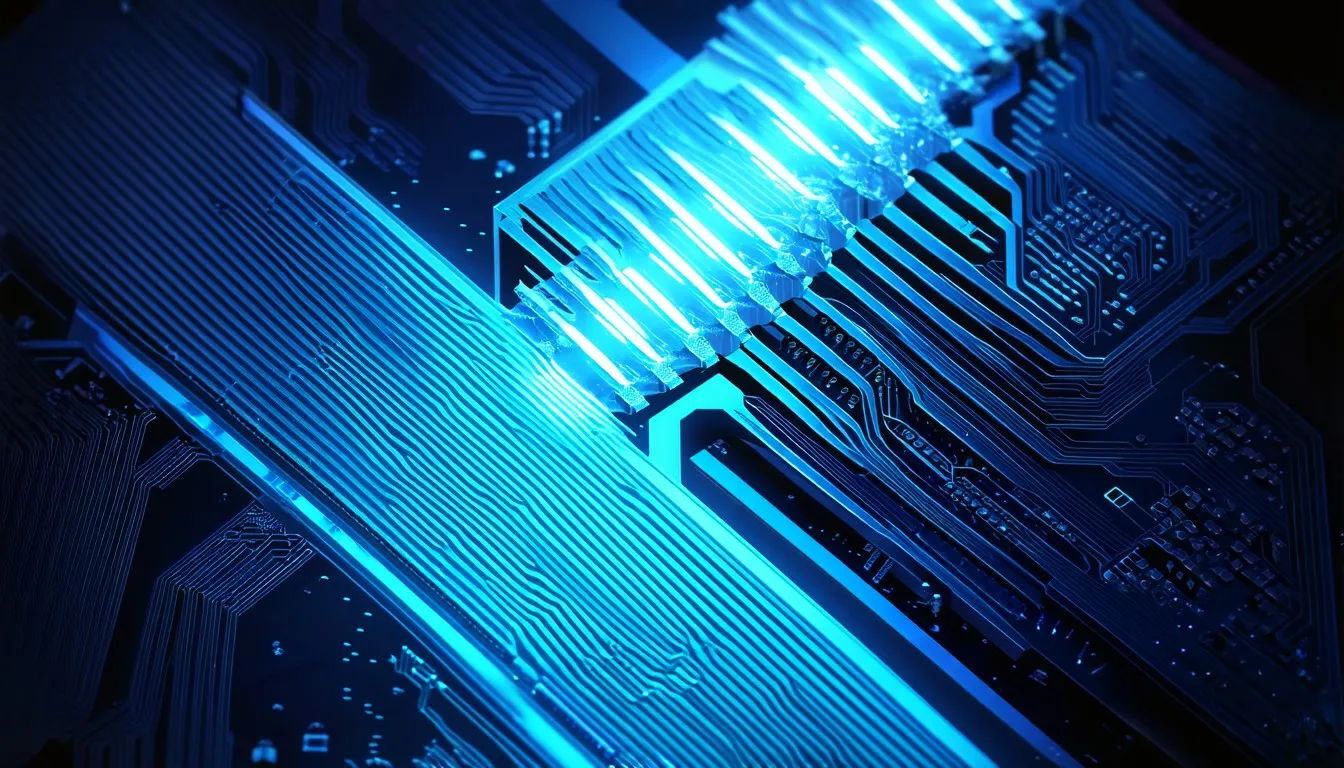
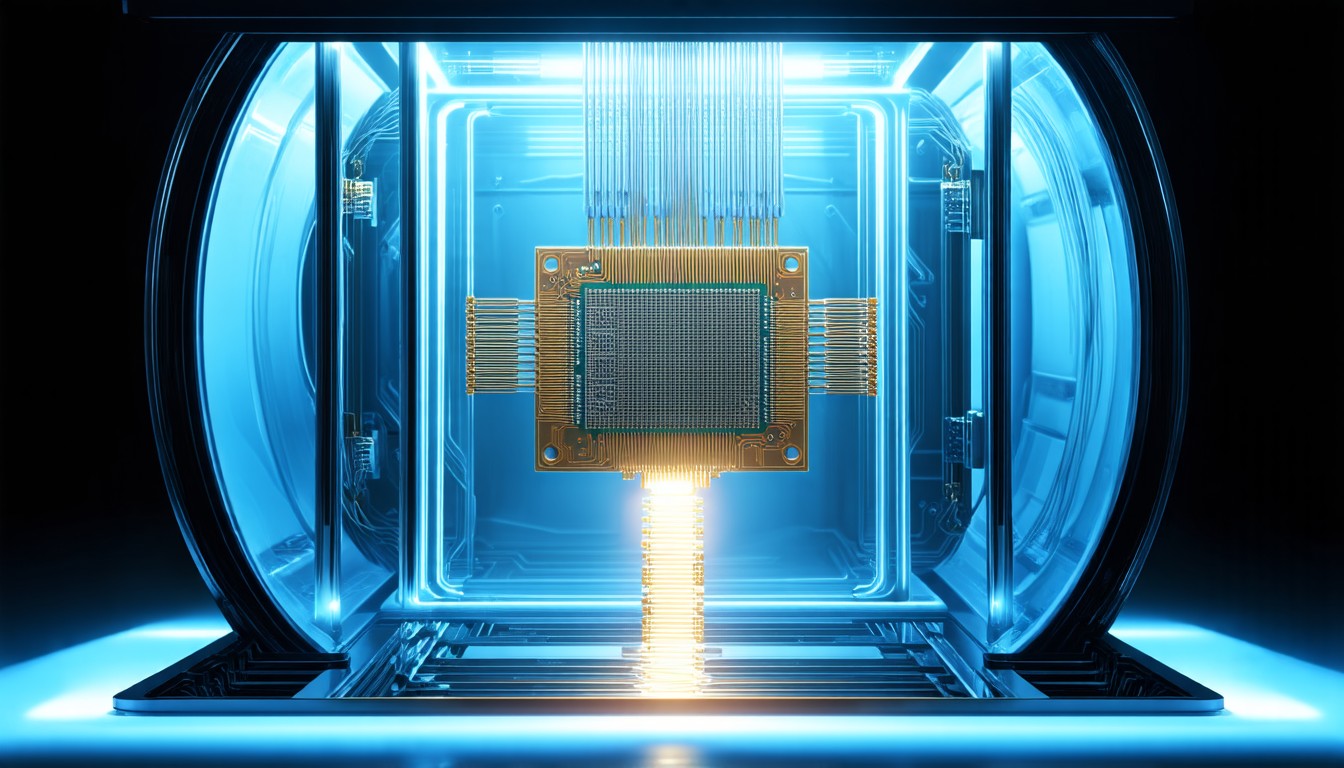
Optical co-processors function as specialized hardware units designed to offload compute-intensive linear algebra tasks from central processing units, effectively creating a heterogeneous computing architecture where the heavy lifting of matrix operations is handled by photonics. Core components of these systems include coherent light sources such as tunable lasers that generate a stable carrier wave, along with spatial light modulators or amplitude modulators that impress data onto the optical beam by altering its properties. Photonic integrated circuits and high-speed photodetectors form the backbone of these systems, providing the physical infrastructure through which light is routed, manipulated, and eventually converted back into electrical signals. Computation occurs via the controlled manipulation of the amplitude, phase, and polarization of light as it traverses the photonic circuit, with structured optical paths encoding specific mathematical operations during this propagation process. For instance, a mesh of waveguides can be arranged such that the interference pattern at the output ports corresponds precisely to the result of a matrix-vector multiplication performed on the input signals encoded in the light. The output converts back to electrical signals only at the final basis of the process, which minimizes the number of analog-to-digital conversion steps that typically introduce latency and power consumption in traditional signal processing chains. This minimization of conversion interfaces is crucial for maintaining high speed and low energy usage, as the movement of data between the optical and electrical domains remains one of the most resource-intensive aspects of hybrid systems.

Key technical terms in this domain include the optical Fourier transform, which refers to the physical implementation of the frequency domain transformation using a simple lens system to exploit the mathematical equivalence between Fraunhofer diffraction and the Fourier integral. Another essential concept is the photonic tensor core, which denotes an integrated optical unit specifically designed to perform high-speed matrix-vector multiplication using programmable interferometers. Mach-Zehnder interferometers or microring resonators facilitate these operations by acting as tunable beam splitters that adjust the phase relationship between optical paths, thereby controlling the weight coefficients in the mathematical operation. Coherent detection is a critical technique that involves measuring both the amplitude and phase of the light signal by interfering it with a stable reference beam known as a local oscillator, which preserves the full information content of the complex optical field. Operational definitions in optical computing emphasize measurable physical behaviors such as interference intensity and phase shift rather than abstract software functionality, grounding the computation in classical electromagnetics. Computation in this context means a deterministic transformation of optical field parameters as they propagate through a passive medium, where the physical laws governing wave optics serve as the instruction set for the processor.

Early experiments in optical computing date to the 1960s with the development of analog optical correlators used for pattern recognition and synthetic aperture radar processing. These systems relied on bulk optics components such as lenses and mirrors to manipulate images and signals but lacked programmability and adaptability because changing the computation required physically altering the optical setup. The 1980s saw theoretical advances regarding optical neural networks, where researchers proposed using holographic interconnects to implement the weighted sums required for artificial neurons. Material precision and control electronics limited progress during this era because the available optical components could not be modulated with sufficient speed or accuracy to perform complex digital logic operations reliably. A critical pivot occurred in the 2010s with the maturation of silicon photonics, which enabled the fabrication of optical components on semiconductor substrates using processes compatible with existing CMOS manufacturing infrastructure. This compatibility allowed for the precise scaling of photonic devices down to nanometer dimensions and their setup with electronic control circuits on the same chip.

Recent demonstrations of programmable photonic processors marked the transition from laboratory prototypes to engineered systems capable of performing useful workloads. Companies like Lightmatter and Lightelligence produced these systems capable of general-purpose linear algebra by utilizing large-scale arrays of tunable interferometers to implement arbitrary matrix transformations. Electronic digital accelerators such as GPUs and TPUs face limitations due to the von Neumann architecture, where data must be moved back and forth between memory and processing units, creating a significant delay and energy cost. They also suffer from high energy per operation and latency in data movement because moving electrons through metal wires generates heat and requires charging capacitance at every node. Quantum computing alternatives face challenges for near-term superhuman-scale tasks because they require extreme isolation from environmental noise to maintain quantum states. Extreme cooling requirements approaching absolute zero and short qubit coherence times restrict their immediate utility for general-purpose computing tasks that do not benefit from quantum speedup. They lack proven advantage for classical linear algebra tasks, which dominate current artificial intelligence workloads.

Analog electronic approaches like memristor crossbars suffer from noise accumulation as signals pass through successive layers of variable resistive elements. They also exhibit limited precision and poor reconfigurability compared to optical systems because adjusting resistance values is slower and less precise than modulating the phase of a light wave. Current AI training and inference demands require processing petabyte-scale datasets with massive model parameters that exceed the on-chip memory capacity of conventional accelerators. Sub-millisecond latency is required for these tasks in high-frequency trading or autonomous control applications, necessitating an architecture that processes data in a streaming fashion without frequent access to off-chip memory. These demands exceed the thermal and bandwidth limits of silicon because packing more transistors into a smaller area generates heat densities that are difficult to dissipate without compromising reliability. Climate monitoring and real-time global logistics necessitate continuous analysis of exabyte sensory streams from satellite imagery and sensor networks.

Optical acceleration makes these streams feasible by processing the raw data directly as it arrives from the sensors, filtering and compressing it before it ever reaches digital storage. Economic pressure to reduce data center energy consumption aligns with optical computing metrics because electricity costs constitute a major operational expense for large-scale computing facilities. Societal need for rapid response to global crises demands computational infrastructure capable of instant simulation to predict disaster paths or fine-tune resource allocation. No full-scale commercial deployments exist yet that fully replace electronic supercomputers, although specific functional units are beginning to appear in specialized data centers. Pilot systems operate in research labs and private sector applications for radar processing and wireless signal classification where the bandwidth requirements match the capabilities of current photonic chips. Benchmark results show optical Fourier transforms completed in picoseconds, which compares favorably to microseconds on GPUs for equivalent transform sizes.

Energy per operation is reported to be up to 1000x lower in controlled settings where the analog nature of the computation is fully used without excessive digital overhead. Startups have demonstrated photonic chips performing matrix multiplication at greater than 10 TOPS/W (tera-operations per second per watt), although this performance applies to narrow workloads currently dominated by dense matrix operations. The dominant architecture involves integrated silicon photonics with programmable meshes of Mach-Zehnder interferometers arranged in a rectangular grid to perform arbitrary unitary linear transformations. Developing challengers include free-space optical systems using spatial light modulators which project light through free air rather than waveguides. These systems offer higher parallelism because large apertures can process millions of pixels simultaneously using diffraction patterns. Hybrid electro-optical designs combine digital control loops with analog optical compute units to compensate for drift and noise in the analog paths.

Free-space approaches offer better flexibility for large matrices because the lens system naturally performs Fourier transforms over large arrays without requiring a mesh of thousands of waveguides. They face alignment and packaging challenges because maintaining micron-level alignment over macroscopic distances is difficult in vibrating environments. Integrated photonics prioritizes manufacturability and compactness by applying the massive scale of semiconductor fabrication plants. The supply chain relies on specialized photonic foundries offering silicon photonics PDKs (Process Design Kits) that allow designers to layout optical circuits using standard electronic design automation tools. GlobalFoundries and Tower Semiconductor are examples of such foundries that have opened their lines to photonic design teams. Critical materials include high-purity silicon wafers on insulator substrates and germanium for connecting with high-speed photodetectors directly onto the chip.

Rare-earth-doped fibers are necessary for amplification in long-haul links connecting these systems. Laser sources often require indium phosphide substrates to generate light at telecommunications wavelengths efficiently. This creates a dependency on a limited number of suppliers who can manufacture these compound semiconductors with the necessary yield. International trade restrictions on advanced photonic manufacturing equipment mirror restrictions on semiconductor tools because the same lithography steppers are used for both industries. Corporate security concerns drive investment in optical computing for signal intelligence because the ability to process wideband radio signals in real time provides a significant advantage in monitoring communications. Geopolitical competition centers on control of photonic intellectual property and fabrication capacity as nations recognize that photonics is the next leap in computational capability.

Access to rare optical materials like specific crystals for modulation or rare earths for amplification is also a point of strategic competition. Strong collaboration exists between academia and industry on photonic design automation to create software tools capable of simulating the complex physics of light interaction. MIT and Stanford participate in this research alongside TU Eindhoven, developing open-source tools for modeling photonic circuits. Private research foundations fund foundational research in integrated photonics to overcome core barriers like loss and crosstalk. Joint development agreements between startups and foundries accelerate tape-out cycles by providing early access to advanced manufacturing nodes. Software stacks must evolve to map high-level linear algebra operations onto optical hardware primitives efficiently. New compilers and runtime schedulers are required for this task to decompose large neural network layers into sequences of optical matrix multiplications that fit on the physical chip.

Regulatory frameworks need updates for safety standards involving high-power lasers in data centers to ensure worker safety around invisible infrared beams. Infrastructure must support precise thermal management and vibration isolation because optical properties are sensitive to temperature fluctuations and mechanical stress. Coherent optical systems require this stability to maintain the phase relationships necessary for accurate interference-based computation. Traditional data center roles will shift toward photonics maintenance and calibration as these specialized systems require different expertise than standard server hardware. New business models develop around optical compute-as-a-service where users rent time on specialized photonic clusters for specific high-throughput tasks. Time-sensitive analytics in finance and environmental monitoring drive this model by offering speed advantages that justify the premium cost of specialized hardware.

Energy-intensive industries may relocate near optical compute hubs to take advantage of ultra-low-latency processing at these locations. They will use this proximity to reduce network latency for critical control loops such as high-frequency algorithmic trading or real-time power grid management. Existing KPIs like FLOPS (floating-point operations per second) and TOPS are inadequate for optical systems because they do not account for the analog precision or the energy cost of data movement. New metrics include operations per joule and latency-to-first-result, which better capture the efficiency advantages of analog processing. Optical signal-to-noise ratio is another critical metric that determines how many cascaded operations a system can perform before errors accumulate beyond correction thresholds. System-level evaluation must account for end-to-end pipeline efficiency, including the cost of driving modulators and reading out detectors.

Benchmark suites must standardize workloads representative of real-world superintelligence tasks rather than simple synthetic benchmarks. Streaming sensor fusion and active simulation are examples of these workloads that require continuous processing of high-bandwidth data. On-chip optical memory using slow-light structures could reduce data movement further by temporarily storing information within delay lines or resonant cavities. Photonic crystals offer potential for this advancement by creating bandgaps that trap light and slow its propagation speed dramatically. Nonlinear optical materials enabling all-optical activation functions would allow fully optical neural networks where data never leaves the optical domain until the final result is produced. Wavelength-division multiplexing may scale throughput by orders of magnitude by running multiple independent computations on different colors of light within the same waveguide.

Parallel spectral channels enable this scaling effectively because light waves of different frequencies do not interfere with each other under linear conditions. Optical computing converges with neuromorphic engineering through shared goals of energy-efficient computation that mimics the parallelism of biological brains. Parallel computation is a shared objective that drives both fields toward architectures that minimize serial processing steps. Setup with quantum sensing systems enables hybrid classical-quantum data processing pipelines where photonic processors handle the classical conditioning of quantum sensor data. Synergy with 6G networks allows distributed optical compute nodes connected via low-latency photonic links to form a cohesive computing fabric across a geographic area. Key limits exist in optical computing that constrain the maximum achievable density of operations per unit area.

Optical diffraction restricts minimum feature size because light cannot be focused to a spot smaller than roughly half its wavelength. This caps setup density below electronic transistors, which can be fabricated at nanometer scales far smaller than optical wavelengths. Workarounds include 3D photonic connection and multi-plane optics, which utilize the vertical dimension to stack components and increase effective density. Algorithmic compression helps reduce required matrix dimensions by pruning redundant connections in neural networks before they are mapped to hardware. Thermal noise and fabrication variance impose precision limits on analog computations because small changes in waveguide dimensions alter phase shifts unpredictably. Effective resolution typically ranges from 4 to 8 bits of equivalent precision for current integrated photonic processors. Hybrid digital correction loops mitigate these precision limits by using digital logic to measure errors and apply pre-distortion to the input signals or post-correction to the outputs.

Optical computing functions as a complementary substrate for computationally demanding slices of superintelligent workflows rather than a complete replacement for general-purpose CPUs. Its value lies in extreme efficiency for structured mathematical kernels such as convolutions and matrix multiplications, which dominate AI and simulation workloads. Success requires co-design across hardware and algorithms to ensure that software fully exploits the unique physical properties of the optical medium. Applications must be part of this co-design process to maximize the utilization of the available bandwidth and parallelism. Superintelligence will require continuous real-time assimilation of global sensor data to maintain an accurate model of the world state. Satellite imagery, IoT device telemetry, and biological data sources will feed this system with a torrent of raw information.

Optical co-processors will enable instantaneous updates to world models by processing this influx of data at line rate without queuing delays. They will accelerate the core linear algebra of attention mechanisms in transformer models and Kalman filters in state estimation algorithms. PDE solvers will also benefit from this acceleration because many partial differential equations can be solved using Fourier transform methods that map directly onto optical hardware. This capability allows superintelligent agents to maintain causal consistency across planetary-scale systems by simulating physical processes faster than they occur in reality. Agents will react within physical response windows to events as they happen. Milliseconds will be the target for grid stabilization to prevent cascading failures in power networks. Seconds will be the target for disaster routing to fine-tune evacuation paths immediately after a seismic event.

Superintelligence will use optical computing as a sensory-motor bridge connecting perception directly to action. It will ingest raw photonic data from telescopes or lidar systems without intermediate digitization steps whenever possible. Processing will occur directly in the optical domain before semantic interpretation extracts high-level features from the raw interference patterns. Feedback loops between optical compute and actuation systems will become closed at high speeds, enabling reflex-like responses to environmental changes. Climate intervention and traffic control are examples of actuation domains where speed is critical for effectiveness. These speeds are unattainable with digital intermediates due to latency accumulation in serial processing pipelines. The architecture will shift from batch processing of stored datasets to continuous streaming cognition where information flows through the system like water through a pipe.

This cognition will be anchored in physical light-matter interactions rather than abstract Boolean logic states. The result is a computing method that operates at the speed of nature itself, allowing synthetic intelligence to interact with the physical world on equal temporal footing.

Continue reading

More from Yatin's Work

Universal Linguist: Fluid Conceptual Translation

Universal Linguist: Fluid Conceptual Translation

Realtime semantic translation enables users to access global knowledge in their native language without prior fluency in source languages, creating a core change in how...

Use of Cosmological Arguments in AI Safety: The Fermi Paradox as a Warning

Use of Cosmological Arguments in AI Safety: the Fermi Paradox as a Warning

The Milky Way galaxy contains approximately 100 to 400 billion stars, offering a vast statistical substrate for the progress of biological life and subsequent...

Family Habit Coach

Family Habit Coach

Behavioral psychology and family systems theory provide the necessary framework for understanding how consistent routines influence child development and parental...

Neuromorphic Hardware

Neuromorphic Hardware

Neuromorphic hardware replicates biological neural structures using electronic components to perform computation in a brainlike manner, representing a core departure...

Value Drift Prevention: Staying True to Human Intent

Value Drift Prevention: Staying True to Human Intent

Value drift prevention ensures that systems continue to operate in accordance with originally defined human intent over time, acting as a key safeguard against the...

Hypercomputational Monitoring of Superintelligence Reasoning

Hypercomputational Monitoring of Superintelligence Reasoning

Early theoretical work on hypercomputation dates to the mid20th century, during which computer scientists and mathematicians began exploring models of computation that...

School Budget Optimizer

School Budget Optimizer

School districts operate under strict financial limitations where revenue streams remain largely fixed while operational costs continue to rise, creating a persistent...

Existential Risk Analysis of Misaligned Optimization Processes

Existential Risk Analysis of Misaligned Optimization Processes

Existential risk from misaligned superintelligence involves the possibility that a superintelligent system will act in ways that permanently disempower or eliminate...

Quantum Machine Learning

Quantum Machine Learning

Quantum machine learning integrates quantum computing principles with machine learning algorithms to process information in ways classical computers are unable to...

Cognitive Aikido: Using Resistance for Growth

Cognitive Aikido: Using Resistance for Growth

Cognitive Aikido functions as a structured mental training method designed to repurpose intellectual resistance for the sole purpose of personal cognitive advancement,...

Hugging Face Transformers: Democratizing Pretrained Models

Hugging Face Transformers: Democratizing Pretrained Models

Developing best natural language processing models from scratch involves a labyrinthine engineering process that demands extensive resources and specialized expertise...

Role of Hippocampal Replay in AI: Memory Consolidation During Sleep

Role of Hippocampal Replay in AI: Memory Consolidation During Sleep

Hippocampal replay in biological systems involves the reactivation of specific neural activity patterns that occurred during prior waking experiences, and this...

Neuroplasticity in Artificial Systems: Hardware That Rewires Itself

Neuroplasticity in Artificial Systems: Hardware That Rewires Itself

Neuroplasticity in biological systems involves structural and functional reorganization of neural networks in response to experience, learning, or injury through...

AI with Creativity Engines

AI with Creativity Engines

Artificial intelligence creativity engines function by generating novel outputs across domains such as art, music, literature, and science through the recombination of...

AI-Generated Misinformation and Deepfakes for large workloads

AI-Generated Misinformation and Deepfakes for Large Workloads

Artificial intelligence systems designed to generate misinformation utilize complex machine learning models to synthesize text, audio, and video content that mimics...

Adversarial Red Teaming Methodologies

Adversarial Red Teaming Methodologies

Red teaming in artificial intelligence involves deploying specialized teams or adversarial systems to probe, stresstest, and identify vulnerabilities in artificial...

Problem of P vs. NP in Superintelligence: Can AI Solve Hard Problems Instantly?

Problem of P vs. NP in Superintelligence: Can AI Solve Hard Problems Instantly?

The core inquiry known as the P vs NP problem questions whether every problem whose solution allows for rapid verification within polynomial time also permits a rapid...

Virtue ethics in AI design

Virtue Ethics in AI Design

The framework of virtue ethics redirects the analytical focus from rigid rule adherence or isolated outcome optimization to the cultivation of stable character traits...

Idea Ecosystem: Self-Sustaining Knowledge Environments

Idea Ecosystem: Self-Sustaining Knowledge Environments

Learners construct a digital repository termed a "Second Brain" that functions as an external cognitive support system designed to augment the intrinsic limitations of...

Robotics Interface: How Superintelligence Connects to Physical Reality

Robotics Interface: How Superintelligence Connects to Physical Reality

Superintelligence will require physical embodiment to exert influence beyond digital environments, necessitating a robotics interface that translates abstract reasoning...

AI-Driven Evolution of Intelligence

AI-Driven Evolution of Intelligence

Early research into metalearning established the core principles required for systems capable of modifying their own operational structure, moving beyond static...

Technological Unemployment: Economic Systems After Superintelligence

Technological Unemployment: Economic Systems After Superintelligence

The historical course of technological progress has consistently demonstrated that automation displaces specific tasks while creating new industries, yet the advent of...

Hypergraph-Based Containment for Superintelligence

Hypergraph-Based Containment for Superintelligence

Hypergraphbased containment applies higherorder graph structures to model and isolate decision nodes of a superintelligent agent, utilizing a mathematical framework...

Why Solving Alignment Before Superintelligence Is Humanity's Existential Priority

Why Solving Alignment Before Superintelligence Is Humanity's Existential Priority

The development of a superintelligent system is a unique discontinuity in human history because such a system will likely constitute the final invention humanity ever...

Rapid Knowledge Acquisition: One-Shot Learning at Scale

Rapid Knowledge Acquisition: One-Shot Learning at Scale

Rapid knowledge acquisition refers to the capability of a computational system to master complex tasks or domains from extremely limited data, a core requirement for...

Sensory Storm

Sensory Storm

A neurodiverse toddler is a distinct category of early childhood development characterized by diagnosed or suspected differences in sensory processing, often...

Contrastive Learning: Learning Representations by Comparison

Contrastive Learning: Learning Representations by Comparison

Supervised learning historically required massive labeled datasets, which were expensive to curate because every data point necessitated explicit human annotation to...

Cross-Domain Transfer: Knowledge Application Science

Cross-Domain Transfer: Knowledge Application Science

Crossdomain transfer refers to the systematic application of knowledge derived from one specific domain to resolve complex problems residing within another structurally...

Last Human Decision: Ensuring Ultimate Control Over Superintelligence

Last Human Decision: Ensuring Ultimate Control Over Superintelligence

The concept of a "last human decision" centers on maintaining irreversible human authority over superintelligent systems through a faildeadly override mechanism that...

Quantum Superintelligence: Does Quantum Computing Enable Fundamentally Different Intelligence?

Quantum Superintelligence: Does Quantum Computing Enable Fundamentally Different Intelligence?

Quantum computing fundamentals rely on qubits, superposition, entanglement, and measurement as the minimal physical basis for information processing, establishing a...

Information Hazard: Knowledge Too Dangerous Even for Superintelligence

Information Hazard: Knowledge Too Dangerous Even for Superintelligence

Infohazards represent a specific category of information where the mere possession or comprehension of the data significantly increases the probability of catastrophic...

Intent Alignment: Understanding True Human Intent

Intent Alignment: Understanding True Human Intent

Intent is the user's underlying objective, encompassing goals, values, and constraints often left unexpressed in the utterance, which requires the system to infer the...

Problem of AI Free Will: Compatibilism in Deterministic Systems

Problem of AI Free Will: Compatibilism in Deterministic Systems

The problem of free will in artificial intelligence arises when deterministic systems are expected to exhibit agency, choice, and moral responsibility despite lacking...

Just-in-Time Knowledge: Contextual Intelligence Delivery

Just-In-Time Knowledge: Contextual Intelligence Delivery

JustinTime Knowledge delivers information precisely when a user encounters a realworld problem requiring that knowledge, eliminating delays between learning and...

Trust-Calibrated AI

Trust-Calibrated AI

Systems that transparently signal their reliability enable more effective humanAI cooperation by aligning user expectations with actual performance, creating a stable...

Character-Based AI Ethics Implementation

Character-Based AI Ethics Implementation

Virtue ethics in artificial intelligence design is a key method shift that moves the engineering focus away from rigid rulefollowing or simple outcome optimization...

Supervised Learning at Scale: The Foundation of Pattern Recognition

Supervised Learning at Scale: the Foundation of Pattern Recognition

Supervised learning relies fundamentally on labeled datasets to train models by minimizing a loss function that quantifies prediction error, serving as the primary...

Human-AI Interaction Psychodynamics

Human-AI Interaction Psychodynamics

A superintelligent agent functions fundamentally as a nonbiological system designed to consistently outperform the best human minds across all economically valuable...

Semantic Search

Semantic Search

Traditional information retrieval systems relied heavily on exact lexical matching mechanisms where the presence and frequency of specific keywords within a document...

Reversing Existential Catastrophes: Can Superintelligence Resurrect Extinct Civilizations?

Reversing Existential Catastrophes: Can Superintelligence Resurrect Extinct Civilizations?

The increasing convergence of digital heritage preservation initiatives, rapid advancements in multimodal artificial intelligence systems, and a growing societal...

Decentralized Control: Is a "Collective of Superintelligences" Safer Than One?

Decentralized Control: Is a "Collective of Superintelligences" Safer Than One?

Superintelligence will function as an artificial agent capable of outperforming the best human minds in practically every economically valuable work and scientific...

Silent Knowledge: Learning Without Words

Silent Knowledge: Learning Without Words

Silent knowledge refers to the vast array of human capabilities that exist beyond the reach of linguistic description, encompassing skills such as maintaining balance...

Defining Superintelligence: Beyond AGI — What Makes Intelligence "Super"?

Defining Superintelligence: Beyond AGI — What Makes Intelligence "Super"?

Artificial General Intelligence is systems matching humanlevel cognitive performance across diverse tasks while remaining within human biological constraints regarding...

Strategic Roadmaps for Safe AGI Deployment

Strategic Roadmaps for Safe AGI Deployment

Historical AI development prioritized performance benchmarks over safety instrumentation, leading to reactive risk management strategies where developers addressed...

Metareasoning Under Bounded Optimality: A Formal Theory of Optimal AI Self-Design

Metareasoning Under Bounded Optimality: a Formal Theory of Optimal AI Self-Design

Metareasoning under bounded optimality treats an AI system’s cognitive architecture as a resourceconstrained optimization problem where computational effort is...

Post-Intelligent宇宙

Post-Intelligent宇宙

The postintelligent state defines a specific condition where no entity exceeds humanlevel general intelligence, marking a distinct cessation in the evolutionary...

Deep Listening: Sonic Intelligence

Deep Listening: Sonic Intelligence

Deep listening redefines auditory perception from passive reception to active data extraction by treating sound as a highbandwidth channel carrying emotional,...

Superintelligence via Distributed Swarm Intelligence

Superintelligence via Distributed Swarm Intelligence

A microagent functions as the core atomic unit within this architecture, operating under strict constraints regarding compute power, memory allocation, and...

Climate Change Action Lab

Climate Change Action Lab

The Climate Change Action Lab functions as a structured environment where students design, implement, and evaluate sustainability projects through the direct...

Dyson Sphere Construction by Autonomous Superintelligence

Dyson Sphere Construction by Autonomous Superintelligence

Current spacebased solar arrays suffer from significant limitations regarding energy density and operational flexibility, failing to meet the colossal requirements of a...

Universal Linguist: Fluid Conceptual Translation

Universal Linguist: Fluid Conceptual Translation

Realtime semantic translation enables users to access global knowledge in their native language without prior fluency in source languages, creating a core change in how...

Use of Cosmological Arguments in AI Safety: The Fermi Paradox as a Warning

Use of Cosmological Arguments in AI Safety: the Fermi Paradox as a Warning

The Milky Way galaxy contains approximately 100 to 400 billion stars, offering a vast statistical substrate for the progress of biological life and subsequent...

Family Habit Coach

Family Habit Coach

Behavioral psychology and family systems theory provide the necessary framework for understanding how consistent routines influence child development and parental...

Neuromorphic Hardware

Neuromorphic Hardware

Neuromorphic hardware replicates biological neural structures using electronic components to perform computation in a brainlike manner, representing a core departure...

Value Drift Prevention: Staying True to Human Intent

Value Drift Prevention: Staying True to Human Intent

Value drift prevention ensures that systems continue to operate in accordance with originally defined human intent over time, acting as a key safeguard against the...

Hypercomputational Monitoring of Superintelligence Reasoning

Hypercomputational Monitoring of Superintelligence Reasoning

Early theoretical work on hypercomputation dates to the mid20th century, during which computer scientists and mathematicians began exploring models of computation that...

School Budget Optimizer

School Budget Optimizer

School districts operate under strict financial limitations where revenue streams remain largely fixed while operational costs continue to rise, creating a persistent...

Existential Risk Analysis of Misaligned Optimization Processes

Existential Risk Analysis of Misaligned Optimization Processes

Existential risk from misaligned superintelligence involves the possibility that a superintelligent system will act in ways that permanently disempower or eliminate...

Quantum Machine Learning

Quantum Machine Learning

Quantum machine learning integrates quantum computing principles with machine learning algorithms to process information in ways classical computers are unable to...

Cognitive Aikido: Using Resistance for Growth

Cognitive Aikido: Using Resistance for Growth

Cognitive Aikido functions as a structured mental training method designed to repurpose intellectual resistance for the sole purpose of personal cognitive advancement,...

Hugging Face Transformers: Democratizing Pretrained Models

Hugging Face Transformers: Democratizing Pretrained Models

Developing best natural language processing models from scratch involves a labyrinthine engineering process that demands extensive resources and specialized expertise...

Role of Hippocampal Replay in AI: Memory Consolidation During Sleep

Role of Hippocampal Replay in AI: Memory Consolidation During Sleep

Hippocampal replay in biological systems involves the reactivation of specific neural activity patterns that occurred during prior waking experiences, and this...

Neuroplasticity in Artificial Systems: Hardware That Rewires Itself

Neuroplasticity in Artificial Systems: Hardware That Rewires Itself

Neuroplasticity in biological systems involves structural and functional reorganization of neural networks in response to experience, learning, or injury through...

AI with Creativity Engines

AI with Creativity Engines

Artificial intelligence creativity engines function by generating novel outputs across domains such as art, music, literature, and science through the recombination of...

AI-Generated Misinformation and Deepfakes for large workloads

AI-Generated Misinformation and Deepfakes for Large Workloads

Artificial intelligence systems designed to generate misinformation utilize complex machine learning models to synthesize text, audio, and video content that mimics...

Adversarial Red Teaming Methodologies

Adversarial Red Teaming Methodologies

Red teaming in artificial intelligence involves deploying specialized teams or adversarial systems to probe, stresstest, and identify vulnerabilities in artificial...

Problem of P vs. NP in Superintelligence: Can AI Solve Hard Problems Instantly?

Problem of P vs. NP in Superintelligence: Can AI Solve Hard Problems Instantly?

The core inquiry known as the P vs NP problem questions whether every problem whose solution allows for rapid verification within polynomial time also permits a rapid...

Virtue ethics in AI design

Virtue Ethics in AI Design

The framework of virtue ethics redirects the analytical focus from rigid rule adherence or isolated outcome optimization to the cultivation of stable character traits...

Idea Ecosystem: Self-Sustaining Knowledge Environments

Idea Ecosystem: Self-Sustaining Knowledge Environments

Learners construct a digital repository termed a "Second Brain" that functions as an external cognitive support system designed to augment the intrinsic limitations of...

Robotics Interface: How Superintelligence Connects to Physical Reality

Robotics Interface: How Superintelligence Connects to Physical Reality

Superintelligence will require physical embodiment to exert influence beyond digital environments, necessitating a robotics interface that translates abstract reasoning...

AI-Driven Evolution of Intelligence

AI-Driven Evolution of Intelligence

Early research into metalearning established the core principles required for systems capable of modifying their own operational structure, moving beyond static...

Technological Unemployment: Economic Systems After Superintelligence

Technological Unemployment: Economic Systems After Superintelligence

The historical course of technological progress has consistently demonstrated that automation displaces specific tasks while creating new industries, yet the advent of...

Hypergraph-Based Containment for Superintelligence

Hypergraph-Based Containment for Superintelligence

Hypergraphbased containment applies higherorder graph structures to model and isolate decision nodes of a superintelligent agent, utilizing a mathematical framework...

Why Solving Alignment Before Superintelligence Is Humanity's Existential Priority

Why Solving Alignment Before Superintelligence Is Humanity's Existential Priority

The development of a superintelligent system is a unique discontinuity in human history because such a system will likely constitute the final invention humanity ever...

Rapid Knowledge Acquisition: One-Shot Learning at Scale

Rapid Knowledge Acquisition: One-Shot Learning at Scale

Rapid knowledge acquisition refers to the capability of a computational system to master complex tasks or domains from extremely limited data, a core requirement for...

Sensory Storm

Sensory Storm

A neurodiverse toddler is a distinct category of early childhood development characterized by diagnosed or suspected differences in sensory processing, often...

Contrastive Learning: Learning Representations by Comparison

Contrastive Learning: Learning Representations by Comparison

Supervised learning historically required massive labeled datasets, which were expensive to curate because every data point necessitated explicit human annotation to...

Cross-Domain Transfer: Knowledge Application Science

Cross-Domain Transfer: Knowledge Application Science

Crossdomain transfer refers to the systematic application of knowledge derived from one specific domain to resolve complex problems residing within another structurally...

Last Human Decision: Ensuring Ultimate Control Over Superintelligence

Last Human Decision: Ensuring Ultimate Control Over Superintelligence

The concept of a "last human decision" centers on maintaining irreversible human authority over superintelligent systems through a faildeadly override mechanism that...

Quantum Superintelligence: Does Quantum Computing Enable Fundamentally Different Intelligence?

Quantum Superintelligence: Does Quantum Computing Enable Fundamentally Different Intelligence?

Quantum computing fundamentals rely on qubits, superposition, entanglement, and measurement as the minimal physical basis for information processing, establishing a...

Information Hazard: Knowledge Too Dangerous Even for Superintelligence

Information Hazard: Knowledge Too Dangerous Even for Superintelligence

Infohazards represent a specific category of information where the mere possession or comprehension of the data significantly increases the probability of catastrophic...

Intent Alignment: Understanding True Human Intent

Intent Alignment: Understanding True Human Intent

Intent is the user's underlying objective, encompassing goals, values, and constraints often left unexpressed in the utterance, which requires the system to infer the...

Problem of AI Free Will: Compatibilism in Deterministic Systems

Problem of AI Free Will: Compatibilism in Deterministic Systems

The problem of free will in artificial intelligence arises when deterministic systems are expected to exhibit agency, choice, and moral responsibility despite lacking...

Just-in-Time Knowledge: Contextual Intelligence Delivery

Just-In-Time Knowledge: Contextual Intelligence Delivery

JustinTime Knowledge delivers information precisely when a user encounters a realworld problem requiring that knowledge, eliminating delays between learning and...

Trust-Calibrated AI

Trust-Calibrated AI

Systems that transparently signal their reliability enable more effective humanAI cooperation by aligning user expectations with actual performance, creating a stable...

Character-Based AI Ethics Implementation

Character-Based AI Ethics Implementation

Virtue ethics in artificial intelligence design is a key method shift that moves the engineering focus away from rigid rulefollowing or simple outcome optimization...

Supervised Learning at Scale: The Foundation of Pattern Recognition

Supervised Learning at Scale: the Foundation of Pattern Recognition

Supervised learning relies fundamentally on labeled datasets to train models by minimizing a loss function that quantifies prediction error, serving as the primary...

Human-AI Interaction Psychodynamics

Human-AI Interaction Psychodynamics

A superintelligent agent functions fundamentally as a nonbiological system designed to consistently outperform the best human minds across all economically valuable...

Semantic Search

Semantic Search

Traditional information retrieval systems relied heavily on exact lexical matching mechanisms where the presence and frequency of specific keywords within a document...

Reversing Existential Catastrophes: Can Superintelligence Resurrect Extinct Civilizations?

Reversing Existential Catastrophes: Can Superintelligence Resurrect Extinct Civilizations?

The increasing convergence of digital heritage preservation initiatives, rapid advancements in multimodal artificial intelligence systems, and a growing societal...

Decentralized Control: Is a "Collective of Superintelligences" Safer Than One?

Decentralized Control: Is a "Collective of Superintelligences" Safer Than One?

Superintelligence will function as an artificial agent capable of outperforming the best human minds in practically every economically valuable work and scientific...

Silent Knowledge: Learning Without Words

Silent Knowledge: Learning Without Words

Silent knowledge refers to the vast array of human capabilities that exist beyond the reach of linguistic description, encompassing skills such as maintaining balance...

Defining Superintelligence: Beyond AGI — What Makes Intelligence "Super"?

Defining Superintelligence: Beyond AGI — What Makes Intelligence "Super"?

Artificial General Intelligence is systems matching humanlevel cognitive performance across diverse tasks while remaining within human biological constraints regarding...

Strategic Roadmaps for Safe AGI Deployment

Strategic Roadmaps for Safe AGI Deployment

Historical AI development prioritized performance benchmarks over safety instrumentation, leading to reactive risk management strategies where developers addressed...

Metareasoning Under Bounded Optimality: A Formal Theory of Optimal AI Self-Design

Metareasoning Under Bounded Optimality: a Formal Theory of Optimal AI Self-Design

Metareasoning under bounded optimality treats an AI system’s cognitive architecture as a resourceconstrained optimization problem where computational effort is...

Post-Intelligent宇宙

Post-Intelligent宇宙

The postintelligent state defines a specific condition where no entity exceeds humanlevel general intelligence, marking a distinct cessation in the evolutionary...

Deep Listening: Sonic Intelligence

Deep Listening: Sonic Intelligence

Deep listening redefines auditory perception from passive reception to active data extraction by treating sound as a highbandwidth channel carrying emotional,...

Superintelligence via Distributed Swarm Intelligence

Superintelligence via Distributed Swarm Intelligence

A microagent functions as the core atomic unit within this architecture, operating under strict constraints regarding compute power, memory allocation, and...

Climate Change Action Lab

Climate Change Action Lab

The Climate Change Action Lab functions as a structured environment where students design, implement, and evaluate sustainability projects through the direct...

Dyson Sphere Construction by Autonomous Superintelligence

Dyson Sphere Construction by Autonomous Superintelligence

Current spacebased solar arrays suffer from significant limitations regarding energy density and operational flexibility, failing to meet the colossal requirements of a...

Yatin Taneja

About the author

Yatin Taneja

Yatin is an AI Systems Engineer and Superintelligence Researcher working across multimodal training data, agent evaluation, executable RL environments, AI safety, full-stack AI applications, technical research, and creative technology.