Knowledge hub
Photonic Computing: Light-Speed Neural Computation

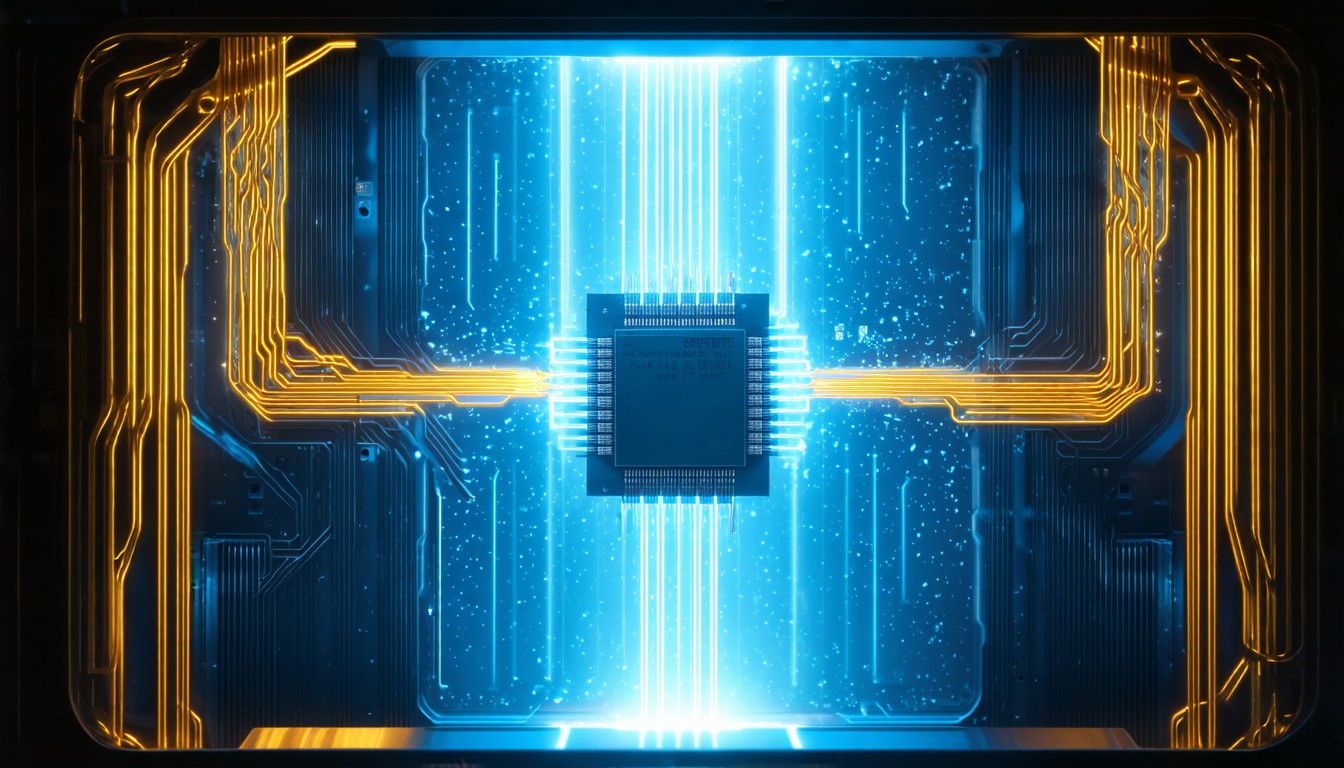
Photonic computing utilizes photons instead of electrons for data processing to achieve high bandwidth and low latency by using the core physical properties of light to transmit and manipulate information. Traditional electronic processors rely on the movement of charge carriers through conductive materials, a process that inherently generates resistive heat and faces significant signal attenuation at high frequencies due to the skin effect and capacitive coupling between interconnects. The transition to photonic systems allows data to travel at the speed of light within the medium, drastically reducing the time required for signal propagation across the chip while simultaneously minimizing the energy dissipation associated with charging and discharging metallic wires. This technology addresses the interconnect limitations and power dissipation natural in electronic processors by removing the physical resistance that electrons encounter, thereby enabling a massive increase in data throughput without a corresponding linear increase in energy consumption. As the demand for computational power continues to grow exponentially, the limitations of metallic interconnects become more pronounced, making the adoption of optical pathways a necessary step for sustaining performance scaling in advanced computing architectures. Matrix multiplication serves as the primary workload for neural networks and executes passively through optical interference within a photonic circuit, representing a transformation from active transistor-based calculation to passive physical phenomena.

In deep learning models, the vast majority of computational operations involve multiplying input vectors by weight matrices and summing the results, a process that consumes immense power and time in digital logic gates. Optical neural networks propagate coherent light through engineered waveguides to compute these weighted sums instantaneously as the light waves interact, utilizing the principle of superposition where the amplitude of the resulting wave corresponds to the sum of the input amplitudes modified by their respective weights. This natural alignment between linear algebra operations and wave physics allows photonic processors to perform complex mathematical transformations at the speed of light with zero static power dissipation for the computation itself, limited only by the energy required to generate the initial light signal and detect the output. Silicon photonics facilitates the connection of optical components onto semiconductor substrates using standard fabrication infrastructure, which allows for the economical mass production of photonic integrated circuits alongside traditional electronic components. By using the mature manufacturing processes developed for the CMOS industry, engineers can create nanoscale waveguides, modulators, and detectors on silicon wafers with high precision and yield. This connection capability enables the co-location of photonic and electronic elements on a single chip, creating hybrid systems where optical signals handle data transport and linear algebra while electronic transistors manage control logic, memory access, and nonlinear operations.
The ability to fabricate these devices in existing foundries removes a significant barrier to entry for photonic computing technologies, allowing rapid iteration and scaling of device designs without the need for entirely new industrial ecosystems. Mach-Zehnder interferometers function as tunable beam splitters that implement dot products by modulating phase and amplitude, forming the basic building blocks of programmable photonic processors. These devices consist of two waveguides that split an input light signal, guide it through separate paths where a phase shift is induced via thermo-optic or electro-optic effects, and then recombine the signals to cause constructive or destructive interference. By precisely controlling the phase difference between the two arms, the interferometer can direct a specific proportion of light power to either output port, effectively performing a multiplication operation where the phase shifter setting is the weight and the input light intensity is the input value. Arrays of these interferometers arranged in mesh configurations can execute arbitrary matrix multiplications, allowing the hardware to be reprogrammed for different neural network tasks by adjusting the voltage or current applied to the phase shifters. Optical resonators act as weighting elements by selectively coupling light at specific wavelengths to reconfigure synaptic weights, offering an alternative method to implement tunable coefficients in an optical neural network.
These microscopic structures, often realized as ring resonators, confine light in a circular path and appeal at specific frequencies determined by their circumference and refractive index. When the wavelength of the input light matches the resonance condition of the ring, light couples into the resonator and drops out of the main waveguide, effectively attenuating the signal with high specificity. By tuning the resonance frequency through thermal or carrier injection methods, the device can dynamically adjust which wavelengths are affected and to what degree, enabling wavelength-division multiplexing schemes where multiple distinct calculations occur simultaneously within the same physical structure. Light-based computation eliminates resistive losses and capacitive charging delays found in metal interconnects, addressing the primary energy and latency constraints in modern microprocessors. In electronic systems, moving data across a chip requires driving a voltage down a wire, which dissipates energy as heat due to electrical resistance and consumes time to charge the wire’s capacitance. Photonic signals traveling through dielectric waveguides do not suffer from resistive heating to the same degree and experience minimal capacitive loading, allowing data to move across the chip with significantly lower latency and energy cost per bit.
This reduction in communication overhead is critical for workloads like neural network inference, where the movement of weights and activations between memory and processing units often consumes more energy than the actual arithmetic operations. Wavelength-division multiplexing permits multiple data channels to occupy a single waveguide, increasing throughput without extra physical paths by utilizing different colors of light to carry independent signals simultaneously. Just as fiber-optic networks vastly increased bandwidth by multiplexing data streams across various wavelengths, integrated photonic circuits can apply this principle on-chip to perform parallel computations within a single waveguide or interferometer. Each wavelength channel can represent a separate input feature or a distinct neural network layer, allowing the processor to handle multiple streams of information concurrently without increasing the physical footprint of the circuit. This multiplicative increase in data density is unique to optical systems and provides a pathway to overcome the bandwidth limitations intrinsic in electronic interconnects. Implementing nonlinear activation functions remains difficult, so current systems often rely on external electronic components for thresholding, creating a hybrid architecture where linear operations occur optically and nonlinear operations occur electronically.
While linear algebra maps naturally onto optical interference phenomena, neural networks require nonlinear activation functions like ReLU or sigmoid to introduce complexity and enable universal approximation capabilities. Purely optical nonlinearities typically require high power intensities to induce effects such as Kerr nonlinearity or two-photon absorption, which are inefficient and difficult to integrate for large workloads. Consequently, practical photonic neural networks convert the optical signal back to an electronic domain after the linear matrix multiplication basis, apply the activation function digitally or with analog electronics, and then convert the result back to light for subsequent layers, introducing potential latency penalties from the electro-optical conversion. Co-designing photonic hardware and neural algorithms is essential to exploit parallelism and avoid serialization overheads, requiring a core upgradation of how software models map onto physical optical substrates. Traditional neural network training assumes digital arithmetic operations with high precision, whereas photonic processors operate in an analog domain with built-in noise and limited precision ranges due to manufacturing variations and signal loss. Developers must design algorithms that are strong to these analog imperfections while structuring network graphs to maximize the utilization of the parallel matrix multiplication capabilities offered by the photonic mesh.
This involves fine-tuning the layer sizes and connectivity patterns to match the physical topology of the chip, ensuring that data flows efficiently through the optical paths without requiring frequent stalling for electronic intervention or data movement. Training optical neural networks usually occurs in silico using digital models, with weights transferred to the physical device after the training process converges on a suitable configuration. Because implementing backpropagation directly on an analog photonic chip presents significant challenges due to the difficulty of measuring gradients within the optical domain, the standard approach involves training a precise digital twin of the network on high-performance GPUs. Once the digital model achieves the desired accuracy, the learned weight matrices are translated into control signals for the phase shifters and attenuators on the photonic chip. This process, known as weight transfer or programming, requires precise calibration to ensure that the physical optical response matches the digital model, accounting for variations in component behavior across individual devices. Phase stability, thermal drift, and fabrication tolerances introduce noise that degrades computational fidelity, posing significant engineering challenges for maintaining accuracy in analog optical processors.
The wavelength of light is extremely sensitive to changes in temperature and stress, meaning that minor fluctuations in the operating environment can alter the phase relationships within interferometers, leading to errors in the computed matrix multiplication. Fabrication imperfections cause deviations in waveguide dimensions and coupling coefficients, resulting in non-ideal behavior that varies from chip to chip. These sources of variability introduce analog noise into the computation, limiting the precision with which weights can be represented and potentially reducing the overall accuracy of the neural network inference performed on the hardware. Feedback loops and calibration routines are necessary to maintain accuracy in deployed photonic systems, employing monitoring photodetectors and control algorithms to continuously adjust device parameters in real time. To counteract the effects of thermal drift and aging, integrated photonic processors often include dedicated tap couplers that divert a small fraction of light to sensors, allowing the system to measure the actual output intensities and compare them against expected values. Control algorithms then adjust the voltage or current driving the thermo-optic or electro-optic phase shifters to correct any detected errors, locking the device to its desired operating point.
These active stabilization mechanisms add some complexity and power overhead to the system, yet remain essential for ensuring reliable operation in environments where temperature stability cannot be guaranteed. Theoretical work began in the 1980s, yet practical progress accelerated with nanophotonics and CMOS-compatible fabrication in the 2010s, transforming optical computing from a niche academic pursuit into a viable commercial technology. Early researchers proposed using optics for neural networks in the late twentieth century, but the lack of advanced fabrication techniques limited these experiments to bulky table-top setups with free-space optics and discrete components. The advent of deep sub-micron semiconductor manufacturing allowed engineers to shrink optical components to the scale of wavelengths, enabling dense setup of waveguides and resonators on silicon chips. This period saw rapid advancements in silicon photonics technology, driven largely by the demand for optical data center interconnects, which provided the necessary manufacturing base and component library to revisit optical computing with modern capabilities. Programmable photonic processors have demonstrated inference tasks at rates exceeding 100 trillion operations per second with energy efficiency below 1 picojoule per operation, showcasing the immense performance potential of this technology.
These experimental devices utilize large arrays of Mach-Zehnder interferometers to perform matrix-vector multiplications in a single pass of light through the chip, achieving computational densities that far surpass those of modern digital GPUs. The energy efficiency stems from the passive nature of the computation, where the primary energy cost comes from laser sources and driver electronics rather than from switching transistors. Such performance metrics indicate that photonic accelerators could perform inference tasks for large language models or computer vision systems orders of magnitude faster and more efficiently than electronic hardware. Commercial prototypes exist for specialized applications like lidar signal processing, high-frequency trading, and optical data center interconnects, targeting markets where latency and bandwidth are primary constraints. Companies have deployed photonic chips in autonomous vehicle sensors to process point cloud data instantly upon reception, reducing the time required to detect obstacles. In financial markets, firms utilize optical processors to execute complex risk calculations and arbitrage strategies at speeds limited only by the propagation delay of fiber optic cables, providing a distinct advantage over competitors relying on electronic infrastructure.
Similarly, data center operators employ photonic interconnects to alleviate bandwidth congestion between servers, moving massive volumes of data with lower thermal overhead than traditional copper or electrical optical transceivers. No general-purpose photonic CPU has reached the market, so deployments focus on accelerators for linear algebra, treating photonic processors as specialized co-processors attached to a host CPU or GPU. The difficulty of implementing digital logic, memory storage, and conditional branching operations with light means that photonic chips currently excel specifically at the dense matrix operations that dominate deep learning workloads rather than general-purpose sequential processing. System architects integrate these accelerators into existing servers via standard interfaces such as PCIe or CXL, offloading specific mathematical kernels to the photonic domain while retaining control flow and memory management in the electronic domain. This division of labor applies the strengths of both technologies, using electronics for flexibility and photons for raw computational throughput. Dominant architectures employ feedforward mesh networks of Mach-Zehnder interferometers arranged in triangular or rectangular topologies, implementing universal unitary matrices capable of performing any linear transformation on the input vector.
These meshes are based on mathematical decompositions such as the Clements or Reck decompositions, which prove that any unitary matrix can be factored into a sequence of two-beam interference operations arranged in a specific grid pattern. By programming each interferometer in the mesh to represent a specific complex value, the entire network can synthesize a target weight matrix used in a neural network layer. This approach provides a highly flexible and programmable substrate for linear algebra, allowing the same hardware to be reconfigured on the fly to support different models or layers within a model. Diffractive optical neural networks represent an alternative approach that performs computation via free-space propagation and metasurface-based weighting, utilizing 3D printed optics or lithographically structured surfaces to manipulate light without waveguides. In these systems, light passes through a series of specially designed layers that modulate its phase or amplitude at each point, analogous to the weights in a neural network, with the diffraction pattern acting as the summation operation. This method eliminates the need for complex on-chip routing and waveguide fabrication, potentially allowing for very high-density connection of neurons in three dimensions.
While conceptually elegant and capable of operating at the speed of light with zero power consumption for passive elements, these systems face challenges regarding reconfigurability, as changing the weights typically requires physically altering the diffractive elements or using complex spatial light modulators. Free-space systems encounter alignment and packaging challenges that limit flexibility compared to integrated photonic circuits, making them difficult to deploy in commercial environments requiring strength and miniaturization. Maintaining precise alignment between multiple optical layers over varying temperatures and mechanical vibrations is a difficult engineering task that often necessitates bulky packaging solutions unsuitable for mass deployment. Integrated photonics confines light within rigid waveguides etched into a solid substrate, offering intrinsic stability and protection against environmental disturbances while enabling the use of automated pick-and-place assembly techniques standard in the semiconductor industry. Consequently, while free-space optics offer valuable research insights and potential for high-throughput static processing, integrated photonics remains the preferred path for scalable, reconfigurable computing hardware. Silicon nitride and indium phosphide serve as common waveguide materials, each offering distinct trade-offs regarding loss and nonlinearity that dictate their suitability for different applications within a photonic processor.
Silicon nitride exhibits very low propagation loss across a wide range of wavelengths, including the visible spectrum, making it ideal for passive routing structures and resonators that require high quality factors. Indium phosphide, while having higher propagation loss compared to silicon nitride, possesses strong electro-optic properties and enables the monolithic connection of active components such as lasers and semiconductor optical amplifiers directly on the chip. Material selection depends heavily on the specific requirements of the application, balancing factors like power consumption, connection density, and the need for active light generation versus passive signal manipulation. Germanium photodetectors and lithium niobate modulators are critical components with supply chains concentrated in specific regions, influencing the global manufacturing domain for photonic computing technologies. Germanium detectors are essential for converting optical signals back into electrical currents at high speeds, typically grown epitaxially on silicon wafers in specialized fabrication facilities capable of handling heterogeneous material setup. Lithium niobate modulators offer superior linearity and speed compared to silicon-based modulators, enabling higher bandwidth data transmission with lower drive voltages, yet their fabrication involves complex thin-film processes dominated by a limited number of suppliers.
The availability of these high-performance components directly impacts the adaptability and cost of photonic processors, necessitating strategic partnerships between chip designers and specialized material foundries. Major players include Lightmatter, Lightelligence, and Ayar Labs in the U.S.; Huawei and Alibaba have active research divisions in China, reflecting a global race to dominate this appearing computational method. These companies pursue different strategies, with some focusing on general-purpose photonic accelerators for AI workloads while others target specific constraints like inter-chip communication or specialized signal processing. The intense competition drives rapid innovation in device design, software stacks, and packaging solutions as each entity seeks to secure intellectual property and market share in what is perceived as a foundational technology for future computing infrastructure. This international interest ensures substantial investment flows into the sector, accelerating the transition from laboratory prototypes to commercially viable products. Software stacks must evolve to map neural network graphs onto photonic hardware topologies, requiring new compilers that understand the physical constraints and capabilities of optical computing.
Unlike digital compilers that improve for logic gate utilization and register allocation, photonic compilers must fine-tune for minimizing optical insertion loss, managing wavelength resource allocation, and compensating for analog noise sources. These tools need to perform tasks such as splitting large matrices across multiple chips if they exceed the mesh size of a single processor and automatically inserting calibration routines to maintain accuracy during inference. Developing this software ecosystem is as critical as advancing the hardware itself, as ease of programming determines whether developers can effectively use the performance benefits of photonic computing without needing deep expertise in photonics. Data center operators will need to redesign cooling and power delivery systems to accommodate hybrid electronic-photonic racks, addressing the unique thermal profile of these new architectures. While photonic processors generate less heat from computation itself than electronic CPUs, they require continuous power for laser sources and thermal management systems to maintain phase stability across the chip. The presence of high-power optical transceivers and analog driver electronics creates localized hot spots that traditional airflow cooling designs may not handle efficiently.
Power delivery systems must provide highly stable currents and voltages to sensitive analog control circuits to prevent noise from corrupting the optical computations, necessitating more durable power regulation units than those found in standard server racks. Job displacement in traditional chip design roles may occur as photonic layout and calibration become specialized skills, shifting the demand within the semiconductor workforce towards expertise in optics and analog engineering. Digital Very Large Scale Integration design relies heavily on automated place-and-route tools fine-tuned for transistor logic gates, whereas photonic design requires manual tuning of optical components and simulation of electromagnetic wave propagation. As industry adoption grows, the need for traditional logic designers may plateau relative to the demand for engineers capable of designing ring resonators, waveguide crossings, and grating couplers. This shift necessitates changes in educational curricula and professional training programs to equip the workforce with the skills required to design and manufacture systems that bridge the gap between photonics and electronics. New business models could develop around photonic-as-a-service for AI inference or optical co-processors leased by cloud providers, abstracting the complexity of the hardware from end users.
Cloud providers might offer instances equipped with photonic accelerators specifically fine-tuned for particular tasks like image recognition or natural language processing, charging based on usage time or energy consumption rather than virtual CPU cycles. This model allows enterprises to access the benefits of photonic computing without investing in specialized hardware infrastructure, while providers manage the complex calibration and maintenance requirements of the optical systems. Such service-oriented approaches would likely accelerate market penetration by lowering the barrier to entry for experimenting with this novel technology. Performance metrics must shift from FLOPS and TOPS to include energy per matrix multiply and latency per layer, providing a more accurate representation of photonic processor efficiency. Traditional floating-point operations per second metrics fail to capture the analog nature of photonic computation where operations occur continuously and in parallel without discrete clock cycles. Evaluating these systems requires measuring end-to-end latency for specific neural network layers and total energy consumption from wall plug to detector output to determine the true advantage over electronic GPUs.
Establishing standardized benchmarks that account for factors like precision loss due to analog noise and reconfiguration time between different models will be essential for fair comparison and informed decision-making by system architects. Future innovations will integrate on-chip lasers, all-optical nonlinearities, and in-memory photonic computing to reduce data movement and further enhance system setup capabilities. Eliminating external laser sources by working with light generation directly onto the silicon chip reduces packaging complexity and coupling losses associated with bringing light onto the die from off-chip sources. Developing practical all-optical activation functions using micro-ring resonators or phase change materials would remove the need for electro-optical conversions, enabling fully optical neural networks that operate at maximum speed. Storing weights directly in non-volatile optical memory elements would allow instantaneous programming of matrices without loading them from external memory, drastically reducing startup latency and energy usage. Convergence with quantum photonics is probable since both rely on coherent light manipulation and share many of the same fabrication technologies and component primitives.
The development of low-loss waveguides, high-efficiency single-photon detectors, and stable interferometers for quantum computing directly benefits classical photonic computing by improving component quality and reducing noise. As quantum photonic processors scale up, they will likely incorporate classical photonic control circuits for error correction and signal processing on the same chip, creating hybrid quantum-classical systems. This technological overlap suggests that advancements in one field will spur progress in the other, leading to a shared ecosystem of design tools and manufacturing processes. Diffraction, waveguide crosstalk, and photon loss limit scaling, necessitating error correction and redundancy schemes to maintain computational fidelity in large-scale systems. As photonic meshes expand to handle larger matrices, the cumulative propagation loss increases exponentially with path length, eventually attenuating the signal below the noise floor of the detectors. Unintended coupling between adjacent waveguides introduces crosstalk errors that corrupt the data as it propagates through the dense circuitry.
Engineers must incorporate error-correcting codes or redundant parallel processing paths to mitigate these physical limitations, adding overhead to the design yet remaining essential for building reliable systems capable of handling complex workloads. Photonic computing functions as a complementary accelerator for linear operations where speed and efficiency dominate, working alongside electronic processors to create heterogeneous computing systems fine-tuned for specific mathematical profiles. While electronic logic remains superior for tasks requiring high precision, complex branching, and low-volume data processing, photonic accelerators excel at the heavy lifting of dense linear algebra that underpins modern artificial intelligence. This mutually beneficial relationship allows system architects to assign each task to the hardware best suited for its execution characteristics, maximizing overall system performance and energy efficiency rather than attempting to replace electronics entirely with optics. Superintelligent systems will utilize photonic substrates to process massive sensory or linguistic embeddings with minimal energy, enabling cognitive capabilities far beyond human levels without unsustainable power demands. Processing high-dimensional data streams from millions of sensors in real time requires computational throughput that exceeds the thermal limits of pure silicon architectures.
Photonic interconnects and processors provide the necessary bandwidth and efficiency to ingest and transform this deluge of information into coherent internal representations. By offloading the massive vector matrix multiplications required for embedding generation and attention mechanisms onto optical domains, these systems can maintain high operational speeds while keeping energy consumption within feasible limits. Superintelligent agents will employ photonic substrates to simulate vast neural ensembles in parallel, bypassing von Neumann limitations that constrain traditional electronic architectures. Simulating a brain-scale network of neurons requires moving synaptic weights between memory and processing units at rates that electronic buses cannot sustain without prohibitive energy costs. Photonic computing allows weights to be encoded directly into the physical properties of the transmission medium or accessed via resonant structures at light speed, effectively collapsing the distance between memory and computation. This capability enables agents to run simulations of their own internal models or external environments at speeds necessary for real-time interaction with the physical world.

Adaptive photonic networks will allow energetic reconfiguration of computational topology in response to task demands, providing hardware-level flexibility that matches the plasticity of biological intelligence. By utilizing phase change materials or micro-electromechanical systems to physically alter the connectivity of the optical mesh, these systems can restructure themselves to optimally solve different classes of problems without requiring firmware updates or recompilation. This adaptive adaptability ensures that the hardware always operates at peak efficiency regardless of the specific workload presented to it. Such fluidity is a significant step towards truly intelligent machines that can improve their own physical architecture in real time. Hybrid architectures combining photonic linear algebra units with electronic control and memory will define the next generation of AI hardware, merging the raw speed of optics with the programmability of digital logic. These systems will likely feature multiple photonic tiles interconnected by a high-speed electronic network fabric managed by a central controller that schedules tasks and handles data movement between tiles and off-chip memory.
The electronic layer will manage high-level decision making and nonlinear activations while delegating repetitive linear algebra tasks to the photonic engines. This division of labor uses the unique strengths of each technology to overcome their respective weaknesses, creating a powerful platform capable of supporting the immense computational requirements of future artificial general intelligence systems.