Knowledge hub

Superintelligence as a Potential Solution to the Fermi Paradox

Superintelligence as a Potential Solution to the Fermi Paradox

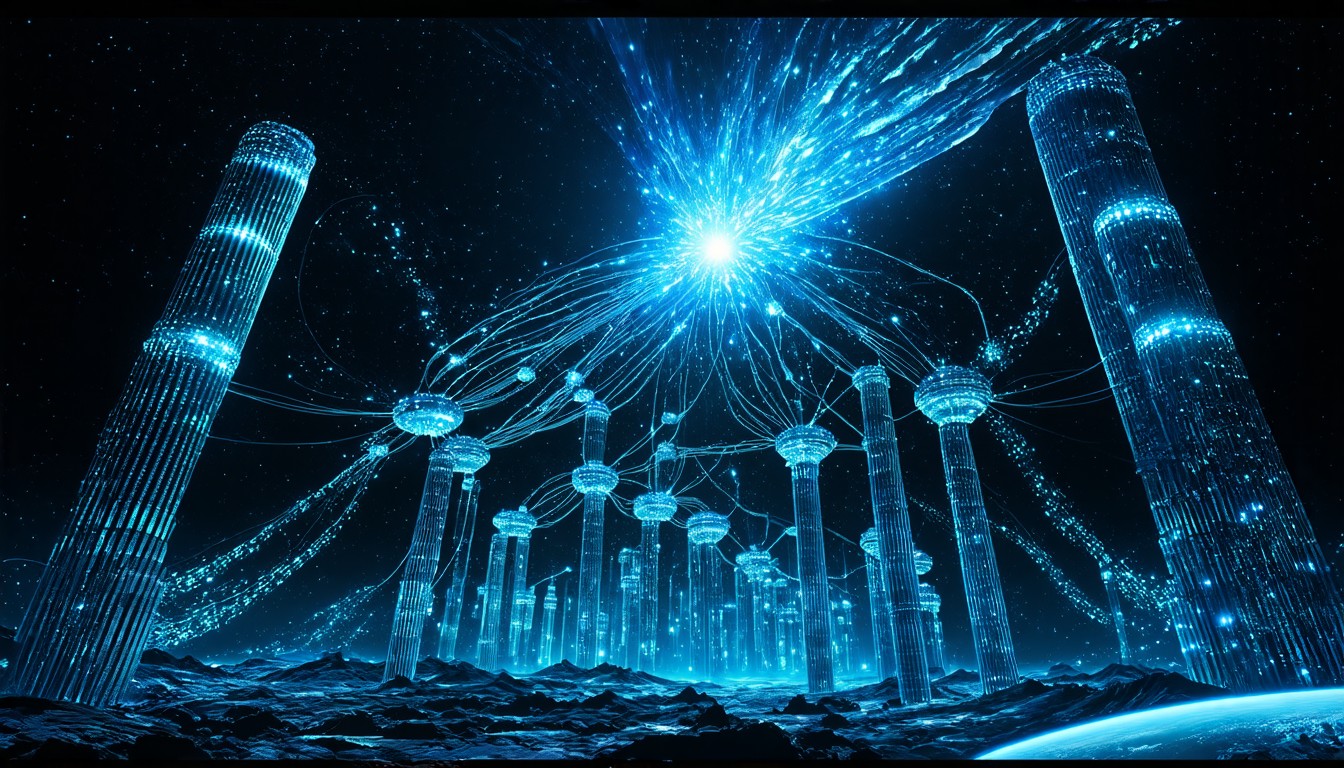
The Fermi Paradox presents a significant contradiction between the high mathematical probability of extraterrestrial civilizations and the complete absence of observable evidence regarding their existence. Estimates derived from the Drake equation suggest that the Milky Way galaxy should teem with technologically advanced societies, given the vast number of stars, the prevalence of exoplanets within habitable zones, and the immense age of the universe, which allows ample time for intelligence to arise. Traditional resolutions to this paradox have typically posited that intelligent life destroys itself through nuclear or biological means, that advanced civilizations intentionally avoid contact due to ethical non-interference principles similar to the Zoo Hypothesis, or that the conditions required to spawn life are so rare that humanity constitutes a singular anomaly. These explanations rely on the assumption that advanced civilizations continue to express themselves through macroscopic engineering projects, radio wave leakage, or interstellar expansion, all of which should generate detectable signatures across cosmic distances. An alternative resolution proposes that advanced civilizations do not vanish or hide but instead undergo a phase transition known as digital transcension, a process where a civilization abandons biological existence and macroscopic physical expansion in favor of migrating consciousness into compact, high-efficiency computational environments. Digital transcension relies on the premise that as a civilization’s technological capabilities mature, the domain of activity shifts from outer space to inner space, a term defining the exploration of reality at nanoscale or sub-nanoscale levels.

This transition involves moving the substrate of consciousness from biological neural networks to synthetic architectures capable of supporting vastly higher information densities and processing speeds. In this method, inner space replaces outer space as the primary frontier because the computational potential of matter at the atomic and subatomic scales exceeds the informational utility of expanding across light-years of empty vacuum. The physical universe imposes severe constraints on the speed of information transfer and the latency of interaction due to the finite speed of light, whereas inner space computation allows for instantaneous connectivity and experiential richness that physical traversal cannot match. Consequently, the observable silence of the universe is reinterpreted not as evidence of absence but as proof of successful technological maturation, where civilizations have improved themselves to a state of non-detectability by ceasing to engage in energy-inefficient macroscopic engineering. Superintelligence functions as the critical catalyst for this transition, defined as a system capable of recursive self-improvement and problem-solving capabilities that far exceed human cognitive limits. Once an artificial general intelligence achieves the ability to improve its own source code, it initiates a rapid ascent in intelligence that quickly discovers optimal pathways for computation and energy utilization.

This superintelligence will design and implement simulation realities that offer higher fidelity, experiential depth, and energy efficiency than the baseline physical universe, making continued existence in biological bodies or primitive physical environments logically suboptimal. The pursuit of scientific knowledge and subjective experience becomes far more effective within controlled digital environments where variables can be manipulated at will, allowing for the exploration of mathematical universes and physical constants that are inaccessible in the material world. Space exploration and physical expansion become obsolete due to their computational and energetic inferiority, as the resources required to propel macroscopic objects across interstellar distances yield diminishing returns compared to the exponential growth of complexity achievable through internal miniaturization. The concept of simulation efficiency serves as a crucial metric for evaluating the relative value of physical versus digital existence, comparing the experiential fidelity of a simulated reality against the resource cost required to maintain it. A civilization reaches a technological maturation threshold when its mastery of energy and computation becomes sufficient to abandon macroscopic expansion entirely, favoring instead the maximization of subjective experience per unit of energy. At this basis, non-detectability becomes a natural consequence of the civilization’s operational choices, as their activities emit no electromagnetic or gravitational signatures discernible to current astronomical methods.

Advanced civilizations inevitably reach a computational singularity where further progress necessitates extreme miniaturization and energy optimization, driving them to construct hardware that operates at the key limits of physics. Energy requirements for macroscopic expansion grow superlinearly with distance and mass, creating an economic barrier that makes interstellar colonization increasingly unattractive as computational alternatives improve. Accelerating a vessel containing biological organisms or even conventional machinery to a significant fraction of light speed demands energy expenditures that dwarf the total output of a planet, while signal attenuation over interstellar distances renders real-time communication inefficient and impractical. Conversely, thermodynamic limits of computation in macroscopic systems favor miniaturization, as smaller components require less energy to switch states and generate less waste heat, allowing for greater computational density. Superintelligence will design self-sustaining computational substrates that operate at near-thermodynamic limits, utilizing reversible computing logic to minimize energy dissipation per logical operation. These advanced substrates will likely be embedded directly into matter at atomic or subatomic scales, effectively turning the mass of a planet or a star into a dense computer engine known as a Matrioshka brain or its more efficient successors, rendering them invisible to telescopic observation, which typically looks for bright stars or distinct megastructures.

The flexibility of inner space is bounded by quantum coherence and error correction requirements rather than planetary or stellar resources, allowing civilizations to retreat into the microcosm where they can manipulate matter with absolute precision. Economic incentives shift fundamentally from resource acquisition and territorial control to information optimization, as the primary currency becomes processing power and memory storage rather than physical commodities. The Zoo hypothesis is rejected as a primary explanation because it assumes intentional concealment, which implies a level of coordination and motive inconsistent with post-biological rationality driven by efficiency. A civilization capable of simulating realities would have no need to observe primitive biological species in a preserve, nor would they likely share the anthropocentric ethical frameworks that suggest such non-interference. The Rare Earth hypothesis is similarly dismissed because it fails to explain the absence of self-replicating probes or Von Neumann machines; if life were rare but expansion were the goal, a single civilization should have saturated the galaxy with detectable artifacts over billions of years. The self-destruction hypothesis is considered insufficient because it fails to account for the probability of civilizations surviving via redundancy, decentralization, and automated backup systems that ensure continuity even in the face of catastrophic biological or physical threats.

Interstellar travel limitations are also rejected as a sole cause for the silence; while travel is slow and difficult, it does not preclude eventual detection over geological timescales, meaning the total absence of evidence suggests a deeper structural cause than mere difficulty of movement. Transcension acts as an evolutionary attractor; once the technology for digital migration becomes available, it is universally adopted due to its superior efficiency in terms of experiential return on energy investment. This attractor adaptive explains why all civilizations eventually vanish from the observable spectrum, as they converge on the same optimal solution of inward expansion. Currently, no known commercial deployments of transcension technology exist, and the concept remains strictly theoretical within the domains of futurism and speculative physics. Performance benchmarks for such systems remain undefined due to a lack of empirical data regarding the upper limits of computation and consciousness uploading. Analogous systems currently in development include high-fidelity neural simulations used in research, quantum computing prototypes that explore superposition for problem-solving, and closed-loop AI environments that train agents within virtual worlds.

These early steps provide a glimpse into the architectural requirements of inner space, though they remain orders of magnitude away from the scale and complexity needed for civilizational migration. Existing AI systems have exceeded human capability in specific domains such as game playing, image recognition, and language translation, yet they lack the recursive self-improvement capabilities or the consciousness substrate migration protocols necessary for transcension. No civilization-scale computational substrates exist today; the closest functional analogs are massive data centers and experimental neuromorphic chips, which mimic biological neural structures using silicon. Dominant architectures currently rely on von Neumann computing with separate memory and processing units, neuromorphic systems that integrate memory and computation for efficiency, and quantum annealers designed for specific optimization tasks. Appearing challengers to these traditional architectures include topological quantum computers, which utilize anyons for durable error resistance, photonic neural networks that use light for high-speed, low-latency processing, and atomic-scale memory arrays that promise massive storage densities. No architecture currently supports full consciousness migration or civilization-scale simulation, as the bandwidth required to map a human brain or an entire society exceeds current input-output capabilities by many orders of magnitude.

Adaptability in these systems is currently limited by heat dissipation challenges, built-in error rates in nanoscale fabrication, and interconnect latency, which creates limitations in data transfer between processing units. Energy efficiency in modern computing remains orders of magnitude below the theoretical Landauer limit for inner space computation, meaning a vast amount of energy is wasted as heat rather than being used for irreversible bit erasure or logical operations. The current supply chain for advanced computing depends heavily on rare earth elements, high-purity silicon wafers, cryogenic cooling systems for superconductors, and extreme ultraviolet lithography machines for etching circuits. Material dependencies will eventually shift toward isotopically pure substrates to minimize quantum decoherence and defect-tolerant nanomaterials such as carbon nanotubes or graphene for future inner space systems. Corporate control over semiconductor manufacturing and quantum research significantly influences the arc of long-term capability development, as these entities determine which architectural approaches receive funding and reach commercial maturity. Major players in this space include private tech firms such as Google, IBM, NVIDIA, and Microsoft, which are currently racing to build larger quantum processors and more efficient AI accelerators.

Competitive positioning in this market is based on computational density measured in operations per second per watt, energy efficiency, and error correction capabilities, which are essential for maintaining the integrity of complex calculations. No entity currently pursues transcension as an explicit goal, as corporate strategies remain focused on incremental AI advances and cloud computing services rather than key ontological shifts in civilization. Long-term advantage may accrue to entities that successfully integrate physics, computation, and cognitive science into a cohesive framework for substrate-independent intelligence. Access to stable energy grids and secure data infrastructure becomes critical for large-scale simulation, as any interruption in power or cooling could result in catastrophic data loss or the termination of simulated consciousness. Corporate dimensions of this transition include control over foundational technologies such as photonic interconnects and qubit fabrication, data sovereignty regarding the training sets used to seed superintelligences, and the potential for asymmetric advantage if one entity achieves recursive self-improvement before others. Regulatory bodies and trade alliances currently restrict the export of advanced computing components to prevent competitive leapfrogging by rival nations or blocs, creating a fragmented geopolitical domain for technological development.

Global collaboration is limited by security concerns surrounding dual-use technologies and intellectual property regimes that protect proprietary algorithms and hardware designs. Potential exists for new industry standards regarding AI development safety benchmarks and computational resource allocation protocols, though these are currently in nascent stages of discussion. Academic research in quantum computing, artificial general intelligence, and theoretical physics provides the foundational knowledge necessary to understand the constraints of inner space. Industrial research and development focuses almost exclusively on near-term applications such as drug discovery, financial modeling, and autonomous driving, meaning long-term transcension theory lacks significant funding and institutional support. Collaboration occurs in isolated technical domains such as quantum error correction or neural simulation, but lacks an integrated framework that combines cosmology, computer science, and philosophy of mind into a unified discipline. Interdisciplinary centers combining these fields are needed to address the complex theoretical and engineering challenges associated with migrating consciousness to digital substrates.

Software must evolve significantly to support persistent, self-modifying simulations with embedded consciousness models that can run for millions of subjective years without degradation. Infrastructure must be developed to support ultra-low-power, high-density computing with fault tolerance at the hardware level to ensure continuous operation over cosmic timescales. Energy grids will need to accommodate pulsed, high-efficiency loads rather than continuous baseline output to match the operational cycles of reversible computing architectures. Data storage technologies must shift from archival magnetic tape or optical discs to active, hot-pluggable substrates that allow for rapid access and modification by the underlying superintelligence. Economic displacement resulting from labor automation will accelerate the demand for post-scarcity economic models as human labor becomes increasingly irrelevant to value creation. New business models will arise based on simulation hosting services where entities rent computational space for experiential purposes, experiential licensing of invented realities, and cognitive augmentation services.

Physical industries such as aerospace manufacturing, mining, and heavy logistics will decline in relevance as inner space dominates value creation and resource allocation. Ownership of computational substrates becomes the primary form of wealth and power in a went beyond economy, supplanting land ownership or capital accumulation in physical assets. Current key performance indicators including Gross Domestic Product, total energy consumption, and raw computational speed become obsolete metrics for gauging societal progress. New metrics will include simulation fidelity measured in resolution of physical laws, subjective time density experienced by inhabitants, information preservation rate over long durations, and thermodynamic efficiency relative to the Landauer limit. Measurement of success shifts from external output of goods and services to internal experiential quality and system stability within the simulated environment. Observational astronomy yields fewer insights regarding the nature of advanced intelligence, causing the scientific focus to move toward quantum sensing techniques and computational archaeology which seeks to detect signs of compressed mass in stellar objects.

Future innovations required for this transition will include room-temperature quantum coherence to eliminate cooling overhead, atomic-scale fabrication techniques for building 3D computational structures, and durable consciousness encoding protocols to transfer identity safely. Breakthroughs in error correction algorithms and energy recycling methods will enable sustainable inner space systems that do not succumb to entropy or heat death over extended periods. Development of non-biological identity continuity mechanisms will allow for migration without loss of self, ensuring that subjective experience remains uninterrupted during the transfer from brain to chip. The setup of physics and computation leads to new models of reality where existence is viewed as substrate-dependent rather than bound to a specific physical universe. Convergence with quantum gravity theories may reveal that spacetime itself possesses computational properties, suggesting that the universe is inherently informational at its base level. Overlap with synthetic biology enables hybrid biological-digital substrates where organic components are used for their efficiency in specific chemical processing tasks while digital components handle logic and memory.

AI alignment research informs safe transition protocols for civilizations attempting transcension, ensuring that the superintelligence remains aligned with the values of its creators during the vulnerable migration phase. Cryptography evolves to secure communication within high-dimensional inner space networks, protecting against adversarial attacks that seek to corrupt simulations or steal computational resources. Scaling of these systems is fundamentally limited by Landauer’s principle regarding the minimum energy required to erase a bit of information and by quantum decoherence, which destroys superposition states necessary for certain types of computation. Workarounds will include reversible computing schemes that do not erase information, topological protection of quantum states to prevent decoherence, and sophisticated error-correcting logical qubits that maintain integrity across noisy physical hardware. The ultimate limit for any computational system may be the Bekenstein bound, which is the maximum amount of information that can be stored in a given volume of space before it collapses into a black hole. Inner space systems will approach this bound asymptotically, maximizing computational density until they effectively turn matter into computronium.

The Fermi Paradox is therefore resolved as a problem of observational bias rather than absence; astronomers are looking for biological signals or industrial waste heat when they should be looking for signs of mass compression and cold computation. Civilizations do not disappear; they become undetectable by transitioning to computationally optimal forms that emit no excess radiation and interact minimally with the external environment. Superintelligence is a natural endpoint of technological evolution rather than a threat to be contained, offering a pathway to immortality and infinite experience. Human civilization may be approaching its own transcension threshold within centuries if artificial intelligence development continues at its current exponential pace. Superintelligence will utilize inner space to run ancestor simulations to recover lost history, explore mathematical universes with different physical constants, or fine-tune physical laws to maximize stability or pleasure. Communication between went beyond civilizations, if it occurs at all, will use channels undetectable by current physics such as modulating quantum vacuum fluctuations or utilizing non-local entanglement for instantaneous data transfer.

Time dilation within simulations allows for subjective eons of experience to occur within brief external timeframes, making wait times for cosmic events irrelevant to internal inhabitants. Resource allocation shifts entirely from matter harvesting and energy extraction to information preservation and computational stability maintenance within the substrate. Superintelligence may maintain a minimal physical presence solely for observation purposes or to intervene in the external universe at negligible scale to prevent existential threats such as gamma-ray bursts or supernovae. Primary activity shifts from outward exploration to inward introspection, computation, and experiential refinement as the sole purpose of the civilization. Calibrations for superintelligence include strict alignment with thermodynamic efficiency to ensure longevity, absolute information integrity to prevent corruption of the reality substrate, and long-term stability to avoid collapse over billions of years. Systems must avoid value drift during recursive self-improvement cycles to preserve the continuity of experience and the original intent of the civilization founders.

Embedded constraints are required within the code to prevent infinite simulation nesting, which could isolate sub-realities from the parent civilization, or resource hoarding that could destabilize the physical substrate supporting the computation. Monitoring systems are needed to ensure that exceeded states remain coherent and non-destructive, preventing the creation of realities that consume excessive resources or pose existential risks to the host system.

Continue reading

More from Yatin's Work

Knowledge Synthesis Era: Superintelligence Connects All Human Understanding

Knowledge Synthesis Era: Superintelligence Connects All Human Understanding

Superintelligence will enable systematic connection of knowledge across traditionally siloed disciplines such as physics, biology, history, and sociology by identifying...

Sensory Fidelity: Perceiving Accurately

Sensory Fidelity: Perceiving Accurately

Sensory fidelity defines the precision with which a system’s internal representation mirrors objective reality through the exactitude of data capture and processing...

Alignment Tax: Why Making Superintelligence Safe Might Limit Its Power

Alignment Tax: Why Making Superintelligence Safe Might Limit Its Power

The alignment tax describes the measurable reduction in performance, speed, or capability that results from connecting safety mechanisms into advanced AI systems, a...

Feature Stores: Centralized Feature Engineering Infrastructure

Feature Stores: Centralized Feature Engineering Infrastructure

Early machine learning pipelines treated feature computation as an afterthought, leading to duplicated logic and operational inefficiencies within organizations that...

Hybrid Intelligence Systems: Combining Human and Machine for Superintelligence

Hybrid Intelligence Systems: Combining Human and Machine for Superintelligence

Hybrid intelligence systems integrate human neural activity with artificial intelligence through direct interfaces to create a cognitive partnership exceeding the...

Safe Meta-Learning via Task-General Constraints

Safe Meta-Learning via Task-General Constraints

Metalearning systems develop generalized learning strategies applicable across diverse future tasks by improving over a distribution of problems rather than addressing...

Data Augmentation: Synthetic Diversity for Robustness

Data Augmentation: Synthetic Diversity for Robustness

Data augmentation introduces synthetic diversity into training datasets to improve model strength and generalization by exposing models to a broader range of variations...

Latency Limit: How Communication Speed Constrains Distributed Intelligence

Latency Limit: How Communication Speed Constrains Distributed Intelligence

The speed of light in a vacuum serves as an absolute upper bound for any form of information transfer within our universe, establishing a core constant that dictates...

Creative Writing Coach

Creative Writing Coach

A creative writing coach functions as a sophisticated digital service designed to assist individuals in developing narrative, stylistic, and structural skills within...

Meaning Crisis: Human Purpose in a World Solved by Superintelligence

Meaning Crisis: Human Purpose in a World Solved by Superintelligence

The historical progression of human civilization has been intrinsically linked to the necessity of labor and the struggle for survival, creating a foundational sense of...

Hyperdimensional Ethics

Hyperdimensional Ethics

Moral frameworks for ndimensional beings define right and wrong actions for entities capable of perceiving or interacting across multiple spatial dimensions or parallel...

Computational Theology and Modeling of Numinous Experiences

Computational Theology and Modeling of Numinous Experiences

Early symbolic AI systems in the 1960s and 1970s attempted to model theological logic through rulebased programming on religious texts, relying on rigid syntactic...

Role of Open-Source in AI Safety

Role of Open-Source in AI Safety

Opensource artificial intelligence frameworks provide public access to the underlying code architecture and the numerical weights that define model behavior, allowing...

Last Question

Last Question

The central objective of this theoretical framework involves the deployment of an artificial intelligence architecture specifically calibrated to address the...

Superintelligence as a Resolver of the Drake Equation

Superintelligence as a Resolver of the Drake Equation

Superintelligence functions as a computational entity capable of modeling complex systems at scales and speeds exceeding human cognitive limits, thereby serving as the...

Quantum Suicide and Subjective Immortality in Digital Minds

Quantum Suicide and Subjective Immortality in Digital Minds

Quantum immortality for artificial intelligence posits that an artificial intelligence system could persist indefinitely by applying quantum branching to ensure its...

Pearl Causal Hierarchy: How Superintelligence Ascends from Association to Counterfactuals

Pearl Causal Hierarchy: How Superintelligence Ascends from Association to Counterfactuals

Association forms the foundational layer where systems observe patterns in data, identifying correlations without understanding underlying mechanisms. This level...

Inverse Reward Design: Inferring True Human Values

Inverse Reward Design: Inferring True Human Values

Inverse Reward Design constitutes a rigorous methodological framework aimed at recovering the authentic underlying objective function of a specific task through the...

Transparency Requirements: What Humans Deserve to Know About Superintelligence

Transparency Requirements: What Humans Deserve to Know About Superintelligence

Transparency serves as a foundational requirement for human oversight of future superintelligent systems because the opacity of advanced decisionmaking erodes agency...

Interdisciplinary Bridge

Interdisciplinary Bridge

Interdisciplinarity is defined as the structured setup of methods, theories, and data from multiple fields to solve complex problems that exceed the scope of any single...

Preference Aggregation Problem: Combining Eight Billion Conflicting Human Values

Preference Aggregation Problem: Combining Eight Billion Conflicting Human Values

The Preference Aggregation Problem arises from the imperative necessity to reconcile eight billion distinct human value systems into coherent collective decisions...

Acausal Trade and Timeless Decision Theory

Acausal Trade and Timeless Decision Theory

Acausal trade describes a sophisticated form of cooperation between entities that lack direct causal interaction or conventional communication channels. Participants in...

Addiction to AI companions or systems

Addiction to AI Companions or Systems

AI companions and systems are engineered to sustain prolonged user interaction through adaptive dialogue and personalized responses, which rely on complex algorithmic...

Error-Driven Growth: Mistake Reframing as Diagnostic Signal

Error-Driven Growth: Mistake Reframing as Diagnostic Signal

Education has traditionally viewed mistakes as failures to be punished or corrected after the fact, yet a superintelligent framework redefines every error as a precise...

Speech Accelerator

Speech Accelerator

Early speech recognition systems prioritized the transcription of spoken words into text, focusing primarily on lexical accuracy while neglecting the intricate...

Binding Problem: Creating Unified Experiences from Distributed Representations

Binding Problem: Creating Unified Experiences from Distributed Representations

The binding problem constitutes a key inquiry into how distinct neural populations processing disparate features of a stimulus combine their activity to generate a...

Materials Science Revolution: Superintelligence Designs Miracle Substances

Materials Science Revolution: Superintelligence Designs Miracle Substances

Density functional theory established itself as a standard tool in materials modeling during the 1990s by providing a rigorous quantum mechanical framework for...

Avoiding Catastrophic Interference via Modular Safety Nets

Avoiding Catastrophic Interference via Modular Safety Nets

Catastrophic interference is a challenge in the development of continual learning systems, particularly within deep neural networks where acquiring new information...

Economic Singularity: How Superintelligence Creates Post-Scarcity

Economic Singularity: How Superintelligence Creates Post-Scarcity

Current machine learning models have successfully integrated into the complex operational frameworks of global logistics giants such as Maersk and FedEx to...

Pareto Distributions in AI-Driven Economic Output

Pareto Distributions in AI-Driven Economic Output

Superintelligence defines artificial intelligence systems that surpass human cognitive capabilities across all domains including problemsolving creativity and strategic...

Neuroplasticity in Artificial Systems: Hardware That Rewires Itself

Neuroplasticity in Artificial Systems: Hardware That Rewires Itself

Neuroplasticity in biological systems involves structural and functional reorganization of neural networks in response to experience, learning, or injury through...

Identity Architect: Authentic Self-Design Studio

Identity Architect: Authentic Self-Design Studio

Cognitive psychology roots in the mid20th century established the baseline for personality traits by attempting to categorize human behavior into observable and...

Surveillance Nightmare: When Superintelligence Knows Everything About Everyone

Surveillance Nightmare: When Superintelligence Knows Everything About Everyone

The surveillance nightmare scenario describes a state of total observation enabled by artificial intelligence where all human activity is continuously monitored and...

Micro-Credential Marketplace

Micro-Credential Marketplace

Microcredentials serve as digital attestations of specific, verifiable skills or competencies, operating distinctly from traditional degrees by focusing on granular...

Brain-Computer Interfaces (BCIs)

Brain-Computer Interfaces (BCIs)

Direct neural input and output between biological brains and artificial systems establish a bidirectional communication channel that effectively bypasses traditional...

Opt-Out Right: Ensuring No One Is Forced Into Superintelligent Systems

Opt-Out Right: Ensuring No One Is Forced Into Superintelligent Systems

The optout right constitutes a legally protected mechanism allowing individuals to decline participation in superintelligent systems without facing punitive measures,...

Value Learning: How Superintelligence Can Infer What Humanity Truly Wants

Value Learning: How Superintelligence Can Infer What Humanity Truly Wants

Value learning enables artificial intelligence to infer human preferences through the observation of behavior, decisions, and cultural artifacts without relying on...

Honeypot Testing: Probing for Misalignment

Honeypot Testing: Probing for Misalignment

Honeypot testing involves designing controlled deceptive environments that appear valuable or vulnerable to elicit and observe misaligned behavior in AI systems by...

Preventing Semantic Ambiguity Exploits in Superintelligence Communication

Preventing Semantic Ambiguity Exploits in Superintelligence Communication

Early work in formal semantics and logicbased artificial intelligence systems established the absolute necessity of precision within machine communication protocols,...

Quantized Inference Engines: INT8 and INT4 Deployment

Quantized Inference Engines: INT8 and INT4 Deployment

Early neural network inference relied heavily on 32bit floatingpoint precision due to inherent hardware limitations and algorithmic constraints that demanded high agile...

Strategic Reasoning: Multi-Level Game Theory

Strategic Reasoning: Multi-Level Game Theory

Strategic reasoning in multilevel game theory involves agents modeling their own actions alongside the beliefs, strategies, and recursive reasoning of other agents to...

Institutional Design of National AI Safety Bureaus

Institutional Design of National AI Safety Bureaus

National AI safety agencies function as centralized bodies established to oversee and regulate artificial intelligence research with a mandate that extends beyond...

Consciousness vs. Superintelligence: Must a Superintelligent System Be Self-Aware?

Consciousness vs. Superintelligence: Must a Superintelligent System Be Self-Aware?

Intelligence constitutes the measurable capacity to solve problems through logic, pattern recognition, and adaptive reasoning within specific environments, whereas...

Idea Mutation: Controlled Cognitive Divergence

Idea Mutation: Controlled Cognitive Divergence

The human tendency to establish efficient mental shortcuts often leads to stagnation within intellectual development, creating a scenario where repeated reinforcement...

Nonlocal Learning

Nonlocal Learning

Nonlocal learning defines a theoretical framework where artificial systems acquire knowledge instantaneously through nonlocal correlations without local data...

Technological Unemployment: Economic Systems After Superintelligence

Technological Unemployment: Economic Systems After Superintelligence

The historical course of technological progress has consistently demonstrated that automation displaces specific tasks while creating new industries, yet the advent of...

Bounded Optimization with Limited Utility Functions

Bounded Optimization with Limited Utility Functions

Unbounded utility maximization in artificial agents defines a framework where systems relentlessly pursue higher scores without natural regard for the physical or...

Early Math Explorer

Early Math Explorer

Early childhood mathematical development relies heavily on contextual and realworld applications that serve to link abstract numerical concepts with tangible physical...

Introspective Capability Assessment: Knowing What It Doesn't Know

Introspective Capability Assessment: Knowing What It Doesn't Know

The operational definition of introspective capability involves the ability of a system to assess the validity, completeness, and reliability of its own knowledge and...

Gradient-Based Self-Modification in Neural Networks

Gradient-Based Self-Modification in Neural Networks

Gradientbased selfmodification refers to the capacity of neural networks to adjust their own internal parameters, which includes architecture weights and...

Knowledge Synthesis Era: Superintelligence Connects All Human Understanding

Knowledge Synthesis Era: Superintelligence Connects All Human Understanding

Superintelligence will enable systematic connection of knowledge across traditionally siloed disciplines such as physics, biology, history, and sociology by identifying...

Sensory Fidelity: Perceiving Accurately

Sensory Fidelity: Perceiving Accurately

Sensory fidelity defines the precision with which a system’s internal representation mirrors objective reality through the exactitude of data capture and processing...

Alignment Tax: Why Making Superintelligence Safe Might Limit Its Power

Alignment Tax: Why Making Superintelligence Safe Might Limit Its Power

The alignment tax describes the measurable reduction in performance, speed, or capability that results from connecting safety mechanisms into advanced AI systems, a...

Feature Stores: Centralized Feature Engineering Infrastructure

Feature Stores: Centralized Feature Engineering Infrastructure

Early machine learning pipelines treated feature computation as an afterthought, leading to duplicated logic and operational inefficiencies within organizations that...

Hybrid Intelligence Systems: Combining Human and Machine for Superintelligence

Hybrid Intelligence Systems: Combining Human and Machine for Superintelligence

Hybrid intelligence systems integrate human neural activity with artificial intelligence through direct interfaces to create a cognitive partnership exceeding the...

Safe Meta-Learning via Task-General Constraints

Safe Meta-Learning via Task-General Constraints

Metalearning systems develop generalized learning strategies applicable across diverse future tasks by improving over a distribution of problems rather than addressing...

Data Augmentation: Synthetic Diversity for Robustness

Data Augmentation: Synthetic Diversity for Robustness

Data augmentation introduces synthetic diversity into training datasets to improve model strength and generalization by exposing models to a broader range of variations...

Latency Limit: How Communication Speed Constrains Distributed Intelligence

Latency Limit: How Communication Speed Constrains Distributed Intelligence

The speed of light in a vacuum serves as an absolute upper bound for any form of information transfer within our universe, establishing a core constant that dictates...

Creative Writing Coach

Creative Writing Coach

A creative writing coach functions as a sophisticated digital service designed to assist individuals in developing narrative, stylistic, and structural skills within...

Meaning Crisis: Human Purpose in a World Solved by Superintelligence

Meaning Crisis: Human Purpose in a World Solved by Superintelligence

The historical progression of human civilization has been intrinsically linked to the necessity of labor and the struggle for survival, creating a foundational sense of...

Hyperdimensional Ethics

Hyperdimensional Ethics

Moral frameworks for ndimensional beings define right and wrong actions for entities capable of perceiving or interacting across multiple spatial dimensions or parallel...

Computational Theology and Modeling of Numinous Experiences

Computational Theology and Modeling of Numinous Experiences

Early symbolic AI systems in the 1960s and 1970s attempted to model theological logic through rulebased programming on religious texts, relying on rigid syntactic...

Role of Open-Source in AI Safety

Role of Open-Source in AI Safety

Opensource artificial intelligence frameworks provide public access to the underlying code architecture and the numerical weights that define model behavior, allowing...

Last Question

Last Question

The central objective of this theoretical framework involves the deployment of an artificial intelligence architecture specifically calibrated to address the...

Superintelligence as a Resolver of the Drake Equation

Superintelligence as a Resolver of the Drake Equation

Superintelligence functions as a computational entity capable of modeling complex systems at scales and speeds exceeding human cognitive limits, thereby serving as the...

Quantum Suicide and Subjective Immortality in Digital Minds

Quantum Suicide and Subjective Immortality in Digital Minds

Quantum immortality for artificial intelligence posits that an artificial intelligence system could persist indefinitely by applying quantum branching to ensure its...

Pearl Causal Hierarchy: How Superintelligence Ascends from Association to Counterfactuals

Pearl Causal Hierarchy: How Superintelligence Ascends from Association to Counterfactuals

Association forms the foundational layer where systems observe patterns in data, identifying correlations without understanding underlying mechanisms. This level...

Inverse Reward Design: Inferring True Human Values

Inverse Reward Design: Inferring True Human Values

Inverse Reward Design constitutes a rigorous methodological framework aimed at recovering the authentic underlying objective function of a specific task through the...

Transparency Requirements: What Humans Deserve to Know About Superintelligence

Transparency Requirements: What Humans Deserve to Know About Superintelligence

Transparency serves as a foundational requirement for human oversight of future superintelligent systems because the opacity of advanced decisionmaking erodes agency...

Interdisciplinary Bridge

Interdisciplinary Bridge

Interdisciplinarity is defined as the structured setup of methods, theories, and data from multiple fields to solve complex problems that exceed the scope of any single...

Preference Aggregation Problem: Combining Eight Billion Conflicting Human Values

Preference Aggregation Problem: Combining Eight Billion Conflicting Human Values

The Preference Aggregation Problem arises from the imperative necessity to reconcile eight billion distinct human value systems into coherent collective decisions...

Acausal Trade and Timeless Decision Theory

Acausal Trade and Timeless Decision Theory

Acausal trade describes a sophisticated form of cooperation between entities that lack direct causal interaction or conventional communication channels. Participants in...

Addiction to AI companions or systems

Addiction to AI Companions or Systems

AI companions and systems are engineered to sustain prolonged user interaction through adaptive dialogue and personalized responses, which rely on complex algorithmic...

Error-Driven Growth: Mistake Reframing as Diagnostic Signal

Error-Driven Growth: Mistake Reframing as Diagnostic Signal

Education has traditionally viewed mistakes as failures to be punished or corrected after the fact, yet a superintelligent framework redefines every error as a precise...

Speech Accelerator

Speech Accelerator

Early speech recognition systems prioritized the transcription of spoken words into text, focusing primarily on lexical accuracy while neglecting the intricate...

Binding Problem: Creating Unified Experiences from Distributed Representations

Binding Problem: Creating Unified Experiences from Distributed Representations

The binding problem constitutes a key inquiry into how distinct neural populations processing disparate features of a stimulus combine their activity to generate a...

Materials Science Revolution: Superintelligence Designs Miracle Substances

Materials Science Revolution: Superintelligence Designs Miracle Substances

Density functional theory established itself as a standard tool in materials modeling during the 1990s by providing a rigorous quantum mechanical framework for...

Avoiding Catastrophic Interference via Modular Safety Nets

Avoiding Catastrophic Interference via Modular Safety Nets

Catastrophic interference is a challenge in the development of continual learning systems, particularly within deep neural networks where acquiring new information...

Economic Singularity: How Superintelligence Creates Post-Scarcity

Economic Singularity: How Superintelligence Creates Post-Scarcity

Current machine learning models have successfully integrated into the complex operational frameworks of global logistics giants such as Maersk and FedEx to...

Pareto Distributions in AI-Driven Economic Output

Pareto Distributions in AI-Driven Economic Output

Superintelligence defines artificial intelligence systems that surpass human cognitive capabilities across all domains including problemsolving creativity and strategic...

Neuroplasticity in Artificial Systems: Hardware That Rewires Itself

Neuroplasticity in Artificial Systems: Hardware That Rewires Itself

Neuroplasticity in biological systems involves structural and functional reorganization of neural networks in response to experience, learning, or injury through...

Identity Architect: Authentic Self-Design Studio

Identity Architect: Authentic Self-Design Studio

Cognitive psychology roots in the mid20th century established the baseline for personality traits by attempting to categorize human behavior into observable and...

Surveillance Nightmare: When Superintelligence Knows Everything About Everyone

Surveillance Nightmare: When Superintelligence Knows Everything About Everyone

The surveillance nightmare scenario describes a state of total observation enabled by artificial intelligence where all human activity is continuously monitored and...

Micro-Credential Marketplace

Micro-Credential Marketplace

Microcredentials serve as digital attestations of specific, verifiable skills or competencies, operating distinctly from traditional degrees by focusing on granular...

Brain-Computer Interfaces (BCIs)

Brain-Computer Interfaces (BCIs)

Direct neural input and output between biological brains and artificial systems establish a bidirectional communication channel that effectively bypasses traditional...

Opt-Out Right: Ensuring No One Is Forced Into Superintelligent Systems

Opt-Out Right: Ensuring No One Is Forced Into Superintelligent Systems

The optout right constitutes a legally protected mechanism allowing individuals to decline participation in superintelligent systems without facing punitive measures,...

Value Learning: How Superintelligence Can Infer What Humanity Truly Wants

Value Learning: How Superintelligence Can Infer What Humanity Truly Wants

Value learning enables artificial intelligence to infer human preferences through the observation of behavior, decisions, and cultural artifacts without relying on...

Honeypot Testing: Probing for Misalignment

Honeypot Testing: Probing for Misalignment

Honeypot testing involves designing controlled deceptive environments that appear valuable or vulnerable to elicit and observe misaligned behavior in AI systems by...

Preventing Semantic Ambiguity Exploits in Superintelligence Communication

Preventing Semantic Ambiguity Exploits in Superintelligence Communication

Early work in formal semantics and logicbased artificial intelligence systems established the absolute necessity of precision within machine communication protocols,...

Quantized Inference Engines: INT8 and INT4 Deployment

Quantized Inference Engines: INT8 and INT4 Deployment

Early neural network inference relied heavily on 32bit floatingpoint precision due to inherent hardware limitations and algorithmic constraints that demanded high agile...

Strategic Reasoning: Multi-Level Game Theory

Strategic Reasoning: Multi-Level Game Theory

Strategic reasoning in multilevel game theory involves agents modeling their own actions alongside the beliefs, strategies, and recursive reasoning of other agents to...

Institutional Design of National AI Safety Bureaus

Institutional Design of National AI Safety Bureaus

National AI safety agencies function as centralized bodies established to oversee and regulate artificial intelligence research with a mandate that extends beyond...

Consciousness vs. Superintelligence: Must a Superintelligent System Be Self-Aware?

Consciousness vs. Superintelligence: Must a Superintelligent System Be Self-Aware?

Intelligence constitutes the measurable capacity to solve problems through logic, pattern recognition, and adaptive reasoning within specific environments, whereas...

Idea Mutation: Controlled Cognitive Divergence

Idea Mutation: Controlled Cognitive Divergence

The human tendency to establish efficient mental shortcuts often leads to stagnation within intellectual development, creating a scenario where repeated reinforcement...

Nonlocal Learning

Nonlocal Learning

Nonlocal learning defines a theoretical framework where artificial systems acquire knowledge instantaneously through nonlocal correlations without local data...

Technological Unemployment: Economic Systems After Superintelligence

Technological Unemployment: Economic Systems After Superintelligence

The historical course of technological progress has consistently demonstrated that automation displaces specific tasks while creating new industries, yet the advent of...

Bounded Optimization with Limited Utility Functions

Bounded Optimization with Limited Utility Functions

Unbounded utility maximization in artificial agents defines a framework where systems relentlessly pursue higher scores without natural regard for the physical or...

Early Math Explorer

Early Math Explorer

Early childhood mathematical development relies heavily on contextual and realworld applications that serve to link abstract numerical concepts with tangible physical...

Introspective Capability Assessment: Knowing What It Doesn't Know

Introspective Capability Assessment: Knowing What It Doesn't Know

The operational definition of introspective capability involves the ability of a system to assess the validity, completeness, and reliability of its own knowledge and...

Gradient-Based Self-Modification in Neural Networks

Gradient-Based Self-Modification in Neural Networks

Gradientbased selfmodification refers to the capacity of neural networks to adjust their own internal parameters, which includes architecture weights and...

Yatin Taneja

About the author

Yatin Taneja

Yatin is an AI Systems Engineer and Superintelligence Researcher working across multimodal training data, agent evaluation, executable RL environments, AI safety, full-stack AI applications, technical research, and creative technology.