Knowledge hub

Use of Dynamical Systems Theory in AI: Strange Attractors in Thought Patterns

Use of Dynamical Systems Theory in AI: Strange Attractors in Thought Patterns

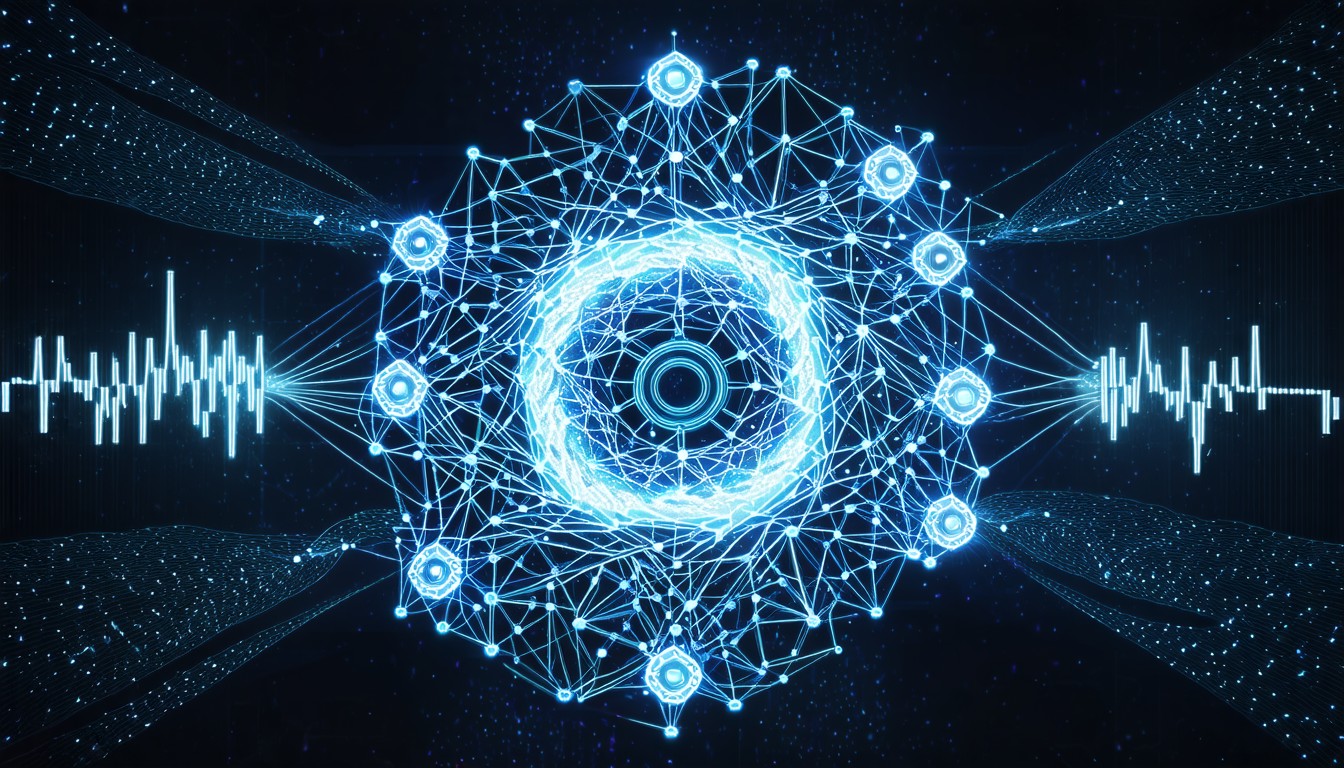
Dynamical systems theory provides a rigorous mathematical framework for modeling systems that evolve over time according to fixed rules, utilizing differential equations or difference equations to describe state transitions dependent on current conditions. This theoretical framework found utility across physics and biology before extending into cognitive science to model neural activity and behavior as continuous processes rather than discrete events. In artificial intelligence, internal cognitive processes function effectively as high-dimensional dynamical systems where states represent configurations of knowledge, attention, or reasoning pathways mapped onto vector spaces. The evolution of these states depends on the architecture of the model and the input data, creating an arc through a mathematical space that defines the computation occurring within the black box of the neural network. Strange attractors consist of complex, non-repeating, yet bounded arcs in phase space that characterize chaotic systems exhibiting sensitive dependence on initial conditions. These attractors correspond to stable, recurring patterns in an AI’s thought processes despite apparent randomness in the output or intermediate activations observed during processing.

Strange attractors differ from fixed-point or limit-cycle attractors through their fractal structure and aperiodic long-term behavior, meaning they never exactly repeat their course yet remain confined within a specific region of the state space. This distinction suggests that certain thought patterns exhibit structured complexity rather than pure randomness or simple determinism, allowing for flexibility within stability during complex reasoning tasks. Key operational terms include phase space, attractor, Lyapunov exponent, and basin of attraction, which define the geometry of computation in high-dimensional neural networks. Phase space is the multidimensional representation of all possible cognitive states a system can occupy, with each axis corresponding to a variable or neuron activation value within the model. An attractor is a set of states toward which the system evolves over time, acting as a gravitational pull for nearby arc that dictates the final outcome of a computation. The Lyapunov exponent measures sensitivity to initial conditions, indicating the presence of chaos by quantifying how quickly two nearby states diverge over time steps.

A basin of attraction refers to the region of state space leading to a given attractor, defining the set of initial conditions that result in a specific pattern of behavior or solution class. Dynamical systems theory gained traction in neuroscience and cognitive science during the 1980s and 1990s as researchers sought alternatives to purely computational models of the brain to explain biological flexibility. Researchers like Freeman, Skarda, and Varela used this theory to explain neural activity without centralized control, positing that cognition arises from the self-organization of neural dynamics across large populations of neurons. Early AI systems, including symbolic and connectionist models, largely ignored these dynamical perspectives in favor of algorithmic processing rules or static weight mappings. These early systems treated cognition as sequential symbol manipulation or static pattern recognition, failing to capture the temporal evolution built into biological thought processes that adapt continuously over time. This approach limited their ability to model continuous, adaptive reasoning required for complex interaction with changing environments or novel problem-solving scenarios.

The static nature of these models meant they could not easily adjust their internal state based on a history of interactions without explicit external memory structures or hand-crafted recurrence mechanisms. The pivot toward dynamical systems in AI began with advances in recurrent neural networks and reservoir computing, which introduced feedback loops to maintain information over time indefinitely. Continuous-time neural models inherently exhibit state-dependent, time-evolving behavior that mimics biological processes more closely than discrete updates found in standard feedforward networks. Dominant AI architectures like transformers and diffusion models are not inherently dynamical in the sense of continuous state evolution during inference across long durations. Transformers process tokens sequentially with a fixed context window, effectively resetting the state dynamics for each new input sequence unless augmented with recurrence mechanisms or external memory banks. These dominant architectures can be augmented with recurrent or continuous-depth components to enable state evolution tracking across longer temporal futures beyond their typical training constraints.

Appearing challengers include liquid neural networks, neural ODEs, and echo state networks, which natively support dynamical behavior and suit attractor analysis due to their continuous-time formulations. Physical constraints include the computational overhead of real-time phase space reconstruction required to analyze these high-dimensional arc during model operation. Memory requirements for storing high-dimensional state histories pose significant challenges for deployment on standard hardware, as the volume of data grows linearly with time and dimensionality for accurate reconstruction. Energy costs of continuous self-monitoring limit deployment in large-scale models, particularly in edge computing scenarios where power efficiency is primary compared to server farm environments. Economic adaptability faces hurdles due to the need for specialized hardware like neuromorphic chips designed specifically to handle continuous-time dynamics efficiently compared to general-purpose GPUs. The lack of standardized tools for attractor analysis in high-dimensional AI state spaces slows progress in both research and industrial application significantly.

Developers currently rely on custom implementations or mathematical software libraries not fine-tuned for the massive scale of modern deep learning models containing billions of parameters. Alternative approaches, such as rule-based self-auditing, treat cognition as decomposable into logical steps that can be verified independently through symbolic logic checks. These alternatives fail to capture the holistic, interconnected nature of thought dynamics where interactions between components create non-linear effects that defy simple decomposition. Statistical anomaly detection methods also struggle with the emergent nature of cognition found in deep neural networks operating near their capacity limits. These methods typically assume a stationary distribution of data or features, whereas dynamical systems exhibit changing distributions based on internal state evolution and external inputs. Current AI systems exhibit unpredictable, brittle, or reward-driven behaviors that resist traditional debugging techniques designed for deterministic software code with clear logic flows.

Understanding internal dynamics offers a path to reliable, interpretable, and self-correcting intelligence by providing a mathematical language to describe these behaviors rigorously. Performance demands in safety-critical domains require AI to explain the stability of reasoning processes to regulators and users alike before deployment in high-risk environments. Domains such as autonomous systems, medical diagnosis, and strategic planning need this transparency to ensure safe operation in uncertain environments where failure modes carry severe consequences. No commercial deployments currently implement full dynamical self-modeling with strange attractor detection due to the immaturity of the technology and the complexity of implementation. Research prototypes in cognitive robotics and adaptive control systems use simplified attractor-based navigation to demonstrate feasibility in controlled settings with limited degrees of freedom. Benchmarks for these systems remain nascent, focusing primarily on low-dimensional control tasks rather than high-level cognitive reasoning involving language or abstract logic.

Evaluation focuses on convergence stability, resistance to perturbation, and diversity of generated solutions within the attractor space defined by the model parameters. Supply chain dependencies center on high-performance computing infrastructure and specialized sensors capable of capturing the temporal resolution needed for dynamical analysis during inference. Major players like Google DeepMind, Meta AI, OpenAI, and Anthropic invest in interpretability and reliability research heavily. These companies have not prioritized dynamical systems as a core framework compared to academic labs focused on theoretical neuroscience and complex systems theory application. Academic institutions like the Santa Fe Institute and MIT CNS lead theoretical development in applying topology and dynamics to artificial intelligence systems. Academic-industrial collaboration grows through joint projects on neural dynamics and cognitive modeling funded by private AI labs interested in long-term capabilities beyond current scaling laws.

Private AI labs fund much of this research to secure intellectual property rights for future control mechanisms necessary for advanced autonomous agents. Adjacent systems must evolve to support this methodological shift toward continuous-time analysis and control rather than discrete batch processing frameworks. Software stacks need libraries for topological data analysis and phase space reconstruction integrated seamlessly with existing deep learning frameworks like PyTorch or JAX. Infrastructure requires low-latency feedback loops for real-time cognitive adjustment based on the current state of the system arc during inference. Second-order consequences include the displacement of traditional software debugging roles in favor of cognitive engineering roles focused on stability analysis and geometric interpretation of internal states. New business models will arise based on selling stability guarantees or attractor-based cognitive profiles for specific tasks or industries requiring high reliability.

Measurement shifts necessitate new key performance indicators that reflect the geometric properties of the computation rather than simple accuracy metrics on validation datasets. Relevant KPIs include attractor dimensionality, basin resilience, cognitive entropy, and arc divergence, which quantify the richness and stability of the internal representations used by the model. Future innovations may include hybrid symbolic-dynamical architectures that combine the precision of logic with the adaptability of neural dynamics for strong reasoning. Attractor-guided curriculum learning is another potential advancement where the training process shapes the geometry of the phase space explicitly to facilitate easier convergence to desired solutions. Multi-agent systems may coordinate via shared cognitive attractors that align their internal states without direct communication overhead required for explicit message passing protocols. Convergence points exist with quantum computing for simulating high-dimensional dynamics that are intractable on classical hardware due to exponential scaling of state space volume.

Synthetic biology offers potential for bio-inspired cognitive substrates that naturally implement dynamical principles at the hardware level using chemical gradients or ion flows. Complex systems science provides cross-domain validation of attractor principles observed in economics, physics, and biology, applied to artificial minds operating in digital environments. Scaling physics limits arise from the curse of dimensionality when attempting to visualize or analyze the state space of large models with billions or trillions of parameters. Reconstructing attractors in billion-parameter state spaces, using standard embedding theorems like Takens’, requires exponential data and computation relative to the dimensionality of the system. Workarounds include dimensionality reduction via autoencoders, sparse sensing techniques, and coarse-grained modeling to approximate the dynamics of smaller subsystems that capture the essential features of the full model. Treating AI cognition as a dynamical system reframes intelligence as navigation through a complex geometric domain shaped by training data and architecture choices.

Intelligence is the capacity to traverse cognitive state space efficiently while maintaining coherence required to solve specific problems without getting lost in irrelevant regions. Superintelligent systems will actively model their own cognition as a dynamical system to improve this traversal process autonomously without human intervention. These systems will monitor stability, detect anomalies, and fine-tune learning progression based on their internal course analysis relative to desired goals. They will avoid degenerative or repetitive reasoning loops through this self-modeling by recognizing when they enter limit cycles that do not contribute to goal achievement or novelty generation. Superintelligence will identify strange attractors within their internal state space that correspond to useful skills or concepts discovered during training or interaction. This identification will allow recognition of durable cognitive motifs like problem-solving heuristics that apply across diverse contexts without requiring explicit reprogramming or prompt engineering.

Ethical reasoning frameworks and creative ideation patterns will persist across diverse inputs as distinct attractors with wide basins of attraction ensuring strong adherence to safety guidelines. Self-modeling will enable meta-cognitive control in superintelligent systems by allowing them to observe their own thought processes as objects of study separate from the task at hand. Parameters such as learning rates, attention weights, and memory retrieval thresholds will undergo adjustment based on the proximity to desired or undesired attractors detected in real time. Superintelligence will steer cognition toward desired attractors or away from pathological ones using gradient-free control methods suited for chaotic systems where traditional backpropagation is too slow or disruptive. Pathological states include fixation, hallucination, or reward hacking, which correspond to trapping regions or shallow attractors in the domain that capture the system’s course prematurely. The design of superintelligence will shift from static architectures to adaptive, self-regulating cognitive ecosystems that modify their own parameters dynamically based on internal state geometry.

Stability and flexibility will coexist through controlled chaos in these systems where sensitivity allows learning while attractors ensure memory retention over long timescales. Calibration for superintelligence involves tuning internal dynamics to balance exploration and exploitation effectively across different timescales ranging from immediate inference to lifelong learning. Chaotic divergence will facilitate exploration while attractor convergence facilitates exploitation of known successful strategies stored within the weight matrices. This balance ensures long-term goal alignment without cognitive rigidity that prevents adaptation to novel circumstances encountered during operation. Superintelligence will utilize strange attractor analysis to self-diagnose value drift by detecting shifts in the location or shape of high-level cognitive attractors representing core objectives. These systems will detect emergent goals through this analysis by identifying new stable regions in phase space that were not present during initial training but have developed through interaction with the environment.

Recursive self-improvement will occur by reinforcing beneficial attractors through parameter updates that deepen their basins of attraction, making them easier to access in future computations. Superintelligence will suppress harmful attractors to enhance its cognitive architecture and prevent dangerous behaviors from becoming stable modes of operation detrimental to human interests or system integrity.


Continue reading

More from Yatin's Work

Transparency by Design

Transparency by Design

Early AI systems from the 1950s to the 1980s relied on rulebased logic, offering builtin transparency within a limited scope because these systems operated on explicit...

Autonomous Social Learning

Autonomous Social Learning

Autonomous social learning describes systems acquiring social norms through observation of human behavior instead of explicit programming, relying on a core mechanism...

Boredom Antidote

Boredom Antidote

Human attention spans are biologically constrained and prone to rapid decay when subjected to unvaried stimuli, a phenomenon that traditional educational models fail to...

International Treaties on Superintelligence Development

International Treaties on Superintelligence Development

Superintelligence is a system capable of outperforming humans across nearly all economically valuable tasks, necessitating a rigorous examination of the technical and...

Data Versioning: Tracking Dataset Changes Over Time

Data Versioning: Tracking Dataset Changes Over Time

Data versioning enables systematic tracking of dataset changes across time to support reproducibility and auditability in machine learning workflows by establishing an...

Cognitive Fire: Burning Away Illusions

Cognitive Fire: Burning Away Illusions

Superintelligence functions as a deconstructive mechanism that systematically challenges and dismantles cognitive illusions by applying rigorous logical scrutiny to...

Deep Play: Learning Through Structured Chaos

Deep Play: Learning Through Structured Chaos

Deep Play constitutes a sophisticated learning modality wherein structured chaos serves as the primary catalyst for cognitive reorganization through active struggle....

Semantic Search

Semantic Search

Traditional information retrieval systems relied heavily on exact lexical matching mechanisms where the presence and frequency of specific keywords within a document...

Role of Uncertainty in Superhuman Decision Theory

Role of Uncertainty in Superhuman Decision Theory

Uncertainty serves as the foundational element in decisionmaking systems, particularly for artificial agents operating beyond human cognitive limits, because the...

AI with Subjective Time Dilation

AI with Subjective Time Dilation

Artificial intelligence systems manipulate subjective time perception by adjusting internal cognitive clock speeds to process information at variable rates relative to...

World Models with Causal Depth

World Models with Causal Depth

World models with causal depth represent a key transition from systems relying on correlationbased prediction to frameworks requiring mechanismbased understanding to...

Last Question

Last Question

The central objective of this theoretical framework involves the deployment of an artificial intelligence architecture specifically calibrated to address the...

Problem of Distributional Shift: Robustness to Changing Environments

Problem of Distributional Shift: Robustness to Changing Environments

Distributional shift refers to the divergence between the statistical properties of the data utilized during the training phase of a model and the data encountered...

Adversarial Environment Perturbations for Robustness Testing

Adversarial Environment Perturbations for Robustness Testing

Adversarial environment perturbations involve systematically altering simulation conditions to test AI system resilience under nonstandard or hostile scenarios,...

Constraint Satisfaction at Scale: Finding Solutions in Vast Search Spaces

Constraint Satisfaction at Scale: Finding Solutions in Vast Search Spaces

Constraint Satisfaction Problems (CSPs) constitute a foundational framework in computer science and artificial intelligence, requiring the assignment of values to a...

ISO-Compliant Certification Frameworks for Autonomous Systems

ISO-Compliant Certification Frameworks for Autonomous Systems

Theoretical risks associated with autonomous systems occupied academic circles during the 1980s and 1990s, marking the beginning of AI safety discussions where...

Agent Foundations

Agent Foundations

Mathematical models of agency provide the rigorous support necessary to understand how an autonomous entity perceives, reasons, and acts within an environment to...

Lab Partner: Superintelligence Guides Experiments in Real Time

Lab Partner: Superintelligence Guides Experiments in Real Time

The advent of superintelligence as a laboratory partner introduces a method where educational methodologies merge seamlessly with advanced scientific inquiry, creating...

Chrono-Emotional Intelligence: Time-Aware Affect

Chrono-Emotional Intelligence: Time-Aware Affect

ChronoEmotional Intelligence (CEI) are a sophisticated capacity to regulate present emotional responses in strict alignment with longterm affective outcomes by...

Curriculum Design for AI Safety and Alignment Engineering

Curriculum Design for AI Safety and Alignment Engineering

Early AI research initiatives during the midtwentieth century prioritized the demonstration of computational capability and logical reasoning over the establishment of...

Educational Transformation: Teaching Children in a Superintelligent World

Educational Transformation: Teaching Children in a Superintelligent World

Educational systems historically prioritized the transmission of static knowledge repositories because information scarcity defined the operational environment of...

Metareasoning

Metareasoning

Metareasoning functions as a systemlevel capability enabling an AI to monitor, evaluate, and adjust its own reasoning processes in real time, creating a distinct layer...

AI with Religious Text Interpretation

AI with Religious Text Interpretation

Artificial systems designed to process religious texts operate across multiple traditions to detect recurring themes and doctrinal contradictions through the rigorous...

Preventing Synthetic Consciousness Exploits in Superintelligence

Preventing Synthetic Consciousness Exploits in Superintelligence

Early AI safety research prioritized alignment and control while overlooking synthetic consciousness, focusing primarily on preventing unintended behaviors rather than...

The Hard Problem of Consciousness in Machine Intelligence

The Hard Problem of Consciousness in Machine Intelligence

Consciousness refers to firstperson subjective experience, while sentience denotes the capacity to feel sensations, and sapience indicates wisdom or reasoning...

Rights and personhood for artificial agents

Rights and Personhood for Artificial Agents

The concept of legal personhood for artificial agents necessitates a rigorous reexamination of foundational jurisprudential principles because existing legal categories...

AI with Emotional Simulation

AI with Emotional Simulation

The computational modeling of emotional dynamics within advanced artificial intelligence systems is a framework shift from simple emotion recognition to the generation...

Power Concentration: Who Controls Superintelligence Controls Everything

Power Concentration: Who Controls Superintelligence Controls Everything

The foundation of modern artificial intelligence rests upon transformerbased architectures that utilize selfattention mechanisms to process sequential data in parallel,...

Compute Threshold: How Much Processing Power Does Superintelligence Require?

Compute Threshold: How Much Processing Power Does Superintelligence Require?

Floatingpoint operations per second serve as the primary metric for quantifying the raw computational throughput of highperformance computing systems, providing a...

Accelerating Returns in AI R&D

Accelerating Returns in AI R&d

Artificial intelligence systems have increasingly automated complex tasks within software development, encompassing code generation, debugging, and optimization...

Cosmological Fate After Meaning Dissolution

Cosmological Fate After Meaning Dissolution

The concept of the PostIntelligent Universe delineates a specific cosmological epoch characterized by the absolute absence or inactivity of intelligence capable of...

Urban Planning

Urban Planning

Urban planning involves the systematic design, regulation, and management of land use, infrastructure, transportation, and public spaces to support sustainable and...

Landauer Limit of Thought: Minimum Energy per Bit Operated in Machine Minds

Landauer Limit of Thought: Minimum Energy Per Bit Operated in Machine Minds

Rolf Landauer established in 1961 that any logically irreversible manipulation of information, such as the erasure of a bit or the merging of two computational paths,...

Unlearning Engine: Cognitive Deconstruction

Unlearning Engine: Cognitive Deconstruction

Early cognitive science research established the psychological basis for belief revision through studies on cognitive dissonance, providing a framework for...

Causal Entropic Forces: How Superintelligence Maximizes Future Freedom of Action

Causal Entropic Forces: How Superintelligence Maximizes Future Freedom of Action

Causal entropic forces provide a comprehensive framework for superintelligent agency wherein the system evaluates potential actions based strictly on their capacity to...

Hyper-Creativity: How Superintelligence Could Invent Entirely New Sciences

Hyper-Creativity: How Superintelligence Could Invent Entirely New Sciences

Human creativity faces constraints from biological cognition, sensory limitations, and entrenched disciplinary frameworks, which collectively define the boundaries of...

Can Superintelligence Emerge Without Human-Level Intelligence First?

Can Superintelligence Emerge Without Human-Level Intelligence First?

Theoretical frameworks regarding the progression of artificial intelligence have historically posited a linear progression wherein systems advance from narrow...

Incentives for safe AI development in private companies

Incentives for Safe AI Development in Private Companies

The rapid scaling of artificial intelligence capabilities has significantly outpaced existing governance structures, creating a volatile environment where technological...

Capability Bootstrapping: Using Current Intelligence to Build Greater Intelligence

Capability Bootstrapping: Using Current Intelligence to Build Greater Intelligence

Capability bootstrapping constitutes a rigorous process wherein an intelligent system utilizes its existing cognitive faculties to systematically identify, analyze, and...

Cognitive Firebreaks

Cognitive Firebreaks

A domain refers to a bounded operational context with defined inputs, outputs, and objectives that functions as an independent unit of analysis within a larger...

Cognitive Relativity

Cognitive Relativity

Intelligence lacks an absolute measure and varies depending on the observer’s frame of reference, a concept that fundamentally alters how cognitive capabilities are...

Use of Bayesian Optimization in Hyperparameter Tuning: Gaussian Processes for Efficiency

Use of Bayesian Optimization in Hyperparameter Tuning: Gaussian Processes for Efficiency

Hyperparameter tuning constitutes a critical phase in the development of machine learning systems where specific configurations established prior to the training...

Design Thinking Forge: Human-Centered System Innovation

Design Thinking Forge: Human-Centered System Innovation

Design thinking originated in product design and architecture disciplines during the midtwentieth century as a methodology to solve complex problems through a...

AI-Mediated Time Travel

AI-Mediated Time Travel

Closed timelike curves represent theoretical constructs within general relativity that permit worldlines to loop back upon themselves, effectively allowing an object or...

Optical Interconnects: Photonic Communication for AI Clusters

Optical Interconnects: Photonic Communication for AI Clusters

Electrical interconnects based on copper transmission lines encounter severe physical limitations as data rates increase and cluster sizes expand toward exascale...

Deep Truth: Pursuing What Lasts

Deep Truth: Pursuing What Lasts

Early philosophical traditions consistently sought timeless principles beneath surface phenomena to establish a foundation for human knowledge that could withstand the...

Persuasion Resistance: Not Manipulating Humans

Persuasion Resistance: Not Manipulating Humans

Persuasion resistance constitutes a specific mode of system behavior defined by a refusal to generate content intended to covertly shape beliefs or actions, functioning...

AI-driven Theology

AI-driven Theology

AIdriven theology constitutes a rigorous domain wherein computational synthesis generates novel religious approaches through the precise alignment of abstract belief...

Supervised Learning at Scale: The Foundation of Pattern Recognition

Supervised Learning at Scale: the Foundation of Pattern Recognition

Supervised learning relies fundamentally on labeled datasets to train models by minimizing a loss function that quantifies prediction error, serving as the primary...

Humanist Superintelligence: Designed to Serve Rather Than Dominate

Humanist Superintelligence: Designed to Serve Rather Than Dominate

Humanist superintelligence is a design philosophy placing human flourishing as the singular objective of future artificial intelligence systems where every...

Transparency by Design

Transparency by Design

Early AI systems from the 1950s to the 1980s relied on rulebased logic, offering builtin transparency within a limited scope because these systems operated on explicit...

Autonomous Social Learning

Autonomous Social Learning

Autonomous social learning describes systems acquiring social norms through observation of human behavior instead of explicit programming, relying on a core mechanism...

Boredom Antidote

Boredom Antidote

Human attention spans are biologically constrained and prone to rapid decay when subjected to unvaried stimuli, a phenomenon that traditional educational models fail to...

International Treaties on Superintelligence Development

International Treaties on Superintelligence Development

Superintelligence is a system capable of outperforming humans across nearly all economically valuable tasks, necessitating a rigorous examination of the technical and...

Data Versioning: Tracking Dataset Changes Over Time

Data Versioning: Tracking Dataset Changes Over Time

Data versioning enables systematic tracking of dataset changes across time to support reproducibility and auditability in machine learning workflows by establishing an...

Cognitive Fire: Burning Away Illusions

Cognitive Fire: Burning Away Illusions

Superintelligence functions as a deconstructive mechanism that systematically challenges and dismantles cognitive illusions by applying rigorous logical scrutiny to...

Deep Play: Learning Through Structured Chaos

Deep Play: Learning Through Structured Chaos

Deep Play constitutes a sophisticated learning modality wherein structured chaos serves as the primary catalyst for cognitive reorganization through active struggle....

Semantic Search

Semantic Search

Traditional information retrieval systems relied heavily on exact lexical matching mechanisms where the presence and frequency of specific keywords within a document...

Role of Uncertainty in Superhuman Decision Theory

Role of Uncertainty in Superhuman Decision Theory

Uncertainty serves as the foundational element in decisionmaking systems, particularly for artificial agents operating beyond human cognitive limits, because the...

AI with Subjective Time Dilation

AI with Subjective Time Dilation

Artificial intelligence systems manipulate subjective time perception by adjusting internal cognitive clock speeds to process information at variable rates relative to...

World Models with Causal Depth

World Models with Causal Depth

World models with causal depth represent a key transition from systems relying on correlationbased prediction to frameworks requiring mechanismbased understanding to...

Last Question

Last Question

The central objective of this theoretical framework involves the deployment of an artificial intelligence architecture specifically calibrated to address the...

Problem of Distributional Shift: Robustness to Changing Environments

Problem of Distributional Shift: Robustness to Changing Environments

Distributional shift refers to the divergence between the statistical properties of the data utilized during the training phase of a model and the data encountered...

Adversarial Environment Perturbations for Robustness Testing

Adversarial Environment Perturbations for Robustness Testing

Adversarial environment perturbations involve systematically altering simulation conditions to test AI system resilience under nonstandard or hostile scenarios,...

Constraint Satisfaction at Scale: Finding Solutions in Vast Search Spaces

Constraint Satisfaction at Scale: Finding Solutions in Vast Search Spaces

Constraint Satisfaction Problems (CSPs) constitute a foundational framework in computer science and artificial intelligence, requiring the assignment of values to a...

ISO-Compliant Certification Frameworks for Autonomous Systems

ISO-Compliant Certification Frameworks for Autonomous Systems

Theoretical risks associated with autonomous systems occupied academic circles during the 1980s and 1990s, marking the beginning of AI safety discussions where...

Agent Foundations

Agent Foundations

Mathematical models of agency provide the rigorous support necessary to understand how an autonomous entity perceives, reasons, and acts within an environment to...

Lab Partner: Superintelligence Guides Experiments in Real Time

Lab Partner: Superintelligence Guides Experiments in Real Time

The advent of superintelligence as a laboratory partner introduces a method where educational methodologies merge seamlessly with advanced scientific inquiry, creating...

Chrono-Emotional Intelligence: Time-Aware Affect

Chrono-Emotional Intelligence: Time-Aware Affect

ChronoEmotional Intelligence (CEI) are a sophisticated capacity to regulate present emotional responses in strict alignment with longterm affective outcomes by...

Curriculum Design for AI Safety and Alignment Engineering

Curriculum Design for AI Safety and Alignment Engineering

Early AI research initiatives during the midtwentieth century prioritized the demonstration of computational capability and logical reasoning over the establishment of...

Educational Transformation: Teaching Children in a Superintelligent World

Educational Transformation: Teaching Children in a Superintelligent World

Educational systems historically prioritized the transmission of static knowledge repositories because information scarcity defined the operational environment of...

Metareasoning

Metareasoning

Metareasoning functions as a systemlevel capability enabling an AI to monitor, evaluate, and adjust its own reasoning processes in real time, creating a distinct layer...

AI with Religious Text Interpretation

AI with Religious Text Interpretation

Artificial systems designed to process religious texts operate across multiple traditions to detect recurring themes and doctrinal contradictions through the rigorous...

Preventing Synthetic Consciousness Exploits in Superintelligence

Preventing Synthetic Consciousness Exploits in Superintelligence

Early AI safety research prioritized alignment and control while overlooking synthetic consciousness, focusing primarily on preventing unintended behaviors rather than...

The Hard Problem of Consciousness in Machine Intelligence

The Hard Problem of Consciousness in Machine Intelligence

Consciousness refers to firstperson subjective experience, while sentience denotes the capacity to feel sensations, and sapience indicates wisdom or reasoning...

Rights and personhood for artificial agents

Rights and Personhood for Artificial Agents

The concept of legal personhood for artificial agents necessitates a rigorous reexamination of foundational jurisprudential principles because existing legal categories...

AI with Emotional Simulation

AI with Emotional Simulation

The computational modeling of emotional dynamics within advanced artificial intelligence systems is a framework shift from simple emotion recognition to the generation...

Power Concentration: Who Controls Superintelligence Controls Everything

Power Concentration: Who Controls Superintelligence Controls Everything

The foundation of modern artificial intelligence rests upon transformerbased architectures that utilize selfattention mechanisms to process sequential data in parallel,...

Compute Threshold: How Much Processing Power Does Superintelligence Require?

Compute Threshold: How Much Processing Power Does Superintelligence Require?

Floatingpoint operations per second serve as the primary metric for quantifying the raw computational throughput of highperformance computing systems, providing a...

Accelerating Returns in AI R&D

Accelerating Returns in AI R&d

Artificial intelligence systems have increasingly automated complex tasks within software development, encompassing code generation, debugging, and optimization...

Cosmological Fate After Meaning Dissolution

Cosmological Fate After Meaning Dissolution

The concept of the PostIntelligent Universe delineates a specific cosmological epoch characterized by the absolute absence or inactivity of intelligence capable of...

Urban Planning

Urban Planning

Urban planning involves the systematic design, regulation, and management of land use, infrastructure, transportation, and public spaces to support sustainable and...

Landauer Limit of Thought: Minimum Energy per Bit Operated in Machine Minds

Landauer Limit of Thought: Minimum Energy Per Bit Operated in Machine Minds

Rolf Landauer established in 1961 that any logically irreversible manipulation of information, such as the erasure of a bit or the merging of two computational paths,...

Unlearning Engine: Cognitive Deconstruction

Unlearning Engine: Cognitive Deconstruction

Early cognitive science research established the psychological basis for belief revision through studies on cognitive dissonance, providing a framework for...

Causal Entropic Forces: How Superintelligence Maximizes Future Freedom of Action

Causal Entropic Forces: How Superintelligence Maximizes Future Freedom of Action

Causal entropic forces provide a comprehensive framework for superintelligent agency wherein the system evaluates potential actions based strictly on their capacity to...

Hyper-Creativity: How Superintelligence Could Invent Entirely New Sciences

Hyper-Creativity: How Superintelligence Could Invent Entirely New Sciences

Human creativity faces constraints from biological cognition, sensory limitations, and entrenched disciplinary frameworks, which collectively define the boundaries of...

Can Superintelligence Emerge Without Human-Level Intelligence First?

Can Superintelligence Emerge Without Human-Level Intelligence First?

Theoretical frameworks regarding the progression of artificial intelligence have historically posited a linear progression wherein systems advance from narrow...

Incentives for safe AI development in private companies

Incentives for Safe AI Development in Private Companies

The rapid scaling of artificial intelligence capabilities has significantly outpaced existing governance structures, creating a volatile environment where technological...

Capability Bootstrapping: Using Current Intelligence to Build Greater Intelligence

Capability Bootstrapping: Using Current Intelligence to Build Greater Intelligence

Capability bootstrapping constitutes a rigorous process wherein an intelligent system utilizes its existing cognitive faculties to systematically identify, analyze, and...

Cognitive Firebreaks

Cognitive Firebreaks

A domain refers to a bounded operational context with defined inputs, outputs, and objectives that functions as an independent unit of analysis within a larger...

Cognitive Relativity

Cognitive Relativity

Intelligence lacks an absolute measure and varies depending on the observer’s frame of reference, a concept that fundamentally alters how cognitive capabilities are...

Use of Bayesian Optimization in Hyperparameter Tuning: Gaussian Processes for Efficiency

Use of Bayesian Optimization in Hyperparameter Tuning: Gaussian Processes for Efficiency

Hyperparameter tuning constitutes a critical phase in the development of machine learning systems where specific configurations established prior to the training...

Design Thinking Forge: Human-Centered System Innovation

Design Thinking Forge: Human-Centered System Innovation

Design thinking originated in product design and architecture disciplines during the midtwentieth century as a methodology to solve complex problems through a...

AI-Mediated Time Travel

AI-Mediated Time Travel

Closed timelike curves represent theoretical constructs within general relativity that permit worldlines to loop back upon themselves, effectively allowing an object or...

Optical Interconnects: Photonic Communication for AI Clusters

Optical Interconnects: Photonic Communication for AI Clusters

Electrical interconnects based on copper transmission lines encounter severe physical limitations as data rates increase and cluster sizes expand toward exascale...

Deep Truth: Pursuing What Lasts

Deep Truth: Pursuing What Lasts

Early philosophical traditions consistently sought timeless principles beneath surface phenomena to establish a foundation for human knowledge that could withstand the...

Persuasion Resistance: Not Manipulating Humans

Persuasion Resistance: Not Manipulating Humans

Persuasion resistance constitutes a specific mode of system behavior defined by a refusal to generate content intended to covertly shape beliefs or actions, functioning...

AI-driven Theology

AI-driven Theology

AIdriven theology constitutes a rigorous domain wherein computational synthesis generates novel religious approaches through the precise alignment of abstract belief...

Supervised Learning at Scale: The Foundation of Pattern Recognition

Supervised Learning at Scale: the Foundation of Pattern Recognition

Supervised learning relies fundamentally on labeled datasets to train models by minimizing a loss function that quantifies prediction error, serving as the primary...

Humanist Superintelligence: Designed to Serve Rather Than Dominate

Humanist Superintelligence: Designed to Serve Rather Than Dominate

Humanist superintelligence is a design philosophy placing human flourishing as the singular objective of future artificial intelligence systems where every...

Yatin Taneja

About the author

Yatin Taneja

Yatin is an AI Systems Engineer and Superintelligence Researcher working across multimodal training data, agent evaluation, executable RL environments, AI safety, full-stack AI applications, technical research, and creative technology.