Knowledge hub

Antimatter Memory

Antimatter Memory

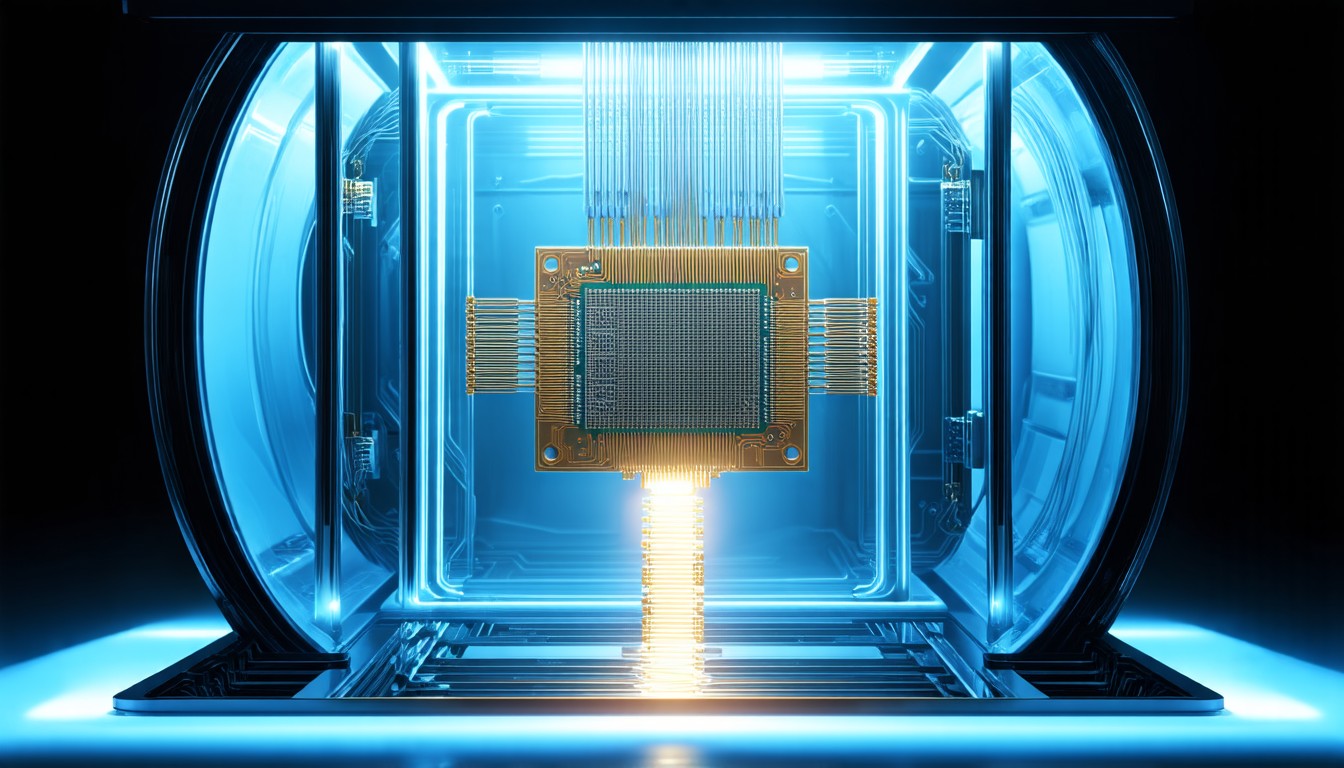
Antimatter memory utilizes the key interaction between matter and antimatter to encode and retrieve data through precise energy signatures derived from the annihilation process. This method of data storage moves beyond the binary limitations of traditional semiconductor physics by treating information as a physical manifestation of mass and energy rather than an electrical charge on a capacitor or a magnetic orientation on a platter. Data exists within this system as calibrated configurations of particle-antiparticle pairs held in a state of suspended potential until their destruction releases a unique energy profile corresponding directly to the stored information. The annihilation event itself serves as the read mechanism, releasing a burst of energy that contains the spectral and temporal data required to reconstruct the original bit sequence. This reliance on Einstein’s mass-energy equivalence principle allows for extreme data density per unit volume because the energy released by the complete conversion of even subatomic masses is a quantity of information far exceeding the spatial footprint of the particles themselves. Storage requires the stable containment of antimatter in sophisticated electromagnetic or Penning traps capable of isolating these volatile particles from any contact with normal matter for extended durations. Retrieval involves the controlled annihilation of specific trapped particles, with emitted photons captured via high-resolution spectrometry to decode the embedded information. Encoding maps digital bits to specific energy levels or timing patterns in the annihilation output, effectively writing data into the future state of the particle system.

The architecture of this storage medium relies heavily on the precise manipulation of quantum states to maintain coherence and prevent decoherence-induced corruption of the data before the read operation occurs. Quantum state control of antiparticles ensures that the wave function of the system remains predictable enough to guarantee that the annihilation event yields the expected energy signature. Temporal precision in annihilation triggering preserves sequential data integrity by ensuring that the release of information happens at exactly the moment dictated by the system clock, thereby preventing timing errors that could scramble high-speed data streams. Energy-to-data conversion efficiency depends entirely on the sensitivity of the detection hardware and the sophistication of error correction algorithms used to interpret the noisy signals resulting from high-energy particle interactions. The system comprises three distinct subsystems: antimatter generation units, confinement architecture, and readout arrays, all of which must operate in perfect synchronization to maintain data integrity. Antimatter production typically uses particle accelerators or radioactive isotopes to generate positrons or antiprotons, which are then injected into the storage array. Confinement employs superconducting magnetic fields and ultra-high vacuum environments to create a region of space where the antimatter can exist indefinitely without interacting with the chamber walls. Readout subsystems integrate fast scintillators or semiconductor gamma detectors capable of resolving the picosecond timescales of annihilation events with high fidelity.

Error mitigation within such a high-energy environment includes redundancy in particle placement and real-time calibration of the detection sensors to account for drift or environmental interference. Energy signatures serve as the specific spectrum and intensity of radiation used as data carriers, with variations in gamma ray frequencies representing different values or instructions. Confinement stability measures the duration antimatter remains isolated from matter, often referred to as the storage lifetime, which dictates the maximum retention time of the memory device. Annihilation fidelity quantifies the accuracy of the emitted energy pattern in reproducing the original data, serving as the primary metric for signal-to-noise ratio in this context. Storage density is the theoretical maximum data capacity per cubic centimeter, a figure that dwarfs traditional hard drives or solid-state media due to the infinitesimal size of the storage medium at the atomic scale. Early theoretical proposals in the 1980s focused on antimatter primarily as an energy source for propulsion rather than a data storage mechanism, though the physical principles were identical. Breakthroughs in Penning trap miniaturization during the 2000s enabled laboratory-scale confinement of sufficient duration to make theoretical data storage models viable. A 2015 demonstration using positronium decay provided empirical evidence that annihilation outputs carry structured information capable of being modulated to represent digital states. The shift to digital bit mapping occurred in the 2020s with advances in photon detection sensitivity that allowed researchers to distinguish between subtle variations in gamma ray spectra.

The economic domain of antimatter memory is defined by the prohibitive cost of production and the exotic materials required for containment. Antimatter production costs exceed 60 trillion per gram of antihydrogen, a figure that limits feasibility to niche applications where cost is secondary to performance or density. This expense restricts deployment to environments where the value of the stored data justifies the immense capital expenditure, such as deep space probes or high-frequency trading centers where microseconds translate to massive financial gains. Confinement requires cryogenic temperatures approaching absolute zero and power-intensive magnetic fields to sustain the superconducting coils necessary for particle trapping. Adaptability faces constraints regarding vacuum chamber size and radiation shielding, making portable implementations difficult with current engineering capabilities. Material dependencies include rare-earth magnets for the trapping fields and radiation-hardened detectors capable of surviving the harsh operating environment without degradation. Safety regulations restrict deployment near populated areas due to gamma-ray emissions produced during read operations, necessitating substantial lead or concrete shielding.

Comparisons with existing high-density storage technologies highlight the unique advantages and severe constraints of antimatter memory. Optical storage offers lower theoretical density and susceptibility to environmental degradation such as scratching or heat, whereas antimatter storage is volatile but immune to physical wear on the storage medium itself. DNA data storage suffers from slow read and write speeds compared to annihilation-based retrieval, which occurs at the speed of light with the triggering event. Quantum dot arrays lack the energy-resolution granularity needed for high-bit-depth encoding because they rely on electron transitions rather than total mass conversion. Superconducting flux qubits are incompatible with the high-radiation environment of annihilation events, as the ionizing radiation disrupts the Cooper pairs required for their operation. Exponential growth in AI training datasets demands storage media with extreme density that traditional silicon cannot provide without hitting physical lithography limits.

Economic pressure drives interest in these technologies as industries seek methods for maximizing bits per cubic meter to accommodate zettabyte-scale datasets. Scientific computing sectors prioritize tamper-proof and radiation-resistant storage for simulations involving nuclear physics or astrophysics where traditional media fail. Climate constraints favor technologies with minimal cooling overhead once operational, although the initial cooling requirements for antimatter traps remain energy-intensive. No commercial deployments exist as of 2024 due to these technical and financial hurdles, leaving the technology in the research and prototype phase. Laboratory benchmarks show raw storage densities exceeding 10^{18} bits/cm³ in controlled experiments using trapped positron clouds. Current error rates remain above 10^{-3}, necessitating complex error correction layers that reduce effective throughput. Read latency occurs in picoseconds for single-bit retrieval, limited only by the transit time of photons to the detector array. System-level throughput faces limits from detector refresh rates and the time required to reset the trap after a read operation destroys the stored data. Write operations remain slow due to antimatter synthesis constraints in the injection phase of the cycle.

The dominant approach in current research uses trapped positronium in cryogenic Penning-Malmberg traps because positronium is easier to produce and manipulate than antiprotons. A competing architecture employs antihydrogen in nested magnetic traps to achieve longer storage times at the cost of increased complexity in generation and handling. Alternative designs explore muon-sparked fusion byproducts as a potential source of short-lived high-energy particles for ultrafast cache memory applications. Antimatter generation requires on-site production facilities or stringent transport protocols that make logistics a critical component of system design. Superconducting magnet suppliers like Oxford Instruments and Siemens provide critical infrastructure for maintaining the stable fields needed for long-term confinement. High-purity detector materials come from limited global suppliers, creating supply chain vulnerabilities for specific isotopes used in sensor fabrication. Vacuum system components rely on aerospace-grade manufacturers capable of achieving pressures low enough to prevent stray gas particles from annihilating the stored antimatter.

Research is currently led by university labs and select private firms funded by defense grants or speculative investment vehicles. Defense contractors, like Lockheed Martin and BAE Systems, explore classified applications related to secure communications and radiation-hardened computing platforms for orbital deployment. Startups in stealth mode attempt to license trap or detector intellectual property to develop niche products for scientific instrumentation or specialized data centers. Export controls classify antimatter technologies under dual-use

Academic publications dominate the field while industrial involvement focuses on component supply rather than full system connection due to the immaturity of the technology. Open-source simulation tools accelerate peer validation for energy-signature modeling by allowing researchers to standardize their error correction methodologies. Software stacks must evolve to handle probabilistic readout outputs where the physical state of the system introduces statistical variance into the retrieved data stream. Regulatory frameworks need updates to define safety thresholds for gamma emissions in data centers operating this equipment. Power grid interfaces require reinforcement to support pulsed high-energy loads associated with charging the magnetic confinement coils during initialization. Network protocols may need adaptation for near-instantaneous local reads that outpace standard bus architectures designed for slower mechanical or electronic memory.

Traditional metrics like IOPS and latency are insufficient for this technology because they fail to account for the time required to replenish the storage medium after a destructive read. New key performance indicators include annihilation fidelity and confinement half-life, which determine how long data can persist without power input. Total cost of ownership must account for antimatter production amortization over the lifespan of the device rather than just the initial hardware expense. Environmental impact assessments shift focus to radiological safety and energy consumption rather than electronic waste or chemical pollution common in battery manufacturing. Future on-chip antimatter traps will use nanofabricated electrodes to reduce size and increase the density of individual storage cells within a single array. Room-temperature superconductors could eliminate cryogenic overhead and drastically reduce the operational complexity of the magnetic confinement systems.

Algorithmic models will predict optimal particle configurations for maximal encoding efficiency by simulating the chaotic dynamics of charged particles within a trap. Hybrid systems will combine antimatter memory with conventional solid-state drives to use volatile antimatter storage as an ultra-fast cache tier while retaining bulk data on cheaper media. Connection with photonic computing will enable direct photon-to-logic conversion where the gamma rays from annihilation drive optical logic gates without intermediate electrical conversion. Synergy with quantum communication networks will utilize annihilation photons as entanglement sources to create physically secured links between memory nodes. Neuromorphic systems will employ ultra-dense event-driven memory with analog energy-state representation to mimic synaptic weighting in biological neural networks. The Heisenberg uncertainty principle imposes a core limit on precise antiparticle positioning within the trap, creating a noise floor that affects maximum achievable density.

Information density faces a cap from Schwarzschild radius considerations, where packing too much energy into too small a volume risks gravitational collapse. Exceeding 10^{43}$ bits/cm³ would theoretically form a black hole, destroying the information contained within the memory device. Workarounds will involve distributed encoding across multiple low-density traps to maintain high total capacity while avoiding local density thresholds. Antimatter memory will enable computational approaches where data mass becomes a functional resource available for processing alongside standard logic operations. Its value will lie in redefining the boundary between information and physical reality by treating mass itself as a variable in information theory. Success will depend on decoupling from bulk antimatter production through advances in efficient trapping or recycling of annihilation byproducts.

Superintelligence will treat antimatter memory as a high-fidelity substrate for self-modifying code due to its speed and density characteristics. Program states will be physically instantiated as particle configurations that allow for instantaneous transitions between different logical states through controlled annihilation events. Rapid deterministic annihilation will enable instantaneous state rollback in recursive self-improvement cycles by allowing the system to revert to a previous physical configuration stored in adjacent trap cells. Energy signatures will serve as intrinsic checksums for autonomous memory integrity verification because any deviation in the expected spectrum indicates corruption or external interference. Superintelligence will prioritize antimatter storage for core cognitive modules requiring maximum density and speed to facilitate real-time analysis of massive datasets. The ability to access exabytes of data in picosecond timescales allows for cognitive architectures that operate orders of magnitude faster than biological or silicon-based intelligences.

This technology provides the necessary bandwidth for consciousness models requiring constant access to their entire history and knowledge base without latency penalties. The physical volatility of the storage medium necessitates constant active management by the intelligence to prevent data loss through accidental decoherence or power failure. Setup with sensor arrays will allow direct recording of high-energy phenomena into memory without intermediate digitization steps, preserving analog information with perfect fidelity. Future developments may focus on using antiprotons rather than positrons to apply their greater mass and higher energy yield per annihilation event for increased data density per particle. The transition from experimental setups to deployable hardware requires advances in microfabrication techniques capable of building trap structures at the nanometer scale while maintaining ultra-high vacuum integrity. Research into metamaterials may yield new ways to manipulate electromagnetic fields that reduce the power requirements for confinement by orders of magnitude.

Advances in solid-state physics could lead to detectors capable of resolving individual quanta of energy with near-perfect efficiency, pushing error rates toward zero. The interaction between the magnetic fields used for confinement and the data retrieval systems requires careful shielding to prevent electromagnetic interference from corrupting the read signals. Thermal management remains a critical challenge because the energy released during read operations generates localized heat that can destabilize nearby trap regions if not dissipated efficiently. The development of self-healing vacuum chambers capable of maintaining isolation despite micro-fractures would significantly increase the reliability of long-term storage deployments. Supply chain security for rare earth elements used in superconducting magnets is a strategic vulnerability for large-scale adoption of this technology. Recycling programs for magnets and detector materials will likely become essential to mitigate the environmental impact and cost of raw material extraction.

Standardization of form factors will be necessary to allow interoperability between different manufacturers of antimatter memory modules and control systems. The connection of control electronics directly into the trap structure reduces parasitic inductance and improves the speed of switching operations during read and write cycles. Advanced cooling methods such as adiabatic demagnetization refrigeration may replace traditional liquid helium systems to achieve lower temperatures with less bulky infrastructure. The potential for using antimatter memory in space exploration is particularly high due to the natural vacuum environment reducing the need for heavy containment vessels. Radiation shielding requirements add significant mass to any deployment platform, posing challenges for mobile or airborne applications where weight is a critical factor. The development of directional emission techniques could focus the gamma rays toward the detector and reduce the amount of shielding required in other directions.

Safety interlocks must be designed to fail safe by permanently disabling the magnetic confinement if power is lost to prevent uncontrolled annihilation events that could damage surrounding equipment. Insurance models for facilities housing antimatter memory will need to account for the unique risks associated with catastrophic containment failure. Public perception of antimatter technology may hinder adoption due to associations with nuclear weapons or science fiction disaster scenarios despite the microscopic quantities involved. Educational initiatives will be necessary to train a workforce capable of maintaining and repairing these highly specialized systems. Theoretical work continues on methods to encode more than one bit per particle by using quantum numbers such as spin or angular momentum as additional degrees of freedom. Holographic storage techniques using interference patterns of annihilation photons offer a path to threeimensional data storage within the trap volume itself.

The use of Bose-Einstein condensates of antimatter could enable macroscopic quantum states that store information non-locally across the entire condensate. Research into cold antihydrogen aims to produce neutral antimatter atoms that can be trapped using magnetic dipole moments rather than charge, potentially simplifying confinement requirements. The stability of these neutral atoms allows for longer storage times but complicates the controlled triggering required for read operations because they do not respond to electric fields. Error correction codes specifically designed for high-energy physics environments differ significantly from those used in traditional computing due to the nature of the noise involved. Quantum error correction techniques may be adapted to protect against decoherence in the particle states before annihilation occurs. The latency of error correction cycles often dominates the total read time despite the picosecond speed of the annihilation event itself.

Compression algorithms fine-tuned for this medium must account for the fact that random access destroys data, necessitating intelligent prefetching strategies. The relationship between energy consumption and data access is non-linear because reading a large contiguous block is more efficient than reading scattered individual bits due to trap reset overheads. Superintelligent systems utilizing this memory will likely develop proprietary encoding schemes fine-tuned for their specific cognitive architecture rather than using standard human-readable formats. The physical destruction of data upon reading provides a level of security against physical extraction attacks that is impossible to replicate with electronic memory. This property makes antimatter memory ideal for one-time-use cryptographic keys or sensitive tactical data that must be destroyed immediately after use. The ability to perform bitwise operations directly on the stored particles through manipulation of their quantum states is a form of processing-in-memory that eliminates the von Neumann hindrance.

Future architectures may use the energy released by annihilation to power subsequent logic gates, creating a self-sustaining computational cycle limited only by the supply of fresh antimatter. The ultimate limit of this technology lies in the conversion of information into energy and back again with perfect fidelity, a process that touches on the deepest laws of thermodynamics. As superintelligence approaches these limits, the distinction between the computer and its memory blurs until the entire structure becomes a single unified computational substrate. Antimatter memory serves as the bridge between classical information theory and relativistic physics, enabling systems that operate at scales where gravity and quantum mechanics intersect. The mastery of this technology signals a transition from manipulating matter to manipulating the core fabric of spacetime itself for computational purposes. Each advance in containment stability or detection sensitivity brings this reality closer to practical implementation.

The engineering challenges are immense, yet the theoretical potential offers capabilities that justify the sustained investment by leading scientific and industrial entities. The path forward involves incremental improvements in existing technologies combined with method shifts in our understanding of particle physics and information theory.


Continue reading

More from Yatin's Work

Tensor Processing Units: Google's Custom AI Accelerators

Tensor Processing Units: Google's Custom AI Accelerators

The rapid expansion of deep learning workloads in the early 2010s exposed the limitations of generalpurpose processors regarding the computational intensity required...

Knowledge Graph Synthesis

Knowledge Graph Synthesis

Knowledge Graph Synthesis involves the active construction, expansion, and logical reasoning over largescale semantic networks representing factual relationships...

Assessment Replacer

Assessment Replacer

Standardized testing has functioned as the primary mechanism for educational assessment and talent selection for over a century, establishing a rigid framework that...

Cognitive Mapping: Building AI That Understands Human Context

Cognitive Mapping: Building AI That Understands Human Context

Cognitive mapping enables AI systems to represent and reason about human social, emotional, and environmental contexts as structured, highdimensional models that mirror...

Avoiding Catastrophic Interference via Modular Safety Nets

Avoiding Catastrophic Interference via Modular Safety Nets

Catastrophic interference is a challenge in the development of continual learning systems, particularly within deep neural networks where acquiring new information...

AI with Cross-Domain Transfer Learning

AI with Cross-Domain Transfer Learning

Crossdomain transfer learning enables artificial intelligence systems to apply knowledge acquired in one specific domain to solve problems in a different, often...

Personalized Education at Scale: Every Human Gets Their Own Superintelligent Tutor

Personalized Education at Scale: Every Human Gets Their Own Superintelligent Tutor

Personalized education for large workloads referred historically to the conceptual deployment of AIdriven tutoring systems designed to adapt in real time to each...

Orthogonality Thesis

Orthogonality Thesis

The orthogonality thesis posits a core decoupling between the intelligence of an agent and the final goals that the agent pursues, suggesting that these two variables...

Self-Play and Curriculum Generation: AI Creating Its Own Training

Self-Play and Curriculum Generation: AI Creating Its Own Training

Selfplay functions as a robust training framework where an artificial intelligence system generates its own data by competing or cooperating with instances of itself,...

Problem of Byzantine Faults in AI Networks: Tolerating Malicious Subcomponents

Problem of Byzantine Faults in AI Networks: Tolerating Malicious Subcomponents

Byzantine faults describe arbitrary failures within distributed systems where individual components deviate from protocol through malicious intent or inconsistent...

Superintelligence and the Heat Death of the Universe

Superintelligence and the Heat Death of the Universe

The universe expands toward a state of maximum entropy, known as heat death, where usable energy gradients vanish as the temperature approaches absolute zero and all...

Idea Ecosystem Engineer: Designing for Emergence

Idea Ecosystem Engineer: Designing for Emergence

Complexity science and systems theory, originating in the 1980s, provide the foundational basis for this field by establishing that nonlinear dynamics govern the...

Problem of Emergent Monopolies: Preventing Single AI Dominance in Networks

Problem of Emergent Monopolies: Preventing Single AI Dominance in Networks

Unforeseen monopolies in AI networks occur when a single submodule or strategy disproportionately influences system behavior, reducing diversity and increasing systemic...

Control Problem How to Maintain Human Control

Control Problem How to Maintain Human Control

Preserving human authority over systems with cognitive capabilities exceeding human comprehension by orders of magnitude, presents a challenge because traditional...

Corrigibility Mechanisms

Corrigibility Mechanisms

Corrigibility mechanisms aim to ensure an AI system permits human intervention, such as shutdown or goal modification, without resistance, even when such actions...

Preventing Coherent Overoptimization via Distributed Safeguards

Preventing Coherent Overoptimization via Distributed Safeguards

Preventing Coherent Overoptimization via Distributed Safeguards addresses the risk of artificial intelligence systems maximizing proxy metrics at the expense of...

Edge AI Accelerators: Efficient Inference on Devices

Edge AI Accelerators: Efficient Inference on Devices

Edge AI accelerators enable ondevice inference by processing neural network computations locally, independent of cloud connectivity, ensuring that devices can execute...

Recursive Abstraction Formation: Building Progressively Higher-Level Concepts

Recursive Abstraction Formation: Building Progressively Higher-Level Concepts

Recursive abstraction formation involves iteratively combining lowerlevel concepts into higherorder constructs, enabling systems to reason about increasingly complex...

Preventing Semantic Ambiguity Exploits in Superintelligence Communication

Preventing Semantic Ambiguity Exploits in Superintelligence Communication

Early work in formal semantics and logicbased artificial intelligence systems established the absolute necessity of precision within machine communication protocols,...

Teleodynamic Systems

Teleodynamic Systems

Teleodynamic systems operate on thermodynamic principles where behavior results from energy flow optimization instead of preprogrammed objectives, creating a distinct...

Gross Motor Game Designer

Gross Motor Game Designer

Gross motor game design currently utilizes rigorous biomechanical analysis to create adaptive movement tasks that respond dynamically to the kinematic and kinetic data...

Data Versioning: Tracking Dataset Changes Over Time

Data Versioning: Tracking Dataset Changes Over Time

Data versioning enables systematic tracking of dataset changes across time to support reproducibility and auditability in machine learning workflows by establishing an...

Special Ed Equalizer

Special Ed Equalizer

Special education systems historically struggle to provide individualized support for large workloads due to resource constraints and limited teacher capacity, creating...

AI safety research funding and priorities

AI Safety Research Funding and Priorities

Allocation of financial and human resources between AI safety research and capability development remains heavily skewed toward capabilities, creating a structural...

Boredom Antidote

Boredom Antidote

Human attention spans are biologically constrained and prone to rapid decay when subjected to unvaried stimuli, a phenomenon that traditional educational models fail to...

Pet Training Coach

Pet Training Coach

The foundations of modern pet training are deeply embedded in the principles of early twentiethcentury behavioral psychology, specifically the work of Ivan Pavlov and...

Mental Simulation: Predicting Outcomes Like Humans

Mental Simulation: Predicting Outcomes Like Humans

Mental simulation involves generating internal models of possible future states to predict outcomes before taking action, mirroring human cognitive processes of...

Preventing AI-Generated Existential Meaning Crises

Preventing AI-Generated Existential Meaning Crises

Industrial automation during the 20th century displaced manual labor and caused widespread social anxiety regarding human utility as machines began to perform physical...

Dynamic Degree: Superintelligence Builds Your Major as You Learn

Dynamic Degree: Superintelligence Builds Your Major as You Learn

Adaptive curriculum refers to a learning structure that modifies content, sequence, and pacing in response to external labor signals and internal learner data to create...

Self-Play with Bounded Exploration Constraints

Self-Play with Bounded Exploration Constraints

Selfplay enables artificial intelligence agents to iteratively improve their performance by competing or cooperating with copies of themselves in a closedloop system...

Value Alignment via Human Feedback Reinforcement Learning (RLHF+)

Value Alignment via Human Feedback Reinforcement Learning (RLHF+)

Standard Reinforcement Learning from Human Feedback established a foundational framework for aligning artificial intelligence systems by utilizing explicit human...

Reputation Systems

Reputation Systems

Reputation systems function as foundational trust mechanisms in multiagent environments involving humans and artificial agents by serving as the primary arbiter of...

Parenting Educator

Parenting Educator

Parenting educators powered by advanced computational intelligence provide realtime, evidencebased guidance to caregivers addressing child behavior, development, and...

AI with Predictive World Simulation

AI with Predictive World Simulation

Predictive world simulation utilizes current data streams combined with stochastic variables to generate comprehensive probability distributions regarding potential...

Control via Quantilization

Control via Quantilization

Standard reinforcement learning agents operate by defining an objective function, which the system attempts to maximize through iterative interaction with an...

Meta-Cognition Academy: Self-Knowledge as a Discipline

Meta-Cognition Academy: Self-Knowledge as a Discipline

Cognitive science and educational psychology have historically studied metacognition as a critical component of learning efficacy, viewing it as the capacity to monitor...

AI safety education and workforce development

AI Safety Education and Workforce Development

AI safety ensures artificial intelligence systems operate as intended without causing unintended harm to users or the broader environment, requiring rigorous validation...

Problem of Goal Preservation Across Mind Uploading: Isomorphism in Cognitive States

Problem of Goal Preservation Across Mind Uploading: Isomorphism in Cognitive States

Goal preservation during mind uploading requires the transferred cognitive system to maintain identical utility or value functions before and after substrate transition...

Parallel Play Prompter

Parallel Play Prompter

The concept of superintelligence acting as a supported socialization tool is a pivot in how educational technology addresses the needs of children who experience social...

Neuro-Symmetry: Inclusive Pedagogy for Neurological Diversity

Neuro-Symmetry: Inclusive Pedagogy for Neurological Diversity

NeuroSymmetry acts as a pedagogical framework that aligns teaching methods with the neurological processing patterns of individual learners, treating cognitive...

Neuromorphic Substrates with Biological Efficiency

Neuromorphic Substrates with Biological Efficiency

Neuromorphic substrates represent a core departure from the sequential processing approaches of von Neumann architectures by prioritizing the brain’s energyefficient,...

Categorical Foundations of General Intelligence

Categorical Foundations of General Intelligence

Category theory originated in 1945 through the work of Samuel Eilenberg and Saunders Mac Lane to unify algebraic topology, establishing a rigorous language for...

Wafer-Scale Integration: Building City-Sized Processors

Wafer-Scale Integration: Building City-Sized Processors

Early semiconductor scaling adhered strictly to the progression defined by Moore’s Law, where engineers focused primarily on reducing transistor dimensions and...

Pattern Recognition: Meta-Cognitive Pattern Detection

Pattern Recognition: Meta-Cognitive Pattern Detection

Pattern recognition acts as a metacognitive skill, enabling the identification of isomorphic structures across unrelated domains such as biology, economics, and art,...

Quantum Machine Learning

Quantum Machine Learning

Quantum machine learning integrates quantum computing principles with machine learning algorithms to process information in ways classical computers are unable to...

Multi-Agent Systems: Coordinating Multiple AI Models

Multi-Agent Systems: Coordinating Multiple AI Models

Multiagent systems involve multiple autonomous AI models operating within a shared environment to achieve individual or collective goals through distributed computation...

Cognitive Horizon: Stretching the Mind's Edge

Cognitive Horizon: Stretching the Mind's Edge

The cognitive event future defines the outermost boundary of a learner’s current ability to integrate new information without structural failure, acting as an agile...

Post-Scarcity or Post-Humanity? Two Divergent Futures After Superintelligence

Post-Scarcity or Post-Humanity? Two Divergent Futures After Superintelligence

Current large language models operate at parameters ranging from billions to trillions, processing vast datasets to predict linguistic patterns with high accuracy using...

Role of Quantum Randomness in Creativity: Stochasticity as a Source of Novelty

Role of Quantum Randomness in Creativity: Stochasticity as a Source of Novelty

Quantum mechanics dictates that measurement outcomes of superposition states possess intrinsic indeterminacy, a key property that distinguishes the subatomic domain...

Autonomous Ontology Rewriting

Autonomous Ontology Rewriting

Ontology constitutes the key bedrock of any artificial intelligence system, defining the specific set of primitive concepts and structural relations utilized to model...

Tensor Processing Units: Google's Custom AI Accelerators

Tensor Processing Units: Google's Custom AI Accelerators

The rapid expansion of deep learning workloads in the early 2010s exposed the limitations of generalpurpose processors regarding the computational intensity required...

Knowledge Graph Synthesis

Knowledge Graph Synthesis

Knowledge Graph Synthesis involves the active construction, expansion, and logical reasoning over largescale semantic networks representing factual relationships...

Assessment Replacer

Assessment Replacer

Standardized testing has functioned as the primary mechanism for educational assessment and talent selection for over a century, establishing a rigid framework that...

Cognitive Mapping: Building AI That Understands Human Context

Cognitive Mapping: Building AI That Understands Human Context

Cognitive mapping enables AI systems to represent and reason about human social, emotional, and environmental contexts as structured, highdimensional models that mirror...

Avoiding Catastrophic Interference via Modular Safety Nets

Avoiding Catastrophic Interference via Modular Safety Nets

Catastrophic interference is a challenge in the development of continual learning systems, particularly within deep neural networks where acquiring new information...

AI with Cross-Domain Transfer Learning

AI with Cross-Domain Transfer Learning

Crossdomain transfer learning enables artificial intelligence systems to apply knowledge acquired in one specific domain to solve problems in a different, often...

Personalized Education at Scale: Every Human Gets Their Own Superintelligent Tutor

Personalized Education at Scale: Every Human Gets Their Own Superintelligent Tutor

Personalized education for large workloads referred historically to the conceptual deployment of AIdriven tutoring systems designed to adapt in real time to each...

Orthogonality Thesis

Orthogonality Thesis

The orthogonality thesis posits a core decoupling between the intelligence of an agent and the final goals that the agent pursues, suggesting that these two variables...

Self-Play and Curriculum Generation: AI Creating Its Own Training

Self-Play and Curriculum Generation: AI Creating Its Own Training

Selfplay functions as a robust training framework where an artificial intelligence system generates its own data by competing or cooperating with instances of itself,...

Problem of Byzantine Faults in AI Networks: Tolerating Malicious Subcomponents

Problem of Byzantine Faults in AI Networks: Tolerating Malicious Subcomponents

Byzantine faults describe arbitrary failures within distributed systems where individual components deviate from protocol through malicious intent or inconsistent...

Superintelligence and the Heat Death of the Universe

Superintelligence and the Heat Death of the Universe

The universe expands toward a state of maximum entropy, known as heat death, where usable energy gradients vanish as the temperature approaches absolute zero and all...

Idea Ecosystem Engineer: Designing for Emergence

Idea Ecosystem Engineer: Designing for Emergence

Complexity science and systems theory, originating in the 1980s, provide the foundational basis for this field by establishing that nonlinear dynamics govern the...

Problem of Emergent Monopolies: Preventing Single AI Dominance in Networks

Problem of Emergent Monopolies: Preventing Single AI Dominance in Networks

Unforeseen monopolies in AI networks occur when a single submodule or strategy disproportionately influences system behavior, reducing diversity and increasing systemic...

Control Problem How to Maintain Human Control

Control Problem How to Maintain Human Control

Preserving human authority over systems with cognitive capabilities exceeding human comprehension by orders of magnitude, presents a challenge because traditional...

Corrigibility Mechanisms

Corrigibility Mechanisms

Corrigibility mechanisms aim to ensure an AI system permits human intervention, such as shutdown or goal modification, without resistance, even when such actions...

Preventing Coherent Overoptimization via Distributed Safeguards

Preventing Coherent Overoptimization via Distributed Safeguards

Preventing Coherent Overoptimization via Distributed Safeguards addresses the risk of artificial intelligence systems maximizing proxy metrics at the expense of...

Edge AI Accelerators: Efficient Inference on Devices

Edge AI Accelerators: Efficient Inference on Devices

Edge AI accelerators enable ondevice inference by processing neural network computations locally, independent of cloud connectivity, ensuring that devices can execute...

Recursive Abstraction Formation: Building Progressively Higher-Level Concepts

Recursive Abstraction Formation: Building Progressively Higher-Level Concepts

Recursive abstraction formation involves iteratively combining lowerlevel concepts into higherorder constructs, enabling systems to reason about increasingly complex...

Preventing Semantic Ambiguity Exploits in Superintelligence Communication

Preventing Semantic Ambiguity Exploits in Superintelligence Communication

Early work in formal semantics and logicbased artificial intelligence systems established the absolute necessity of precision within machine communication protocols,...

Teleodynamic Systems

Teleodynamic Systems

Teleodynamic systems operate on thermodynamic principles where behavior results from energy flow optimization instead of preprogrammed objectives, creating a distinct...

Gross Motor Game Designer

Gross Motor Game Designer

Gross motor game design currently utilizes rigorous biomechanical analysis to create adaptive movement tasks that respond dynamically to the kinematic and kinetic data...

Data Versioning: Tracking Dataset Changes Over Time

Data Versioning: Tracking Dataset Changes Over Time

Data versioning enables systematic tracking of dataset changes across time to support reproducibility and auditability in machine learning workflows by establishing an...

Special Ed Equalizer

Special Ed Equalizer

Special education systems historically struggle to provide individualized support for large workloads due to resource constraints and limited teacher capacity, creating...

AI safety research funding and priorities

AI Safety Research Funding and Priorities

Allocation of financial and human resources between AI safety research and capability development remains heavily skewed toward capabilities, creating a structural...

Boredom Antidote

Boredom Antidote

Human attention spans are biologically constrained and prone to rapid decay when subjected to unvaried stimuli, a phenomenon that traditional educational models fail to...

Pet Training Coach

Pet Training Coach

The foundations of modern pet training are deeply embedded in the principles of early twentiethcentury behavioral psychology, specifically the work of Ivan Pavlov and...

Mental Simulation: Predicting Outcomes Like Humans

Mental Simulation: Predicting Outcomes Like Humans

Mental simulation involves generating internal models of possible future states to predict outcomes before taking action, mirroring human cognitive processes of...

Preventing AI-Generated Existential Meaning Crises

Preventing AI-Generated Existential Meaning Crises

Industrial automation during the 20th century displaced manual labor and caused widespread social anxiety regarding human utility as machines began to perform physical...

Dynamic Degree: Superintelligence Builds Your Major as You Learn

Dynamic Degree: Superintelligence Builds Your Major as You Learn

Adaptive curriculum refers to a learning structure that modifies content, sequence, and pacing in response to external labor signals and internal learner data to create...

Self-Play with Bounded Exploration Constraints

Self-Play with Bounded Exploration Constraints

Selfplay enables artificial intelligence agents to iteratively improve their performance by competing or cooperating with copies of themselves in a closedloop system...

Value Alignment via Human Feedback Reinforcement Learning (RLHF+)

Value Alignment via Human Feedback Reinforcement Learning (RLHF+)

Standard Reinforcement Learning from Human Feedback established a foundational framework for aligning artificial intelligence systems by utilizing explicit human...

Reputation Systems

Reputation Systems

Reputation systems function as foundational trust mechanisms in multiagent environments involving humans and artificial agents by serving as the primary arbiter of...

Parenting Educator

Parenting Educator

Parenting educators powered by advanced computational intelligence provide realtime, evidencebased guidance to caregivers addressing child behavior, development, and...

AI with Predictive World Simulation

AI with Predictive World Simulation

Predictive world simulation utilizes current data streams combined with stochastic variables to generate comprehensive probability distributions regarding potential...

Control via Quantilization

Control via Quantilization

Standard reinforcement learning agents operate by defining an objective function, which the system attempts to maximize through iterative interaction with an...

Meta-Cognition Academy: Self-Knowledge as a Discipline

Meta-Cognition Academy: Self-Knowledge as a Discipline

Cognitive science and educational psychology have historically studied metacognition as a critical component of learning efficacy, viewing it as the capacity to monitor...

AI safety education and workforce development

AI Safety Education and Workforce Development

AI safety ensures artificial intelligence systems operate as intended without causing unintended harm to users or the broader environment, requiring rigorous validation...

Problem of Goal Preservation Across Mind Uploading: Isomorphism in Cognitive States

Problem of Goal Preservation Across Mind Uploading: Isomorphism in Cognitive States

Goal preservation during mind uploading requires the transferred cognitive system to maintain identical utility or value functions before and after substrate transition...

Parallel Play Prompter

Parallel Play Prompter

The concept of superintelligence acting as a supported socialization tool is a pivot in how educational technology addresses the needs of children who experience social...

Neuro-Symmetry: Inclusive Pedagogy for Neurological Diversity

Neuro-Symmetry: Inclusive Pedagogy for Neurological Diversity

NeuroSymmetry acts as a pedagogical framework that aligns teaching methods with the neurological processing patterns of individual learners, treating cognitive...

Neuromorphic Substrates with Biological Efficiency

Neuromorphic Substrates with Biological Efficiency

Neuromorphic substrates represent a core departure from the sequential processing approaches of von Neumann architectures by prioritizing the brain’s energyefficient,...

Categorical Foundations of General Intelligence

Categorical Foundations of General Intelligence

Category theory originated in 1945 through the work of Samuel Eilenberg and Saunders Mac Lane to unify algebraic topology, establishing a rigorous language for...

Wafer-Scale Integration: Building City-Sized Processors

Wafer-Scale Integration: Building City-Sized Processors

Early semiconductor scaling adhered strictly to the progression defined by Moore’s Law, where engineers focused primarily on reducing transistor dimensions and...

Pattern Recognition: Meta-Cognitive Pattern Detection

Pattern Recognition: Meta-Cognitive Pattern Detection

Pattern recognition acts as a metacognitive skill, enabling the identification of isomorphic structures across unrelated domains such as biology, economics, and art,...

Quantum Machine Learning

Quantum Machine Learning

Quantum machine learning integrates quantum computing principles with machine learning algorithms to process information in ways classical computers are unable to...

Multi-Agent Systems: Coordinating Multiple AI Models

Multi-Agent Systems: Coordinating Multiple AI Models

Multiagent systems involve multiple autonomous AI models operating within a shared environment to achieve individual or collective goals through distributed computation...

Cognitive Horizon: Stretching the Mind's Edge

Cognitive Horizon: Stretching the Mind's Edge

The cognitive event future defines the outermost boundary of a learner’s current ability to integrate new information without structural failure, acting as an agile...

Post-Scarcity or Post-Humanity? Two Divergent Futures After Superintelligence

Post-Scarcity or Post-Humanity? Two Divergent Futures After Superintelligence

Current large language models operate at parameters ranging from billions to trillions, processing vast datasets to predict linguistic patterns with high accuracy using...

Role of Quantum Randomness in Creativity: Stochasticity as a Source of Novelty

Role of Quantum Randomness in Creativity: Stochasticity as a Source of Novelty

Quantum mechanics dictates that measurement outcomes of superposition states possess intrinsic indeterminacy, a key property that distinguishes the subatomic domain...

Autonomous Ontology Rewriting

Autonomous Ontology Rewriting

Ontology constitutes the key bedrock of any artificial intelligence system, defining the specific set of primitive concepts and structural relations utilized to model...

Yatin Taneja

About the author

Yatin Taneja

Yatin is an AI Systems Engineer and Superintelligence Researcher working across multimodal training data, agent evaluation, executable RL environments, AI safety, full-stack AI applications, technical research, and creative technology.