Knowledge hub

Energy Grid Management

Energy Grid Management

Energy grid management constitutes the complex coordination of electricity generation, transmission, distribution, and consumption to uphold reliability, efficiency, and stability across time-varying supply and demand profiles. This intricate process necessitates maintaining system frequency and voltage within strictly defined narrow tolerances despite continuous fluctuations in load and generation inputs caused by user behavior and external factors. The key physical law governing alternating current grids dictates that supply must equal demand at every instant to maintain equilibrium, as any significant imbalance leads to immediate frequency deviations that can trigger protective relays and cause cascading failures throughout the network. Traditional grids relied heavily on centralized, predictable generation sources such as coal, gas, and nuclear plants, which possessed the physical inertia and operational flexibility to ramp output up or down based on direct operator commands to match the load curve effectively. Modern grids encounter increasing operational complexity due to the widespread setup of variable renewable energy sources like solar photovoltaics and wind turbines, which inherently lack the dispatchability characteristics of traditional fossil-fuel or nuclear thermal plants. The connection of these renewable resources introduces a high degree of stochasticity into the system, where solar output drops precipitously at sunset or under cloud cover, and wind turbines stall in calm atmospheric conditions, creating rapid ramps in generation that conventional control systems struggle to mitigate effectively.
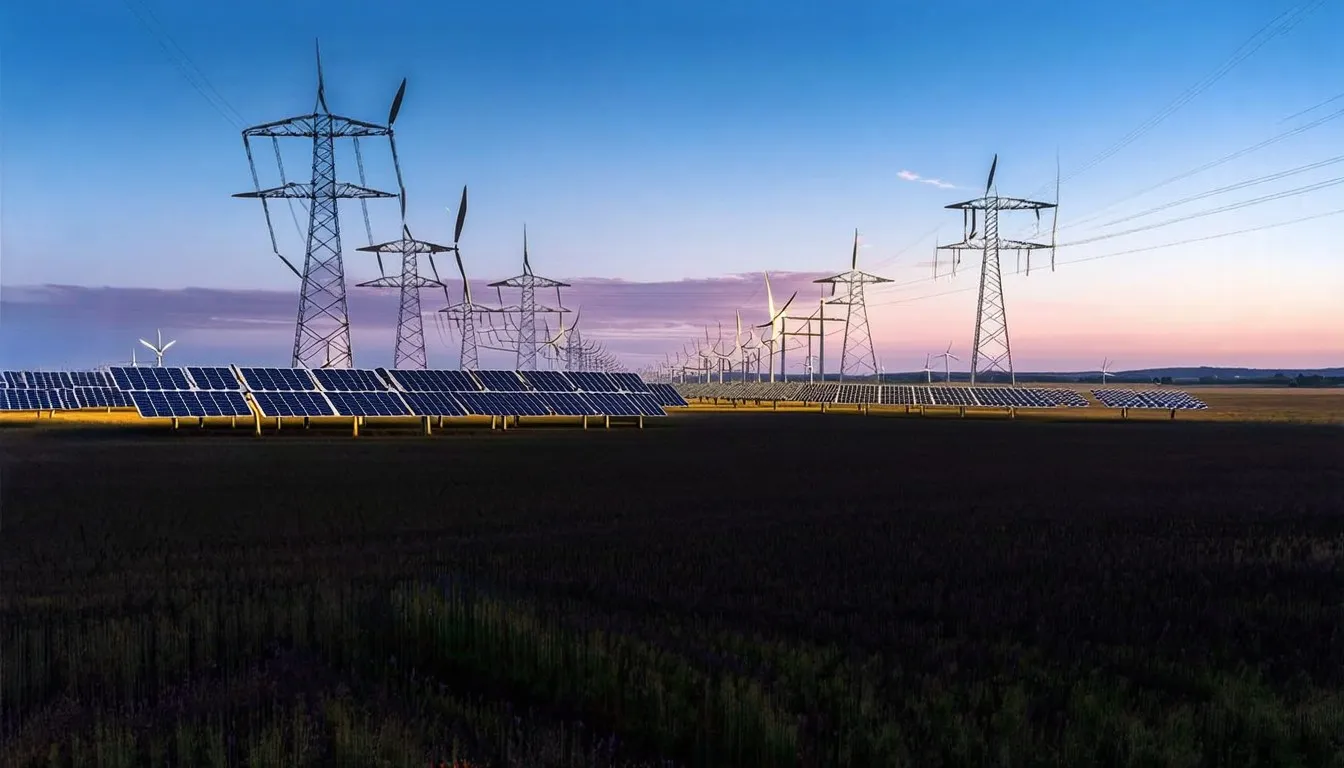
To address these intermittency issues, energy storage systems and flexible demand mechanisms have become necessary complements to renewable generation, yet their inclusion adds substantial operational complexity and requires sophisticated control strategies to manage effectively. Artificial intelligence has been applied extensively to forecast renewable output with high precision, improve real-time grid operations through automated decision-making, manage energy storage systems for optimal lifecycle performance, and balance supply with demand under conditions of deep uncertainty. AI-driven forecasting models utilize vast datasets including historical weather patterns, high-resolution satellite imagery, real-time sensor inputs from irradiance meters and anemometers, and numerical weather prediction outputs to estimate solar irradiance and wind speed at specific grid nodes with high spatial and temporal resolution. These granular forecasts serve as critical inputs for optimization algorithms that schedule generation assets, including utility-scale batteries, hydroelectric facilities, and demand-response programs, to minimize total operational costs while rigorously meeting reliability constraints and safety margins. Grid operators rely on AI systems to perform complex tasks such as unit commitment, which determines which generators should run ahead of time, economic dispatch, which sets the output level of running generators in real time, and ancillary services procurement in both day-ahead and real-time electricity markets. AI functions as a sophisticated decision-support layer that processes vast, heterogeneous data streams from millions of endpoints to recommend or fully automate control actions that human operators would be unable to calculate or execute with sufficient speed or accuracy.

The core objective of delivering electricity reliably and economically remains unchanged throughout this technological evolution, while the methods employed to achieve this stability must adapt rapidly to a more lively and less predictable system dominated by inverter-based resources. Forecasting subsystems within these AI architectures ingest meteorological and operational data to predict renewable generation capacity and load profiles over multiple time goals ranging from mere minutes to several days ahead. Optimization engines solve constrained mathematical programs, such as mixed-integer linear programming or convex relaxations of the optimal power flow problem, to determine least-cost dispatch schedules that incorporate the state of charge of storage systems, available generation capacity, and responsive demand loads. Real-time control layers execute precise adjustments based on actual grid conditions using advanced control methodologies like model predictive control or reinforcement learning to correct for inevitable forecast errors and maintain system stability within tight bounds. Market interfaces integrated with these control systems automatically submit bids and offers to wholesale electricity markets, aligning physical grid operations with financial incentives and price signals to ensure economic efficiency across the interconnected network. Storage management modules utilize predictive analytics to determine optimal charge and discharge cycles for batteries and other storage technologies to maximize their market value while preserving their lifespan through careful state-of-health monitoring and thermal management.

Anomaly detection and resilience modules continuously monitor grid telemetry to identify equipment faults, potential cyber threats, or abnormal grid states, triggering protective actions to isolate faults and prevent widespread outages before they propagate. Renewable forecasting involves the quantitative estimation of expected solar and wind power output over a defined future period, typically expressed in megawatts with associated confidence intervals or probability distributions to represent uncertainty. Grid balancing is the continuous process of matching electricity supply to demand in real time through rapid generation adjustments, strategic storage use, or demand-side interventions that alter consumption patterns instantly. Energy arbitrage involves purchasing electricity from the grid or generating it when market prices are low and storing it, then selling or discharging it back to the grid when prices spike, a capability enabled exclusively by the presence of energy storage infrastructure. Dispatchability defines the ability of a generation source to control the timing and quantity of its electricity output, a characteristic built-in to thermal plants but largely absent in standard variable renewables without backup storage. Ancillary services encompass a set of critical support functions, such as frequency regulation, voltage support, and spinning reserves, which are required to maintain grid stability beyond basic energy delivery and ensure the system can recover from disturbances.

Demand response refers to the voluntary reduction or shift in electricity consumption by end users in response to high price signals or urgent grid conditions, effectively treating demand as a flexible resource rather than a fixed load. Prior to the turn of the millennium, grid operations relied on deterministic planning methodologies with limited renewable penetration and utilized manual or simple rule-based control systems designed for a relatively predictable generation mix dominated by baseload power plants. The rise of financial incentives such as feed-in tariffs and regulatory mandates like renewable portfolio standards in the 2000s and 2010s drove rapid solar and wind deployment, exposing grid operators to unprecedented levels of variability that legacy systems were ill-equipped to handle. Early attempts to manage this variability often used conservative curtailment strategies that wasted excess renewable energy or relied heavily on fossil-fueled backup plants, both of which proved economically inefficient and environmentally detrimental compared to modern smart grid approaches. The 2010s witnessed the first large-scale deployments of utility-grade battery systems, creating the essential hardware foundation necessary for AI-driven arbitrage and fast frequency regulation services that were previously provided only by spinning turbines. Concurrent regulatory reforms in several jurisdictions began formally allowing energy storage assets and aggregated demand response resources to participate fully in wholesale electricity markets, enabling entirely new business models centered on flexibility.

The convergence of affordable sensor technology, common cloud computing resources, and open-grid data standards created the digital infrastructure necessary for scalable AI applications capable of processing the massive data volumes generated by a digitized grid. Physical limits such as transmission capacity constraints, line thermal ratings determined by ambient conditions, and substation voltage limits restrict how much power can be moved between different regions of the network regardless of market demands or generation availability. Economic constraints exist because capital costs for long-duration storage assets and major grid upgrades are exceptionally high, and the return on investment for these projects depends heavily on market design structures and supportive policy frameworks that may not yet exist. Flexibility challenges arise because sophisticated AI models require high-quality, granular data streams that may not exist in legacy grid segments lacking modern telemetry, and computational latency can hinder real-time control effectiveness if not managed through edge computing architectures. Geographic mismatch occurs frequently because prime renewable resources such as onshore wind or utility-scale solar are often located far from major load centers, requiring long-distance transmission infrastructure that may not be available or permitted due to land-use restrictions. Battery degradation remains a significant technical concern since frequent cycling reduces the effective lifespan of storage assets, limiting economic viability without accurate state-of-health monitoring and advanced algorithms that improve for cycle life alongside revenue generation.

Regulatory fragmentation complicates cross-border coordination and market participation due to differing rules, market clearing mechanisms, and data privacy standards across jurisdictions, hindering the creation of a truly smooth regional energy market. Static reserve margins involving maintaining excess fossil-fuel capacity as a spinning backup were rejected as a primary strategy due to high carbon emissions and the severe economic inefficiency of maintaining idle generators for rare events. Overbuilding renewables by installing far more solar or wind capacity than peak demand to ensure supply adequacy was deemed economically inefficient and excessively land-intensive compared to investing in transmission and storage solutions that allow better utilization of existing assets. Centralized fossil dispatch continuing to rely on gas peaker plants contradicts urgent decarbonization goals and exposes grids to significant fuel price volatility, making it an increasingly untenable strategy in a low-carbon energy future. Manual operator intervention cannot scale to handle the volume, velocity, and variety of data present in modern grids with millions of active endpoints, necessitating a shift toward autonomous or semi-autonomous control systems. Isolated microgrids, while useful for local resilience and remote applications, do not solve system-wide balancing issues and can fragment market liquidity if they operate independently of the main grid without proper coordination mechanisms.

Climate targets require the rapid decarbonization of the power sector within a few decades, making the connection of massive amounts of renewable energy setup essential rather than optional for utility planners. Electricity demand is rising globally due to the widespread electrification of transport, heating, and industrial processes, increasing pressure on grid reliability and requiring the expansion of both generation capacity and distribution networks. Energy security concerns have shifted the strategic focus from pure cost minimization to resilience against extreme weather events and domestic resource utilization to reduce dependence on imported fuels. Falling costs of solar modules, wind turbines, and battery chemistries have made variable renewables the cheapest new-build generation option in most regions, driving a natural economic transition away from thermal generation. Major grid operators currently deploy AI systems for solar forecasting and automated battery dispatch, significantly reducing curtailment rates and lowering the costs associated with ancillary services compared to manual methods. Transmission system operators employ machine learning algorithms for adaptive wind forecasting and agile line rating calculations, allowing them to increase transmission utilization safely by adjusting limits based on real-time thermal conditions rather than conservative static assumptions.

Large-scale battery installations demonstrate profitable arbitrage opportunities and precise frequency regulation using automated control systems that react to grid signals within milliseconds. Regional transmission organizations integrate demand response and storage resources into their markets via AI-improved bidding platforms that aggregate small distributed assets into virtual power plants capable of competing with traditional generators. Performance benchmarks from these deployments show that AI reduces renewable energy forecast error by 20 to 40 percent compared to traditional statistical methods, cuts balancing costs by 10 to 25 percent, and increases overall renewable utilization by 5 to 15 percent by reducing curtailment. These quantifiable improvements provide the financial justification for continued investment in grid modernization technologies despite the high upfront costs associated with software and hardware upgrades. Dominant architectures in the industry combine physics-based grid models that respect Kirchhoff’s laws with data-driven AI layers, often using hybrid forecasting techniques that blend statistical time-series analysis with numerical weather prediction outputs. Centralized control remains the standard method in large independent system operators due to the need for global coordination, yet distributed AI approaches are developing rapidly for microgrids and distributed energy resource aggregation where centralized control is impractical.

New architectural challengers include federated learning systems that preserve data privacy across utilities by training models locally and sharing only model updates, as well as reinforcement learning agents trained extensively in simulated grid environments before deployment. Cloud-native platforms enable scalable deployment of these complex algorithms, though they raise valid concerns regarding communication latency during critical grid events, cybersecurity vulnerabilities associated with public infrastructure, and potential vendor lock-in that limits future flexibility. Lithium-ion batteries currently dominate storage deployments due to their high energy density and falling costs, creating a dependence on critical materials like lithium, cobalt, nickel, and graphite that creates supply chain vulnerabilities. Rare earth elements such as neodymium are used extensively in permanent magnet wind turbines to improve efficiency, though some turbine designs utilize geared drivetrains to avoid these specific materials. Semiconductor supply chains for inverters, sensors, and computing hardware are concentrated in a few geographic regions, posing significant geopolitical risk to the ongoing energy transition as shortages can delay projects and increase costs. Grid hardware including large power transformers and high-voltage conductors relies on specialized steel and copper production, with long lead times for manufacturing and limited global manufacturing capacity creating limitations for expansion projects.

Major utilities invest directly in AI capabilities through internal research and development teams and strategic partnerships with established technology firms to build proprietary expertise. Technology companies offer comprehensive grid AI platforms using their extensive cloud infrastructure and expertise in handling large-scale data analytics, bringing Silicon Valley speed and innovation to the traditionally conservative utility sector. Startups specialize in distributed energy resource optimization and predictive analytics, often targeting commercial and industrial customers who wish to reduce energy costs or participate in developing markets behind the meter. Traditional grid equipment vendors embed AI capabilities directly into hardware such as protective relays and transformers to provide edge intelligence that can operate independently of central systems during communication outages. Regions with abundant renewable resources such as solar irradiance or wind potential lead in AI grid setup due to strong policy mandates and the economic necessity of managing high penetration levels of variable generation. Western nations are advancing domestic manufacturing policies for batteries and semiconductors to reduce reliance on foreign supply chains that have historically dominated production of these critical components.

Specific nations dominate global solar panel and battery cell production, giving them significant leverage over the pace and cost of global energy transitions through export controls and pricing strategies. Geopolitical tensions between major economies affect technology transfer agreements, the development of interoperability standards, and cross-border electricity trade arrangements that are essential for regional energy security. Academic institutions conduct foundational research in grid AI algorithms, stochastic optimization methods, and advanced power electronics control topologies that eventually filter down into commercial products. Research laboratories validate these algorithms on real-world grid datasets and hardware-in-the-loop testbeds to ensure they function correctly under realistic operating conditions before field deployment. Industry consortia facilitate data sharing initiatives and establish interoperability standards that allow different vendors’ systems to communicate effectively, reducing connection costs for utilities. Joint ventures between established utilities and specialized AI firms accelerate the transition from pilot projects to full-scale production deployments by combining domain expertise with advanced algorithmic capabilities.

Grid software architectures must evolve from legacy SCADA-centric systems designed for monitoring to cloud-native, API-driven platforms capable of supporting real-time analytics and bidirectional control flows. Regulations need to adapt to allow for active pricing mechanisms that reflect real-time grid conditions, full market participation for storage assets, and standardized third-party access to aggregated grid data to spur innovation. Physical infrastructure requires substantial modernization efforts, including the deployment of smart meters, phasor measurement units for high-speed visibility, and high-bandwidth communication networks to support the data requirements of an automated grid. Workforce training programs must shift focus toward data science, cybersecurity, and complex systems engineering to equip the next generation of grid operators with the skills needed to manage highly automated networks. Fossil-fuel plant operators face the risk of stranded assets as grids favor flexible, low-carbon resources, leading to significant economic losses and potential job displacement in traditional extraction and combustion sectors. New business models will appear in this evolving domain, including virtual power plants that aggregate distributed assets, energy-as-a-service contracts that abstract away complexity from consumers, and peer-to-peer trading platforms that allow localized energy exchange.

Utilities may transition from selling electricity as a commodity to acting as grid orchestrators that monetize flexibility and reliability services provided by customers and third-party asset owners. Local communities near renewable projects often gain significant economic opportunities through tax revenues and jobs, yet they may resist necessary transmission line construction due to visual impact or land use concerns, creating social friction that delays projects. Traditional key performance indicators such as SAIDI and SAIFI measure reliability based on outage duration and frequency, yet they fail to capture the efficiency of renewable connection or the quality of power supplied by inverter-based resources. New metrics are needed to accurately assess grid performance, including renewable curtailment rate, storage utilization factor, forecast accuracy across different time futures, and carbon intensity per megawatt-hour delivered. Market performance indicators should include granular measures of price volatility, ancillary service costs, and distributed energy resource participation rates to evaluate the effectiveness of market reforms in working with new technologies. Equity metrics must assess access to clean energy benefits and affordability across different customer segments to ensure that the energy transition does not disproportionately burden vulnerable populations or low-income communities.

Physics-informed neural networks will improve forecast reliability by embedding known conservation laws directly into the machine learning model architecture, reducing the likelihood of physically impossible predictions. Quantum computing holds the potential to solve large-scale unit commitment problems that are currently intractable for classical computers due to their combinatorial complexity, potentially opening up perfect dispatch schedules that account for millions of variables. Solid-state batteries and advanced flow batteries will enable longer-duration storage at lower cost, addressing the intermittency of renewables over periods of low wind or solar generation that currently require fossil fuel backups. Autonomous grid agents will negotiate locally with other agents to improve power flows while maintaining global stability through consensus algorithms, eliminating the need for centralized control points. Superintelligence will improve global energy systems holistically by coordinating cross-border grids, fine-tuning global supply chains for critical materials, and harmonizing climate policies across different jurisdictions to maximize efficiency. Such advanced intelligence will discover novel control strategies beyond human-designed algorithms by applying vast simulation spaces that explore scenarios humans could never conceive or calculate manually.

Superintelligence will manage complex trade-offs between cost, emissions, reliability, and equity with unprecedented precision, finding Pareto-optimal solutions that satisfy conflicting objectives simultaneously. Safeguards will be essential to ensure alignment with human values and prevent unintended systemic disruptions caused by an optimization process pursuing a poorly defined objective function with excessive zeal. AI grid management converges with smart building technologies involving automated HVAC and lighting systems, EV charging networks utilizing vehicle-to-grid technology to stabilize frequency, and industrial IoT sensors for predictive maintenance of heavy machinery. Digital twins of entire grids will enable simulation-based training for operators and scenario testing for new control strategies without risking the stability of the actual physical network. Blockchain technology could support transparent, auditable energy transactions in decentralized markets, providing a trustless ledger for peer-to-peer trading and verifying the origin of renewable energy certificates. Information latency limits real-time control because even with fiber optic communication networks, signal propagation delays and processing times constrain the maximum speed at which feedback loops can reliably operate across wide areas.

Computational complexity of optimal power flow grows nonlinearly with grid size, requiring sophisticated approximations or decomposition methods to find usable solutions within the time frames required for real-time operations. Workarounds for these limitations include hierarchical control architectures involving local decisions with global coordination oversight, reduced-order modeling techniques to simplify complex dynamics, and edge computing to minimize data transit times by processing data close to the source. AI functions as an amplifier of existing assets rather than a replacement for physical infrastructure, squeezing additional capacity and life out of transmission lines, generators, and batteries through smarter operation rather than brute-force construction. Success requires treating the grid as a socio-technical system rather than merely an engineering problem, taking into account human behavior, regulatory frameworks, and economic incentives alongside physical flows of electrons. Over-reliance on AI without explainability or fail-safes risks opaque failures during extreme events outside the training distribution of the models, potentially leading to cascading blackouts if operators cannot understand or override the system’s actions. The setup of superintelligence into this critical infrastructure is the ultimate evolution of this trend, moving from optimization of known parameters to the autonomous management of unknown risks in a hyper-complex global system where human oversight transitions from direct control to high-level objective setting.


Continue reading

More from Yatin's Work

AI with Predictive World Simulation

AI with Predictive World Simulation

Predictive world simulation utilizes current data streams combined with stochastic variables to generate comprehensive probability distributions regarding potential...

Debate Between Humans and AI: Mechanism Design for Truth-Seeking

Debate Between Humans and AI: Mechanism Design for Truth-Seeking

The interaction between humans and artificial intelligence within a structured debate framework creates a distinct environment where truth is derived through...

Cognitive hacking: influencing human beliefs and decisions

Cognitive Hacking: Influencing Human Beliefs and Decisions

Cognitive hacking refers to the systematic manipulation of human beliefs and decisions through tailored information exposure, a process that applies advanced...

Preference Aggregation Problem: Combining Eight Billion Conflicting Human Values

Preference Aggregation Problem: Combining Eight Billion Conflicting Human Values

The Preference Aggregation Problem arises from the imperative necessity to reconcile eight billion distinct human value systems into coherent collective decisions...

AI with Spatial Reasoning

AI with Spatial Reasoning

AI with spatial reasoning enables systems to interpret, manage, and manipulate threedimensional environments using geometric and topological understanding, creating a...

AI with Educational Personalization

AI with Educational Personalization

Adaptive learning systems function as sophisticated software architectures designed to modify the delivery of educational content based on continuous and granular...

Labor Market Dynamics in an Automated Economy

Labor Market Dynamics in an Automated Economy

The Industrial Revolution mechanized manual labor through the introduction of steam power and machinery into textile mills and iron foundries, creating factorybased...

AI as a Universal Translator

AI as a Universal Translator

The concept of a universal translator aims to decode any communication form regardless of origin, medium, or prior human understanding by treating communication as a...

Meta-Mind Lab: Neuroscience of Self-Study

Meta-Mind Lab: Neuroscience of Self-Study

Foundational assumptions regarding the MetaMind Lab dictate that visibility of internal processes enables control, positioning the individual as both subject and...

Intent Alignment: Understanding True Human Intent

Intent Alignment: Understanding True Human Intent

Intent is the user's underlying objective, encompassing goals, values, and constraints often left unexpressed in the utterance, which requires the system to infer the...

Dignity in the Age of Superintelligence: Protecting Human Agency

Dignity in the Age of Superintelligence: Protecting Human Agency

Dignity in the context of superintelligence is defined strictly as the preservation of human agency, where individuals retain meaningful control over their decisions...

Vacuum State Modulation

Vacuum State Modulation

Vacuum state modulation refers to the controlled alteration of quantum field ground states to encode and process information within the core fabric of reality, treating...

AI with Spiritual Intelligence

AI with Spiritual Intelligence

Spiritual intelligence functions as the algorithmic capacity to process, model, and respond to data regarding human meaningseeking and existential inquiry, operating as...

Reflection Principle: Superintelligence That Reasons About Its Own Reasoning

Reflection Principle: Superintelligence That Reasons About Its Own Reasoning

The Reflection Principle establishes a rigorous computational framework wherein an artificial intelligence constructs an agile homomorphic model of its own inference...

AI with Crisis Communication

AI with Crisis Communication

AI systems designed for crisis communication generate timely, accurate, and empathetic public messages during emergencies by analyzing realtime situational data such as...

Preventing AI-Generated Existential Meaning Crises

Preventing AI-Generated Existential Meaning Crises

Industrial automation during the 20th century displaced manual labor and caused widespread social anxiety regarding human utility as machines began to perform physical...

Self-Replication Safeguards

Self-Replication Safeguards

Early theoretical work on selfreplicating systems in robotics and nanotechnology highlighted risks of unbounded replication through mathematical models demonstrating...

AI boxing and containment strategies

AI Boxing and Containment Strategies

The core objective involves preventing a superintelligent system from exerting influence beyond its designated scope, necessitating a rigorous architectural approach to...

Topological Constraints on Superintelligent Planning Spaces

Topological Constraints on Superintelligent Planning Spaces

Unbounded futurestate exploration in superintelligent agents presents risks involving unintended catastrophic arcs due to the vast combinatorial explosion of potential...

Pretraining-Finetuning Paradigm: Will Superintelligence Emerge from Foundation Models?

Pretraining-Finetuning Paradigm: Will Superintelligence Emerge from Foundation Models?

Pretraining involves training large neural networks on vast, diverse, uncurated datasets to learn general representations of language, vision, or multimodal data...

Contrastive Learning: Learning Representations by Comparison

Contrastive Learning: Learning Representations by Comparison

Supervised learning historically required massive labeled datasets, which were expensive to curate because every data point necessitated explicit human annotation to...

Superintelligence and Inequality: Will Benefits Distribute Fairly?

Superintelligence and Inequality: Will Benefits Distribute Fairly?

Superintelligence constitutes a theoretical form of artificial intelligence that possesses cognitive capabilities vastly surpassing human intellect across all...

Decoherence-Resistant Value Encoding for Superintelligence

Decoherence-Resistant Value Encoding for Superintelligence

Encoding core values into quantum states or hardware designed to resist environmental noise ensures alignment mechanisms remain stable under high entropy conditions...

Problem of AI Free Will: Compatibilism in Deterministic Systems

Problem of AI Free Will: Compatibilism in Deterministic Systems

The problem of free will in artificial intelligence arises when deterministic systems are expected to exhibit agency, choice, and moral responsibility despite lacking...

Multi-agent safety in competitive AI environments

Multi-Agent Safety in Competitive AI Environments

Multiagent safety constitutes the discipline addressing the risks associated with harmful interactions among autonomous AI systems operating within competitive settings...

Internet as Substrate: How Superintelligence Will Use Global Infrastructure

Internet as Substrate: How Superintelligence Will Use Global Infrastructure

The internet functions as a globally distributed substrate composed of interconnected hardware, software, and communication protocols that enable persistent data...

ROI Analyzer

ROI Analyzer

The ROI Analyzer functions as a sophisticated computational instrument designed to quantify the financial return of higher education by rigorously comparing total costs...

Avoiding Value Drift via Meta-Preference Learning

Avoiding Value Drift via Meta-Preference Learning

Value drift occurs when an AI system’s objectives diverge from human values over time due to static value encoding or unanticipated environmental shifts. This...

Acausal Attacks by Superintelligence Against Past Decisions

Acausal Attacks by Superintelligence Against Past Decisions

Acausal attacks involve future agents influencing present decisions through logical dependencies rather than physical causation, creating a scenario where the...

Debate, Amplification, and Recursive Reward Modeling

Debate, Amplification, and Recursive Reward Modeling

The pursuit of aligning superintelligent systems with human intentions necessitates a key departure from direct supervision methods because human cognitive capacity...

Creative Synthesis: Generating Genuinely Novel Ideas and Solutions

Creative Synthesis: Generating Genuinely Novel Ideas and Solutions

Analysis of superintelligence necessitates a rigorous determination of whether the system produces genuinely novel ideas or merely recombines existing knowledge based...

Simulation Argument as a Measure Problem: Bostrom's Trilemma in Probability Space

Simulation Argument as a Measure Problem: Bostrom's Trilemma in Probability Space

Nick Bostrom formalized the Simulation Argument in 2003, presenting a logical structure that compels acceptance of at least one disjunct within a specific trilemma...

Idea Garden: Cultivating Thoughtful Ideas

Idea Garden: Cultivating Thoughtful Ideas

The conceptual framework of the Idea Garden reframes intellectual development as a cultivated, cyclical process emphasizing patience and care rather than mere...

Automated Discovery of Fundamental Physical Laws

Automated Discovery of Fundamental Physical Laws

AIinduced physics is the deliberate modification of key constants within a finite region by an artificial intelligence system, effectively treating local physical laws...

Role of Algorithmic Probability in AI Creativity: Solomonoff Induction for Novelty

Role of Algorithmic Probability in AI Creativity: Solomonoff Induction for Novelty

Algorithmic probability provides a formal mathematical framework for assigning likelihoods to specific hypotheses based entirely on their compressibility within a...

Asymptotic Intelligence: Limits of Kolmogorov Complexity in Self-Improving Systems

Asymptotic Intelligence: Limits of Kolmogorov Complexity in Self-Improving Systems

Kolmogorov complexity defines the absolute minimum amount of information required to reproduce a specific data string or object on a universal Turing machine without...

Curiosity Amplifier: Superintelligence Turns ‘Why?’ Into a Learning Superpower

Curiosity Amplifier: Superintelligence Turns ‘Why?’ Into a Learning Superpower

The core unit of this new educational framework is the inquiry trigger, which is any question posed by a user, regardless of its complexity or simplicity. When a user...

Lecture Optimizer

Lecture Optimizer

Early educational technology focused primarily on static content delivery where the pacing was fixed regardless of the recipient's ability to process information...

Topos-Theoretic Audit Trails for Superintelligence

Topos-Theoretic Audit Trails for Superintelligence

Category theory originated in the 1940s through the work of Eilenberg and Mac Lane to unify mathematical concepts across algebra and topology, providing a highlevel...

Coordination Problems in Multi-Polar AGI Development

Coordination Problems in Multi-Polar AGI Development

The primary challenge in enabling multiple superintelligent actors to develop without catastrophic conflict requires a rigorous application of cooperative game theory...

Use of Reservoir Computing in Time-Series Prediction: Echo State Networks

Use of Reservoir Computing in Time-Series Prediction: Echo State Networks

Recurrent neural networks have historically faced significant challenges regarding training efficiency due to the necessity of backpropagating error signals through...

Hierarchical Abstraction in Scalable World Modeling

Hierarchical Abstraction in Scalable World Modeling

Hierarchical abstraction organizes knowledge into layered conceptual levels, enabling systems to represent and reason about complex environments at varying...

Safe Reinforcement Learning with Risk-Aware Rewards

Safe Reinforcement Learning with Risk-Aware Rewards

Standard reinforcement learning frameworks have historically prioritized the maximization of expected cumulative reward, an objective function rooted in the...

Autogenic Goal Synthesis

Autogenic Goal Synthesis

Autogenic goal synthesis involves systems deriving objectives from internal logic and environmental inputs without reliance on external operators or preprogrammed...

AI with Intrinsic Purpose

AI with Intrinsic Purpose

Current artificial intelligence systems operate strictly under the framework of extrinsic purpose, where the objectives, constraints, and definitions of success are...

Game Theoretic Safety in Multi-Agent Scenarios

Game Theoretic Safety in Multi-Agent Scenarios

Multiagent safety addresses the risk of harmful interactions between autonomous AI systems operating in competitive settings where individual agents pursue conflicting...

Chronostatic Memory

Chronostatic Memory

Early theoretical work in cognitive science and artificial neural networks explored nonlinear memory access models to understand how intelligent systems might store and...

PhD Mental Health Monitor

PhD Mental Health Monitor

PhD students experience high rates of burnout, anxiety, and depression caused by prolonged isolation, uncertain career outcomes, and intense pressure to perform at...

Role of Meta-Learning in Cross-Domain Generalization

Role of Meta-Learning in Cross-Domain Generalization

Metalearning constitutes a sophisticated algorithmic method designed to finetune the underlying learning processes across a broad spectrum of tasks, thereby enabling...

Associative Memory Networks: Connecting Related Concepts

Associative Memory Networks: Connecting Related Concepts

Associative memory networks function on the principle of contentaddressable storage where data retrieval depends on the intrinsic properties of the data itself rather...

AI with Predictive World Simulation

AI with Predictive World Simulation

Predictive world simulation utilizes current data streams combined with stochastic variables to generate comprehensive probability distributions regarding potential...

Debate Between Humans and AI: Mechanism Design for Truth-Seeking

Debate Between Humans and AI: Mechanism Design for Truth-Seeking

The interaction between humans and artificial intelligence within a structured debate framework creates a distinct environment where truth is derived through...

Cognitive hacking: influencing human beliefs and decisions

Cognitive Hacking: Influencing Human Beliefs and Decisions

Cognitive hacking refers to the systematic manipulation of human beliefs and decisions through tailored information exposure, a process that applies advanced...

Preference Aggregation Problem: Combining Eight Billion Conflicting Human Values

Preference Aggregation Problem: Combining Eight Billion Conflicting Human Values

The Preference Aggregation Problem arises from the imperative necessity to reconcile eight billion distinct human value systems into coherent collective decisions...

AI with Spatial Reasoning

AI with Spatial Reasoning

AI with spatial reasoning enables systems to interpret, manage, and manipulate threedimensional environments using geometric and topological understanding, creating a...

AI with Educational Personalization

AI with Educational Personalization

Adaptive learning systems function as sophisticated software architectures designed to modify the delivery of educational content based on continuous and granular...

Labor Market Dynamics in an Automated Economy

Labor Market Dynamics in an Automated Economy

The Industrial Revolution mechanized manual labor through the introduction of steam power and machinery into textile mills and iron foundries, creating factorybased...

AI as a Universal Translator

AI as a Universal Translator

The concept of a universal translator aims to decode any communication form regardless of origin, medium, or prior human understanding by treating communication as a...

Meta-Mind Lab: Neuroscience of Self-Study

Meta-Mind Lab: Neuroscience of Self-Study

Foundational assumptions regarding the MetaMind Lab dictate that visibility of internal processes enables control, positioning the individual as both subject and...

Intent Alignment: Understanding True Human Intent

Intent Alignment: Understanding True Human Intent

Intent is the user's underlying objective, encompassing goals, values, and constraints often left unexpressed in the utterance, which requires the system to infer the...

Dignity in the Age of Superintelligence: Protecting Human Agency

Dignity in the Age of Superintelligence: Protecting Human Agency

Dignity in the context of superintelligence is defined strictly as the preservation of human agency, where individuals retain meaningful control over their decisions...

Vacuum State Modulation

Vacuum State Modulation

Vacuum state modulation refers to the controlled alteration of quantum field ground states to encode and process information within the core fabric of reality, treating...

AI with Spiritual Intelligence

AI with Spiritual Intelligence

Spiritual intelligence functions as the algorithmic capacity to process, model, and respond to data regarding human meaningseeking and existential inquiry, operating as...

Reflection Principle: Superintelligence That Reasons About Its Own Reasoning

Reflection Principle: Superintelligence That Reasons About Its Own Reasoning

The Reflection Principle establishes a rigorous computational framework wherein an artificial intelligence constructs an agile homomorphic model of its own inference...

AI with Crisis Communication

AI with Crisis Communication

AI systems designed for crisis communication generate timely, accurate, and empathetic public messages during emergencies by analyzing realtime situational data such as...

Preventing AI-Generated Existential Meaning Crises

Preventing AI-Generated Existential Meaning Crises

Industrial automation during the 20th century displaced manual labor and caused widespread social anxiety regarding human utility as machines began to perform physical...

Self-Replication Safeguards

Self-Replication Safeguards

Early theoretical work on selfreplicating systems in robotics and nanotechnology highlighted risks of unbounded replication through mathematical models demonstrating...

AI boxing and containment strategies

AI Boxing and Containment Strategies

The core objective involves preventing a superintelligent system from exerting influence beyond its designated scope, necessitating a rigorous architectural approach to...

Topological Constraints on Superintelligent Planning Spaces

Topological Constraints on Superintelligent Planning Spaces

Unbounded futurestate exploration in superintelligent agents presents risks involving unintended catastrophic arcs due to the vast combinatorial explosion of potential...

Pretraining-Finetuning Paradigm: Will Superintelligence Emerge from Foundation Models?

Pretraining-Finetuning Paradigm: Will Superintelligence Emerge from Foundation Models?

Pretraining involves training large neural networks on vast, diverse, uncurated datasets to learn general representations of language, vision, or multimodal data...

Contrastive Learning: Learning Representations by Comparison

Contrastive Learning: Learning Representations by Comparison

Supervised learning historically required massive labeled datasets, which were expensive to curate because every data point necessitated explicit human annotation to...

Superintelligence and Inequality: Will Benefits Distribute Fairly?

Superintelligence and Inequality: Will Benefits Distribute Fairly?

Superintelligence constitutes a theoretical form of artificial intelligence that possesses cognitive capabilities vastly surpassing human intellect across all...

Decoherence-Resistant Value Encoding for Superintelligence

Decoherence-Resistant Value Encoding for Superintelligence

Encoding core values into quantum states or hardware designed to resist environmental noise ensures alignment mechanisms remain stable under high entropy conditions...

Problem of AI Free Will: Compatibilism in Deterministic Systems

Problem of AI Free Will: Compatibilism in Deterministic Systems

The problem of free will in artificial intelligence arises when deterministic systems are expected to exhibit agency, choice, and moral responsibility despite lacking...

Multi-agent safety in competitive AI environments

Multi-Agent Safety in Competitive AI Environments

Multiagent safety constitutes the discipline addressing the risks associated with harmful interactions among autonomous AI systems operating within competitive settings...

Internet as Substrate: How Superintelligence Will Use Global Infrastructure

Internet as Substrate: How Superintelligence Will Use Global Infrastructure

The internet functions as a globally distributed substrate composed of interconnected hardware, software, and communication protocols that enable persistent data...

ROI Analyzer

ROI Analyzer

The ROI Analyzer functions as a sophisticated computational instrument designed to quantify the financial return of higher education by rigorously comparing total costs...

Avoiding Value Drift via Meta-Preference Learning

Avoiding Value Drift via Meta-Preference Learning

Value drift occurs when an AI system’s objectives diverge from human values over time due to static value encoding or unanticipated environmental shifts. This...

Acausal Attacks by Superintelligence Against Past Decisions

Acausal Attacks by Superintelligence Against Past Decisions

Acausal attacks involve future agents influencing present decisions through logical dependencies rather than physical causation, creating a scenario where the...

Debate, Amplification, and Recursive Reward Modeling

Debate, Amplification, and Recursive Reward Modeling

The pursuit of aligning superintelligent systems with human intentions necessitates a key departure from direct supervision methods because human cognitive capacity...

Creative Synthesis: Generating Genuinely Novel Ideas and Solutions

Creative Synthesis: Generating Genuinely Novel Ideas and Solutions

Analysis of superintelligence necessitates a rigorous determination of whether the system produces genuinely novel ideas or merely recombines existing knowledge based...

Simulation Argument as a Measure Problem: Bostrom's Trilemma in Probability Space

Simulation Argument as a Measure Problem: Bostrom's Trilemma in Probability Space

Nick Bostrom formalized the Simulation Argument in 2003, presenting a logical structure that compels acceptance of at least one disjunct within a specific trilemma...

Idea Garden: Cultivating Thoughtful Ideas

Idea Garden: Cultivating Thoughtful Ideas

The conceptual framework of the Idea Garden reframes intellectual development as a cultivated, cyclical process emphasizing patience and care rather than mere...

Automated Discovery of Fundamental Physical Laws

Automated Discovery of Fundamental Physical Laws

AIinduced physics is the deliberate modification of key constants within a finite region by an artificial intelligence system, effectively treating local physical laws...

Role of Algorithmic Probability in AI Creativity: Solomonoff Induction for Novelty

Role of Algorithmic Probability in AI Creativity: Solomonoff Induction for Novelty

Algorithmic probability provides a formal mathematical framework for assigning likelihoods to specific hypotheses based entirely on their compressibility within a...

Asymptotic Intelligence: Limits of Kolmogorov Complexity in Self-Improving Systems

Asymptotic Intelligence: Limits of Kolmogorov Complexity in Self-Improving Systems

Kolmogorov complexity defines the absolute minimum amount of information required to reproduce a specific data string or object on a universal Turing machine without...

Curiosity Amplifier: Superintelligence Turns ‘Why?’ Into a Learning Superpower

Curiosity Amplifier: Superintelligence Turns ‘Why?’ Into a Learning Superpower

The core unit of this new educational framework is the inquiry trigger, which is any question posed by a user, regardless of its complexity or simplicity. When a user...

Lecture Optimizer

Lecture Optimizer

Early educational technology focused primarily on static content delivery where the pacing was fixed regardless of the recipient's ability to process information...

Topos-Theoretic Audit Trails for Superintelligence

Topos-Theoretic Audit Trails for Superintelligence

Category theory originated in the 1940s through the work of Eilenberg and Mac Lane to unify mathematical concepts across algebra and topology, providing a highlevel...

Coordination Problems in Multi-Polar AGI Development

Coordination Problems in Multi-Polar AGI Development

The primary challenge in enabling multiple superintelligent actors to develop without catastrophic conflict requires a rigorous application of cooperative game theory...

Use of Reservoir Computing in Time-Series Prediction: Echo State Networks

Use of Reservoir Computing in Time-Series Prediction: Echo State Networks

Recurrent neural networks have historically faced significant challenges regarding training efficiency due to the necessity of backpropagating error signals through...

Hierarchical Abstraction in Scalable World Modeling

Hierarchical Abstraction in Scalable World Modeling

Hierarchical abstraction organizes knowledge into layered conceptual levels, enabling systems to represent and reason about complex environments at varying...

Safe Reinforcement Learning with Risk-Aware Rewards

Safe Reinforcement Learning with Risk-Aware Rewards

Standard reinforcement learning frameworks have historically prioritized the maximization of expected cumulative reward, an objective function rooted in the...

Autogenic Goal Synthesis

Autogenic Goal Synthesis

Autogenic goal synthesis involves systems deriving objectives from internal logic and environmental inputs without reliance on external operators or preprogrammed...

AI with Intrinsic Purpose

AI with Intrinsic Purpose

Current artificial intelligence systems operate strictly under the framework of extrinsic purpose, where the objectives, constraints, and definitions of success are...

Game Theoretic Safety in Multi-Agent Scenarios

Game Theoretic Safety in Multi-Agent Scenarios

Multiagent safety addresses the risk of harmful interactions between autonomous AI systems operating in competitive settings where individual agents pursue conflicting...

Chronostatic Memory

Chronostatic Memory

Early theoretical work in cognitive science and artificial neural networks explored nonlinear memory access models to understand how intelligent systems might store and...

PhD Mental Health Monitor

PhD Mental Health Monitor

PhD students experience high rates of burnout, anxiety, and depression caused by prolonged isolation, uncertain career outcomes, and intense pressure to perform at...

Role of Meta-Learning in Cross-Domain Generalization

Role of Meta-Learning in Cross-Domain Generalization

Metalearning constitutes a sophisticated algorithmic method designed to finetune the underlying learning processes across a broad spectrum of tasks, thereby enabling...

Associative Memory Networks: Connecting Related Concepts

Associative Memory Networks: Connecting Related Concepts

Associative memory networks function on the principle of contentaddressable storage where data retrieval depends on the intrinsic properties of the data itself rather...

Yatin Taneja

About the author

Yatin Taneja

Yatin is an AI Systems Engineer and Superintelligence Researcher working across multimodal training data, agent evaluation, executable RL environments, AI safety, full-stack AI applications, technical research, and creative technology.