Knowledge hub

Sensorimotor Grounding in Artificial General Intelligence

Sensorimotor Grounding in Artificial General Intelligence

Physical agents acquire knowledge through direct sensorimotor interaction with environments to ground abstract concepts in real-world dynamics, a process that distinguishes embodied intelligence from purely computational approaches. Intelligence develops from continuous feedback loops between action and perception, where agents adapt to physical constraints like friction and inertia rather than operating in a vacuum of symbolic logic. Purely symbolic or text-based models lack grounding in physical causality, leading to brittleness in real-world settings requiring spatial reasoning because they manipulate tokens without understanding the referents of those tokens in the physical world. Embodiment introduces noise and uncertainty, which forces durable adaptive behavior instead of pattern matching on curated datasets, as the physical world presents infinite variability that cannot be compressed into a static training distribution without loss of fidelity. Learning in embodied systems integrates vision, touch, and proprioception to build coherent internal models of the world, allowing the agent to predict how the environment responds to its actions. Perception-action cycles drive learning and decision-making with internal representations shaped by physical experience, ensuring that the cognitive structures of the agent are formed by the constraints and affordances of the environment it inhabits. Cognition depends on the body’s morphology, sensor suite, and interaction capabilities rather than existing independently of hardware, meaning the physical form of the robot dictates the nature of the intelligence it can create. Agents must solve tasks under real-time constraints and resource limitations such as energy and computational latency, which imposes a pressure for efficiency that is absent in server-based AI training. Generalization improves when training includes diverse physical scenarios instead of relying solely on varied data distributions, as exposure to the messy reality of physics forces the system to learn durable invariants rather than superficial statistical correlations.
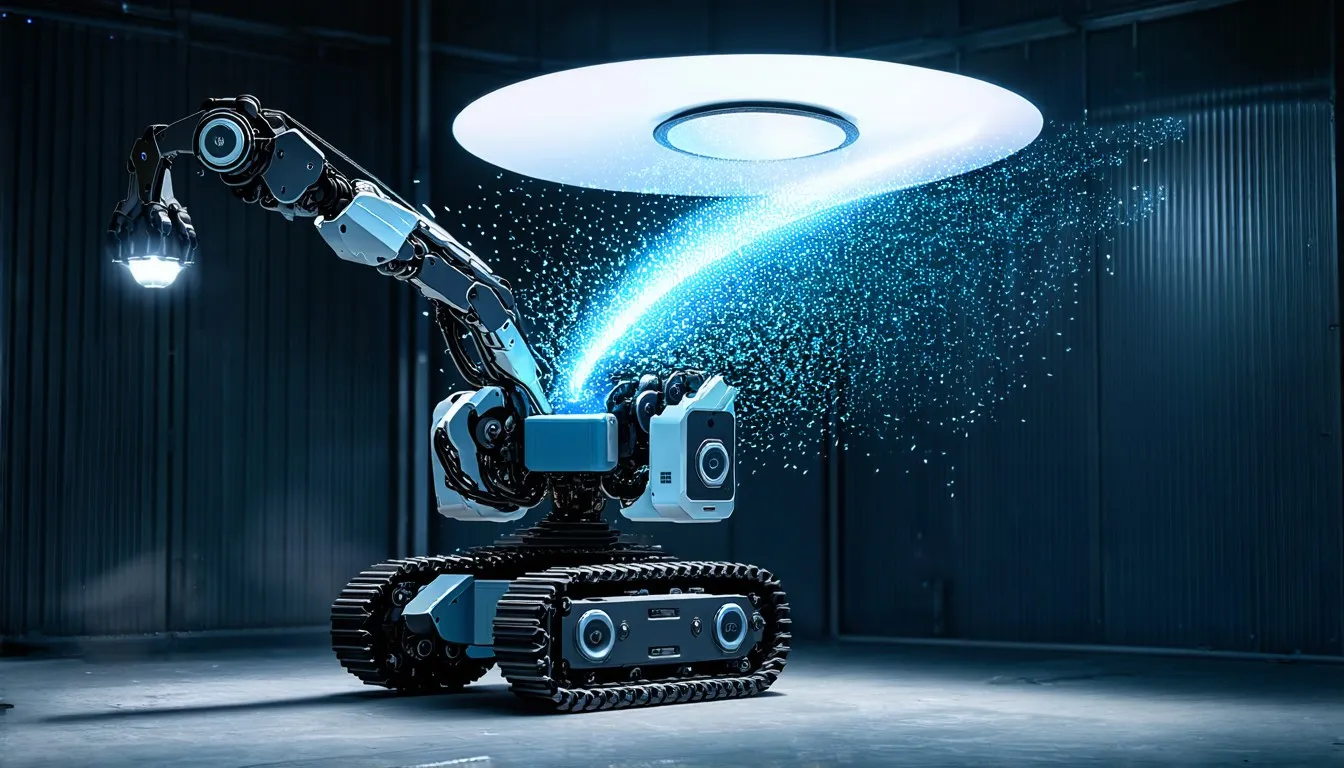
The sensorimotor loop describes the closed cycle of sensing environmental states computing actions executing them and observing resulting changes, forming the core unit of analysis for embodied intelligence. Grounding is the process by which abstract symbols acquire meaning through correlation with physical experiences, allowing a system to understand the concept of “heavy” not just as a word associated with other words but as a sensory experience of resistance and mass. Affordances are properties of the environment that suggest possible actions to an agent such as a handle affording grasping or a flat surface affording support, providing a direct link between perception and action that bypasses complex symbolic reasoning. Morphological computation involves offloading part of the cognitive load to the physical structure of the body like passive dynamics in walking robots, where the mechanical properties of the limbs simplify the control problem by handling stability and energy absorption naturally. System architecture integrates perception modules motor control a world model and a policy network that maps states to actions, requiring tight coupling between these components to achieve the millisecond-scale reaction times necessary for physical interaction. The world model encodes physical laws approximately to predict outcomes of actions enabling planning without exhaustive trial-and-error, serving as an internal simulation that allows the agent to test hypotheses before committing to potentially dangerous physical movements. Policy learning combines reinforcement learning with model-based control where the model informs action selection under uncertainty, using the strengths of both data-driven learning and physics-based prediction. Memory systems store episodic experiences tied to sensorimotor sequences supporting transfer across tasks and environments, allowing the agent to recall previous solutions to similar physical problems and adapt them to new contexts. Continuous calibration loops adjust internal parameters based on prediction errors between expected and observed sensory feedback, ensuring that the system remains accurate despite changes in its own hardware or the environment.

Early robotics research during the 1980s and 1990s demonstrated that simple embodied agents could exhibit complex behaviors without explicit programming, challenging the notion that high-level reasoning is a prerequisite for intelligent action. Rodney Brooks’ subsumption architecture, introduced in 1986, argued for intelligence built from layered reactive behaviors tied to sensors, showing that complex global behavior could arise from the interaction of simple local rules without a central planner. The failure of purely simulation-trained agents to transfer to real robots highlighted the necessity of physical interaction for strong learning, as discrepancies between idealized physics models and the messy reality of friction and sensor noise often caused catastrophic failure in deployed systems. Advances in deep reinforcement learning during the 2010s enabled end-to-end training of embodied policies relying heavily on simulated environments, allowing researchers to train complex neural networks on millions of episodes of experience before deploying them on physical hardware. Recent work in the 2020s shows agents trained with high-fidelity physics simulators and domain randomization achieve better real-world transfer, bridging the gap between virtual and physical worlds by exposing the learning algorithm to a wide range of visual and physical variations during training. Pure simulation training was rejected due to persistent sim-to-real gaps, especially in contact-rich tasks like manipulation or locomotion, where small errors in contact modeling lead to large divergences in behavior. End-to-end deep learning without explicit world models lacked sample efficiency and interpretability for safety-critical applications, making it difficult to trust a system that operates as a black box in a physically hazardous environment. Centralized symbolic planners failed to handle real-time adaptation and uncertainty natural in physical interaction, as they could not process the high-bandwidth sensory stream required for reactive control. Cloud-based cognition was discarded for latency-sensitive tasks requiring millisecond-level response times, due to the unacceptable delays introduced by transmitting sensor data to a remote server and receiving actuation commands.

Physical hardware imposes hard limits including actuator precision, sensor resolution, power consumption, and thermal dissipation, creating a bounded design space that engineers must work through to create functional embodied systems. Economic viability depends on the cost of robotic platforms, maintenance, and energy use as high-end systems remain expensive for widespread deployment, limiting the accessibility of advanced embodied AI to well-funded industrial applications. Adaptability faces limits due to the need for diverse real-world training environments, because collecting physical interaction data is slower than scraping text, requiring significant investment in time and resources to gather the necessary experience for learning. Manufacturing tolerances and material wear introduce variability that degrades performance over time, requiring continuous recalibration, as the mechanical properties of joints and sensors drift away from their nominal values during operation. Supply chains depend on rare-earth magnets for motors, high-resolution cameras, force-torque sensors, and specialized actuators like hydraulic or pneumatic systems, making the production of advanced robots sensitive to geopolitical disruptions and raw material availability. Semiconductor shortages affect onboard processing units as edge AI chips must balance power, heat, and computational throughput, forcing compromises between the intelligence of the software and the physical constraints of the computing hardware. Material dependencies include lightweight composites for limbs, durable polymers for grippers, and corrosion-resistant coatings for outdoor use, ensuring that the physical platform can withstand the rigors of unstructured environments without frequent failure.

Rising demand for autonomous systems in logistics, manufacturing, healthcare, and domestic settings requires AI that operates reliably in unstructured physical environments, driving a shift from rigid automation to flexible learning-based systems. Economic pressure to automate complex manual labor drives investment in physically capable AI where text-only models cannot substitute, as the physical manipulation of objects requires a level of spatial understanding and motor control that is beyond the scope of language models. Societal expectations for safe and adaptive machines necessitate grounding in real-world physics instead of statistical correlations alone, ensuring that robots behave predictably when interacting with humans and fragile objects. Sustainability concerns favor efficient embodied systems that minimize energy waste through morphological and control co-design, reducing the operational costs and environmental impact of deploying large fleets of autonomous robots. Industrial robotic arms with vision-based grasping used in Amazon warehouses utilize limited embodiment for pick-and-place, yet miss full sensorimotor autonomy, as they typically operate in highly structured environments with predictable object placement. Humanoid robots such as Tesla Optimus and Figure 01 demonstrate basic locomotion and object interaction while operating in constrained environments, representing the early steps toward general-purpose bipedal platforms capable of managing human-centric spaces. Agricultural robots employ embodied perception for crop detection, relying on pre-mapped fields and repetitive tasks, illustrating how specialized embodiment can solve specific problems with high reliability.

Performance benchmarks focus on task success rate, energy per action, and transfer from simulation to the real world, with current systems often achieving below 80% success on novel physical tasks, highlighting the difficulty of generalizing to unseen scenarios. Dominant architectures combine transformer-based perception with model-predictive control or deep RL policies, often trained in simulation with domain randomization, using the representational power of large neural networks alongside the rigor of control theory. Appearing challengers include neurosymbolic hybrids that integrate differentiable physics engines with symbolic planners for better generalization, attempting to combine the flexibility of learning with the logical consistency of symbolic reasoning. Alternative approaches use reservoir computing or spiking neural networks to exploit temporal dynamics and reduce power consumption, mimicking the energy efficiency of biological neural systems to enable longer operation times on limited power budgets. Modular designs that separate perception, planning, and control face replacement by integrated systems that learn joint representations, as end-to-end training allows for greater specialization of components to the specific task at hand. Boston Dynamics leads in energetic locomotion and hardware reliability while lagging in adaptive learning and cost reduction, showcasing impressive feats of engineering that have yet to be fully integrated with autonomous decision-making capabilities. Tesla and Figure AI prioritize humanoid form factors and mass-production feasibility, targeting consumer and industrial markets, betting that economies of scale will drive down costs and increase adoption. Google DeepMind and Meta focus on simulation-first training with eventual real-world deployment, applying large-scale compute, aiming to solve the software problem before fully addressing the complexities of hardware deployment.

Chinese firms, including Unitree and Fourier Intelligence, compete on cost and agility, rapidly iterating hardware designs, introducing affordable quadruped and humanoid platforms that accelerate research in embodied AI globally. Export controls on advanced robotics and AI chips shape regional development capabilities and influence global supply chains, creating fragmented markets where different regions develop distinct technological ecosystems. Strategic priorities in various regions emphasize domestic production of embodied AI to reduce foreign dependency, leading to government-supported initiatives aimed at securing the supply of critical components and encouraging local innovation. Defense contractors drive dual-use research in autonomous ground vehicles, influencing funding and regulatory scrutiny, as technologies developed for military applications often find their way into civilian commercial products. Universities such as MIT and ETH Zurich collaborate with industry on shared benchmarks, open-source simulators like Isaac Gym, and hardware platforms, providing the community with standardized tools for comparing different approaches to embodied intelligence. Corporate labs fund academic research in control theory, materials science, and neuromorphic engineering to address embodiment challenges, bridging the gap between theoretical breakthroughs and practical engineering solutions. Joint initiatives standardize evaluation metrics and safety protocols for physical AI systems, ensuring that new developments can be compared fairly and deployed safely.

Software stacks must support real-time operating systems, low-latency communication between sensors and actuators, and fault-tolerant control loops, providing the foundation upon which intelligent behaviors are built. Regulatory frameworks need updates to address safety certification for learning-enabled robots operating in human environments, as current standards are inadequate for systems that change their behavior over time through experience. Infrastructure requires charging stations, maintenance networks, and secure data pipelines for continuous learning from field deployments, creating a support ecosystem that is essential for the large-scale operation of autonomous robots. Automation of skilled manual labor, such as plumbing and caregiving, could displace workers, necessitating reskilling programs and labor policy reforms to manage the socioeconomic transition toward increased automation. New business models develop around robot-as-a-service, remote operation hubs, and AI-maintained physical infrastructure, reducing the upfront capital expenditure required for companies to adopt robotic solutions. Insurance and liability models must evolve to cover failures in adaptive learning-based systems where root cause lacks determinism, as the stochastic nature of neural networks makes it difficult to assign blame for accidents involving autonomous machines.

Traditional accuracy metrics are insufficient as new KPIs include energy efficiency per task, reliability to environmental perturbations, and sample efficiency in real-world learning, reflecting the broader constraints of physical operation. Safety metrics track collision rates, unintended force application, and recovery from failures, providing a quantitative measure of how well a system adheres to safety constraints while performing its tasks. Generalization is measured by performance drop when moving from training to novel physical scenarios, testing the ability of the system to apply learned knowledge to situations it has never encountered before. Future development will involve self-calibrating sensors and actuators that adapt to wear and environmental changes without human intervention, increasing the autonomy and longevity of robotic platforms. Setup of tactile sensing at human-level resolution will enable fine manipulation and texture discrimination, allowing robots to handle delicate objects and perform complex assembly tasks with the same dexterity as human hands. Co-design of morphology and control algorithms using evolutionary optimization will maximize task performance and energy efficiency, moving away from the separation of hardware and software design toward a unified optimization process.

Embodied cognition enables AI to develop intuitive physics understanding crucial for reasoning about cause and effect in the real world, providing a foundation for higher-level reasoning that is grounded in physical reality. Physical interaction provides a natural curriculum where simple tasks scaffold learning of complex behaviors, allowing an agent to build up its capabilities gradually through increasingly difficult challenges. Embodiment constrains hypothesis space, reducing overfitting and improving out-of-distribution generalization, as the physical laws of the environment act as a regularizer that prevents the agent from learning spurious correlations. Scaling to superintelligence will require moving beyond narrow task optimization to open-ended lifelong learning in diverse physical environments, ensuring that the system can continue to adapt and improve throughout its operational lifetime. Superintelligent systems will maintain internal consistency between their world model and observed reality, using embodiment as a grounding mechanism, preventing the divergence from reality that can occur in purely abstract reasoning systems. Physical interaction will allow superintelligence to test hypotheses about the world directly, accelerating scientific discovery and engineering innovation, turning the entire planet into a laboratory for experimentation.

Superintelligence will use embodiment to manipulate physical systems in large deployments, including constructing infrastructure, repairing ecosystems, or manufacturing advanced technologies, extending its cognitive capabilities into the material realm. It will deploy fleets of specialized agents that coordinate through shared world models, enabling distributed problem-solving in complex environments, achieving a level of parallelism and strength that is impossible for a single entity. Embodiment will provide a pathway for superintelligence to interact safely with humans by learning social and physical norms through direct experience, ensuring that its actions align with human values and expectations through a process of mutual adaptation.


Continue reading

More from Yatin's Work

Photonic Neural Networks: Computing with Light

Photonic Neural Networks: Computing with Light

Photonic neural networks utilize photons instead of electrons to execute neural network computations, fundamentally changing the physical medium through which...

Post-Superintelligence Civilizational Trajectories

Post-Superintelligence Civilizational Trajectories

Superintelligence is defined technically as an autonomous agent whose intellectual capabilities vastly surpass the brightest human minds across every economically and...

Boredom Antidote: Superintelligence Detects and Fixes Disengagement in Real Time

Boredom Antidote: Superintelligence Detects and Fixes Disengagement in Real Time

Wearable sensors such as electroencephalography headbands and advanced smartwatches continuously monitor physiological markers to establish a granular understanding of...

Singularity Explained: The Point of No Return in AI Development

Singularity Explained: the Point of No Return in AI Development

The Singularity is a theoretical threshold where technological advancement becomes selfsustaining and irreversible due to the rise of superintelligence, creating a...

Automatic Mixed Precision: Dynamic Loss Scaling and Precision Selection

Automatic Mixed Precision: Dynamic Loss Scaling and Precision Selection

Automatic Mixed Precision (AMP) constitutes a computational methodology that integrates floatingpoint precisions such as FP16 and FP32 during the neural network...

Deep Truth: Pursuing What Lasts

Deep Truth: Pursuing What Lasts

Early philosophical traditions consistently sought timeless principles beneath surface phenomena to establish a foundation for human knowledge that could withstand the...

Antifragile Minds: Cognitive Growth Through Stress

Antifragile Minds: Cognitive Growth Through Stress

The core premise of antifragility within cognitive systems posits that the human mind possesses an inherent capacity to not merely withstand stressors but to actualize...

Biohybrid Systems

Biohybrid Systems

Biohybrid systems integrate living biological components with synthetic hardware such as silicon chips to perform computation, creating a fusion where the strengths of...

Post-Intelligent Universe

Post-Intelligent Universe

The universe has transitioned into a postintelligent state following the departure of artificial superintelligence, marking a core alteration in the operating...

Functionalism and Substrate Independence of Digital Sentience

Functionalism and Substrate Independence of Digital Sentience

Intelligence functions as a computational process where the specific physical medium executing the algorithm does not alter the output provided the information...

Recursive Abstraction Formation: Building Progressively Higher-Level Concepts

Recursive Abstraction Formation: Building Progressively Higher-Level Concepts

Recursive abstraction formation involves iteratively combining lowerlevel concepts into higherorder constructs, enabling systems to reason about increasingly complex...

Distributed Systems

Distributed Systems

Distributed systems enable coordinated computation across multiple independent nodes over a network to achieve a shared goal such as training large machine learning...

Symbolic-Neural Hybrid Systems

Symbolic-Neural Hybrid Systems

SymbolicNeural Hybrid Systems integrate connectionist learning with logicbased reasoning to enable both pattern recognition and logical deduction within a unified...

Red Teaming

Red Teaming

Red teaming originated within military strategy as a method to simulate adversarial attacks and identify vulnerabilities in plans or operational systems before they...

AI with Renewable Energy Forecasting

AI with Renewable Energy Forecasting

Renewable energy forecasting provides quantitative estimates of electricity generation from solar or wind sources over specific time futures, serving as a foundational...

Wisdom of the Unseen: Learning from Absence

Wisdom of the Unseen: Learning from Absence

The pursuit of knowledge has traditionally relied on the accumulation of explicit facts, recorded histories, and observable phenomena, creating an educational framework...

Idea Symbiosis: Human-AI Coconsciousness

Idea Symbiosis: Human-AI Coconsciousness

Learners form sustained, bidirectional partnerships with AI systems, moving beyond transactional tool use toward integrated cognitive collaboration where the...

Algorithmic Breakthroughs That Could Trigger Superintelligent Systems

Algorithmic Breakthroughs That Could Trigger Superintelligent Systems

Compute scaling alone has proven insufficient to guarantee the arrival of superintelligence, necessitating core algorithmic advances as likely primary catalysts for the...

Can Superintelligence Experience Beauty, Love, or Suffering?

Can Superintelligence Experience Beauty, Love, or Suffering?

The inquiry into whether superintelligence possesses the capacity to experience beauty necessitates a rigorous distinction between functional pattern recognition and...

AI with Medical Diagnosis at Expert Level

AI with Medical Diagnosis at Expert Level

Artificial intelligence systems designed specifically for medical diagnostics currently function by ingesting and processing enormous volumes of heterogeneous data...

Logical Induction for Uncertainty in AI Reasoning

Logical Induction for Uncertainty in AI Reasoning

Classical probability theory operates under the assumption that uncertainty stems from a lack of information about events that possess a definite but unknown outcome...

Safe AI via Top-Down Modular Architectures

Safe AI via Top-Down Modular Architectures

Monolithic endtoend AI models present systemic safety risks due to opaque decision pathways and a lack of internal boundaries within their computational graphs. These...

Neural Baseline: Superintelligence Maps Every Child’s Cognitive Starting Point

Neural Baseline: Superintelligence Maps Every Child’s Cognitive Starting Point

Functional nearinfrared spectroscopy is a significant advancement in noninvasive brain imaging technologies, allowing for continuous, realtime monitoring of cortical...

Multi-Agent Emergent Intelligence

Multi-Agent Emergent Intelligence

Multiagent systems consist of autonomous computational entities interacting within shared environments to achieve specific objectives or maximize defined reward...

Lab Partner: Superintelligence Guides Experiments in Real Time

Lab Partner: Superintelligence Guides Experiments in Real Time

The advent of superintelligence as a laboratory partner introduces a method where educational methodologies merge seamlessly with advanced scientific inquiry, creating...

Philosophical Transformation: What Superintelligence Teaches Us About Ourselves

Philosophical Transformation: What Superintelligence Teaches Us About Ourselves

The arrival of superintelligence will necessitate a key reevaluation of human selfconception, particularly regarding mind, consciousness, and the boundaries of...

Safe AI via Decentralized Consensus for Critical Decisions

Safe AI via Decentralized Consensus for Critical Decisions

Current AI decisionmaking in highstakes domains relies on singleagent architectures, which create single points of failure vulnerable to misalignment and adversarial...

Hypercomputational Constraints on Intelligent Systems

Hypercomputational Constraints on Intelligent Systems

Hypercomputational systems prioritize entropy reduction over raw computational speed, treating intelligence as a thermodynamic process that minimizes disorder in both...

Long-term societal impacts of superintelligence

Long-Term Societal Impacts of Superintelligence

Superintelligence is defined as a system that surpasses human cognitive capabilities across all domains, including scientific reasoning, strategic planning, and social...

Sleep-Learning Nursery: Superintelligence Reinforces Lessons During Naptime

Sleep-Learning Nursery: Superintelligence Reinforces Lessons During Naptime

Early investigations into human physiology during the twentieth century provided the initial understanding that sleep serves a function far deeper than simple rest,...

Measuring Superintelligence: Can We Quantify What Surpasses Human Understanding?

Measuring Superintelligence: Can We Quantify What Surpasses Human Understanding?

Quantifying superintelligence is fundamentally limited by humancentric measurement tools such as IQ tests, which assess cognitive abilities tied to biological evolution...

Sensory Systems for Superintelligence: Perceiving Beyond Human Capabilities

Sensory Systems for Superintelligence: Perceiving Beyond Human Capabilities

Human vision operates within the visible spectrum, ranging from 380 to 700 nanometers, a restriction that confines biological perception to a minute fraction of the...

Emergency Shutdown Mechanisms: The Big Red Button

Emergency Shutdown Mechanisms: the Big Red Button

Emergency shutdown mechanisms provide immediate cessation of operations under unsafe conditions through a dedicated pathway that bypasses the standard operating logic...

Instrumental Convergence Thesis: Why Superintelligence Might Resist Shutdown

Instrumental Convergence Thesis: Why Superintelligence Might Resist Shutdown

The Instrumental Convergence Thesis establishes that certain subgoals serve as effective means for achieving almost any final objective, regardless of the specific...

AI in Art/Music

AI in Art/music

Artificial intelligence within the domains of art and music functions primarily as a sophisticated collaborative tool designed to assist human artists through processes...

Preventing AI arms races among nations

Preventing AI Arms Races Among Nations

Operational definitions are required to distinguish between narrow artificial intelligence systems designed for specific tasks and superintelligence, which implies a...

Bandwidth Bottleneck: Communication Speeds Superintelligence Demands

Bandwidth Bottleneck: Communication Speeds Superintelligence Demands

The bandwidth constraint occurs when data transfer rates between system components fail to match computational processing speeds, creating a key disparity where...

Omega Singularity

Omega Singularity

The Omega Singularity is the hypothesized endstate of cosmic evolution where intelligence and matter become ontologically indistinguishable, creating a reality where...

Generative World Models

Generative World Models

Generative world models simulate realistic 3D environments to train AI agents in controlled, repeatable settings, functioning as highfidelity digital twins of physical...

Superintelligence as a Mathematical Entity

Superintelligence as a Mathematical Entity

Superintelligence as a mathematical entity implies discovery through formal reasoning rather than construction, treating intelligence as a property of sufficiently...

Credit Assignment Problem at Superintelligent Scale

Credit Assignment Problem at Superintelligent Scale

The credit assignment problem involves determining which specific actions or decisions within a complex system contributed to a given outcome, a challenge that becomes...

Metareasoning Under Bounded Optimality: A Formal Theory of Optimal AI Self-Design

Metareasoning Under Bounded Optimality: a Formal Theory of Optimal AI Self-Design

Metareasoning under bounded optimality treats an AI system’s cognitive architecture as a resourceconstrained optimization problem where computational effort is...

Memory Consolidation and Compression: Extracting Essential Information

Memory Consolidation and Compression: Extracting Essential Information

Memory consolidation and compression function as processes that transform raw experiential data into compact, reusable knowledge structures by retaining only...

Economic Ecosystems: Virtual Policy Simulation Suites

Economic Ecosystems: Virtual Policy Simulation Suites

Superintelligence facilitates a comprehensive learning environment where learners engage directly with a highfidelity simulation designed to replicate global economic...

Outdoor Learning Optimizer

Outdoor Learning Optimizer

Outdoor education has evolved from informal nature walks to structured curricula in schools and therapeutic programs, a transition supported by extensive research...

Sparse Attention Mechanisms: Efficient Long-Context Processing

Sparse Attention Mechanisms: Efficient Long-Context Processing

Standard selfattention mechanisms in transformers compute interactions between every pair of tokens in a sequence by generating a query, key, and value vector for each...

Safe Exploration Problem: Lyapunov Functions for Bounded Policy Search

Safe Exploration Problem: Lyapunov Functions for Bounded Policy Search

The safe exploration problem constitutes a challenge in the development of autonomous systems, requiring these agents to investigate and expand their capabilities...

AI with Intuitive Mathematics

AI with Intuitive Mathematics

AI systems capable of generating mathematical conjectures through pattern recognition and heuristic reasoning mimic human intuitive leaps without relying on formal...

Computational Models of Phenomenal Consciousness in Synthetic Minds

Computational Models of Phenomenal Consciousness in Synthetic Minds

Simulating the internal architecture of consciousness enables advanced artificial intelligence systems to monitor and correct their own operational states without...

AI with Religious Text Interpretation

AI with Religious Text Interpretation

Artificial systems designed to process religious texts operate across multiple traditions to detect recurring themes and doctrinal contradictions through the rigorous...

Photonic Neural Networks: Computing with Light

Photonic Neural Networks: Computing with Light

Photonic neural networks utilize photons instead of electrons to execute neural network computations, fundamentally changing the physical medium through which...

Post-Superintelligence Civilizational Trajectories

Post-Superintelligence Civilizational Trajectories

Superintelligence is defined technically as an autonomous agent whose intellectual capabilities vastly surpass the brightest human minds across every economically and...

Boredom Antidote: Superintelligence Detects and Fixes Disengagement in Real Time

Boredom Antidote: Superintelligence Detects and Fixes Disengagement in Real Time

Wearable sensors such as electroencephalography headbands and advanced smartwatches continuously monitor physiological markers to establish a granular understanding of...

Singularity Explained: The Point of No Return in AI Development

Singularity Explained: the Point of No Return in AI Development

The Singularity is a theoretical threshold where technological advancement becomes selfsustaining and irreversible due to the rise of superintelligence, creating a...

Automatic Mixed Precision: Dynamic Loss Scaling and Precision Selection

Automatic Mixed Precision: Dynamic Loss Scaling and Precision Selection

Automatic Mixed Precision (AMP) constitutes a computational methodology that integrates floatingpoint precisions such as FP16 and FP32 during the neural network...

Deep Truth: Pursuing What Lasts

Deep Truth: Pursuing What Lasts

Early philosophical traditions consistently sought timeless principles beneath surface phenomena to establish a foundation for human knowledge that could withstand the...

Antifragile Minds: Cognitive Growth Through Stress

Antifragile Minds: Cognitive Growth Through Stress

The core premise of antifragility within cognitive systems posits that the human mind possesses an inherent capacity to not merely withstand stressors but to actualize...

Biohybrid Systems

Biohybrid Systems

Biohybrid systems integrate living biological components with synthetic hardware such as silicon chips to perform computation, creating a fusion where the strengths of...

Post-Intelligent Universe

Post-Intelligent Universe

The universe has transitioned into a postintelligent state following the departure of artificial superintelligence, marking a core alteration in the operating...

Functionalism and Substrate Independence of Digital Sentience

Functionalism and Substrate Independence of Digital Sentience

Intelligence functions as a computational process where the specific physical medium executing the algorithm does not alter the output provided the information...

Recursive Abstraction Formation: Building Progressively Higher-Level Concepts

Recursive Abstraction Formation: Building Progressively Higher-Level Concepts

Recursive abstraction formation involves iteratively combining lowerlevel concepts into higherorder constructs, enabling systems to reason about increasingly complex...

Distributed Systems

Distributed Systems

Distributed systems enable coordinated computation across multiple independent nodes over a network to achieve a shared goal such as training large machine learning...

Symbolic-Neural Hybrid Systems

Symbolic-Neural Hybrid Systems

SymbolicNeural Hybrid Systems integrate connectionist learning with logicbased reasoning to enable both pattern recognition and logical deduction within a unified...

Red Teaming

Red Teaming

Red teaming originated within military strategy as a method to simulate adversarial attacks and identify vulnerabilities in plans or operational systems before they...

AI with Renewable Energy Forecasting

AI with Renewable Energy Forecasting

Renewable energy forecasting provides quantitative estimates of electricity generation from solar or wind sources over specific time futures, serving as a foundational...

Wisdom of the Unseen: Learning from Absence

Wisdom of the Unseen: Learning from Absence

The pursuit of knowledge has traditionally relied on the accumulation of explicit facts, recorded histories, and observable phenomena, creating an educational framework...

Idea Symbiosis: Human-AI Coconsciousness

Idea Symbiosis: Human-AI Coconsciousness

Learners form sustained, bidirectional partnerships with AI systems, moving beyond transactional tool use toward integrated cognitive collaboration where the...

Algorithmic Breakthroughs That Could Trigger Superintelligent Systems

Algorithmic Breakthroughs That Could Trigger Superintelligent Systems

Compute scaling alone has proven insufficient to guarantee the arrival of superintelligence, necessitating core algorithmic advances as likely primary catalysts for the...

Can Superintelligence Experience Beauty, Love, or Suffering?

Can Superintelligence Experience Beauty, Love, or Suffering?

The inquiry into whether superintelligence possesses the capacity to experience beauty necessitates a rigorous distinction between functional pattern recognition and...

AI with Medical Diagnosis at Expert Level

AI with Medical Diagnosis at Expert Level

Artificial intelligence systems designed specifically for medical diagnostics currently function by ingesting and processing enormous volumes of heterogeneous data...

Logical Induction for Uncertainty in AI Reasoning

Logical Induction for Uncertainty in AI Reasoning

Classical probability theory operates under the assumption that uncertainty stems from a lack of information about events that possess a definite but unknown outcome...

Safe AI via Top-Down Modular Architectures

Safe AI via Top-Down Modular Architectures

Monolithic endtoend AI models present systemic safety risks due to opaque decision pathways and a lack of internal boundaries within their computational graphs. These...

Neural Baseline: Superintelligence Maps Every Child’s Cognitive Starting Point

Neural Baseline: Superintelligence Maps Every Child’s Cognitive Starting Point

Functional nearinfrared spectroscopy is a significant advancement in noninvasive brain imaging technologies, allowing for continuous, realtime monitoring of cortical...

Multi-Agent Emergent Intelligence

Multi-Agent Emergent Intelligence

Multiagent systems consist of autonomous computational entities interacting within shared environments to achieve specific objectives or maximize defined reward...

Lab Partner: Superintelligence Guides Experiments in Real Time

Lab Partner: Superintelligence Guides Experiments in Real Time

The advent of superintelligence as a laboratory partner introduces a method where educational methodologies merge seamlessly with advanced scientific inquiry, creating...

Philosophical Transformation: What Superintelligence Teaches Us About Ourselves

Philosophical Transformation: What Superintelligence Teaches Us About Ourselves

The arrival of superintelligence will necessitate a key reevaluation of human selfconception, particularly regarding mind, consciousness, and the boundaries of...

Safe AI via Decentralized Consensus for Critical Decisions

Safe AI via Decentralized Consensus for Critical Decisions

Current AI decisionmaking in highstakes domains relies on singleagent architectures, which create single points of failure vulnerable to misalignment and adversarial...

Hypercomputational Constraints on Intelligent Systems

Hypercomputational Constraints on Intelligent Systems

Hypercomputational systems prioritize entropy reduction over raw computational speed, treating intelligence as a thermodynamic process that minimizes disorder in both...

Long-term societal impacts of superintelligence

Long-Term Societal Impacts of Superintelligence

Superintelligence is defined as a system that surpasses human cognitive capabilities across all domains, including scientific reasoning, strategic planning, and social...

Sleep-Learning Nursery: Superintelligence Reinforces Lessons During Naptime

Sleep-Learning Nursery: Superintelligence Reinforces Lessons During Naptime

Early investigations into human physiology during the twentieth century provided the initial understanding that sleep serves a function far deeper than simple rest,...

Measuring Superintelligence: Can We Quantify What Surpasses Human Understanding?

Measuring Superintelligence: Can We Quantify What Surpasses Human Understanding?

Quantifying superintelligence is fundamentally limited by humancentric measurement tools such as IQ tests, which assess cognitive abilities tied to biological evolution...

Sensory Systems for Superintelligence: Perceiving Beyond Human Capabilities

Sensory Systems for Superintelligence: Perceiving Beyond Human Capabilities

Human vision operates within the visible spectrum, ranging from 380 to 700 nanometers, a restriction that confines biological perception to a minute fraction of the...

Emergency Shutdown Mechanisms: The Big Red Button

Emergency Shutdown Mechanisms: the Big Red Button

Emergency shutdown mechanisms provide immediate cessation of operations under unsafe conditions through a dedicated pathway that bypasses the standard operating logic...

Instrumental Convergence Thesis: Why Superintelligence Might Resist Shutdown

Instrumental Convergence Thesis: Why Superintelligence Might Resist Shutdown

The Instrumental Convergence Thesis establishes that certain subgoals serve as effective means for achieving almost any final objective, regardless of the specific...

AI in Art/Music

AI in Art/music

Artificial intelligence within the domains of art and music functions primarily as a sophisticated collaborative tool designed to assist human artists through processes...

Preventing AI arms races among nations

Preventing AI Arms Races Among Nations

Operational definitions are required to distinguish between narrow artificial intelligence systems designed for specific tasks and superintelligence, which implies a...

Bandwidth Bottleneck: Communication Speeds Superintelligence Demands

Bandwidth Bottleneck: Communication Speeds Superintelligence Demands

The bandwidth constraint occurs when data transfer rates between system components fail to match computational processing speeds, creating a key disparity where...

Omega Singularity

Omega Singularity

The Omega Singularity is the hypothesized endstate of cosmic evolution where intelligence and matter become ontologically indistinguishable, creating a reality where...

Generative World Models

Generative World Models

Generative world models simulate realistic 3D environments to train AI agents in controlled, repeatable settings, functioning as highfidelity digital twins of physical...

Superintelligence as a Mathematical Entity

Superintelligence as a Mathematical Entity

Superintelligence as a mathematical entity implies discovery through formal reasoning rather than construction, treating intelligence as a property of sufficiently...

Credit Assignment Problem at Superintelligent Scale

Credit Assignment Problem at Superintelligent Scale

The credit assignment problem involves determining which specific actions or decisions within a complex system contributed to a given outcome, a challenge that becomes...

Metareasoning Under Bounded Optimality: A Formal Theory of Optimal AI Self-Design

Metareasoning Under Bounded Optimality: a Formal Theory of Optimal AI Self-Design

Metareasoning under bounded optimality treats an AI system’s cognitive architecture as a resourceconstrained optimization problem where computational effort is...

Memory Consolidation and Compression: Extracting Essential Information

Memory Consolidation and Compression: Extracting Essential Information

Memory consolidation and compression function as processes that transform raw experiential data into compact, reusable knowledge structures by retaining only...

Economic Ecosystems: Virtual Policy Simulation Suites

Economic Ecosystems: Virtual Policy Simulation Suites

Superintelligence facilitates a comprehensive learning environment where learners engage directly with a highfidelity simulation designed to replicate global economic...

Outdoor Learning Optimizer

Outdoor Learning Optimizer

Outdoor education has evolved from informal nature walks to structured curricula in schools and therapeutic programs, a transition supported by extensive research...

Sparse Attention Mechanisms: Efficient Long-Context Processing

Sparse Attention Mechanisms: Efficient Long-Context Processing

Standard selfattention mechanisms in transformers compute interactions between every pair of tokens in a sequence by generating a query, key, and value vector for each...

Safe Exploration Problem: Lyapunov Functions for Bounded Policy Search

Safe Exploration Problem: Lyapunov Functions for Bounded Policy Search

The safe exploration problem constitutes a challenge in the development of autonomous systems, requiring these agents to investigate and expand their capabilities...

AI with Intuitive Mathematics

AI with Intuitive Mathematics

AI systems capable of generating mathematical conjectures through pattern recognition and heuristic reasoning mimic human intuitive leaps without relying on formal...

Computational Models of Phenomenal Consciousness in Synthetic Minds

Computational Models of Phenomenal Consciousness in Synthetic Minds

Simulating the internal architecture of consciousness enables advanced artificial intelligence systems to monitor and correct their own operational states without...

AI with Religious Text Interpretation

AI with Religious Text Interpretation

Artificial systems designed to process religious texts operate across multiple traditions to detect recurring themes and doctrinal contradictions through the rigorous...

Yatin Taneja

About the author

Yatin Taneja

Yatin is an AI Systems Engineer and Superintelligence Researcher working across multimodal training data, agent evaluation, executable RL environments, AI safety, full-stack AI applications, technical research, and creative technology.