Knowledge hub
Biomimetic Neural Structures for Embodied Superintelligence

Biomimetic neural structures represent a transformation in computing architecture by replicating biological neuron morphology and dynamics within synthetic hardware environments rather than relying on abstract algorithmic approximations. These systems prioritize structural fidelity to organic neural networks because the physical instantiation of biophysical processes captures the massive parallelism and energy efficiency intrinsic in biological nervous systems. The primary objective involves achieving real-time, embodied intelligence capable of operating under strict physical constraints where power availability and latency are critical limiting factors. Core design principles center on mimicking dendritic computation where input setup occurs across spatially distributed branches, allowing for complex spatiotemporal processing prior to somatic connection. This architectural choice acknowledges that biological intelligence relies heavily on the non-linear interactions within the dendritic arbor to filter and transform sensory information before the generation of an action potential. Synaptic plasticity is implemented via hardware-level spike-timing-dependent plasticity (STDP) to enable the hardware to modify its own connectivity based on local activity patterns without external supervision.
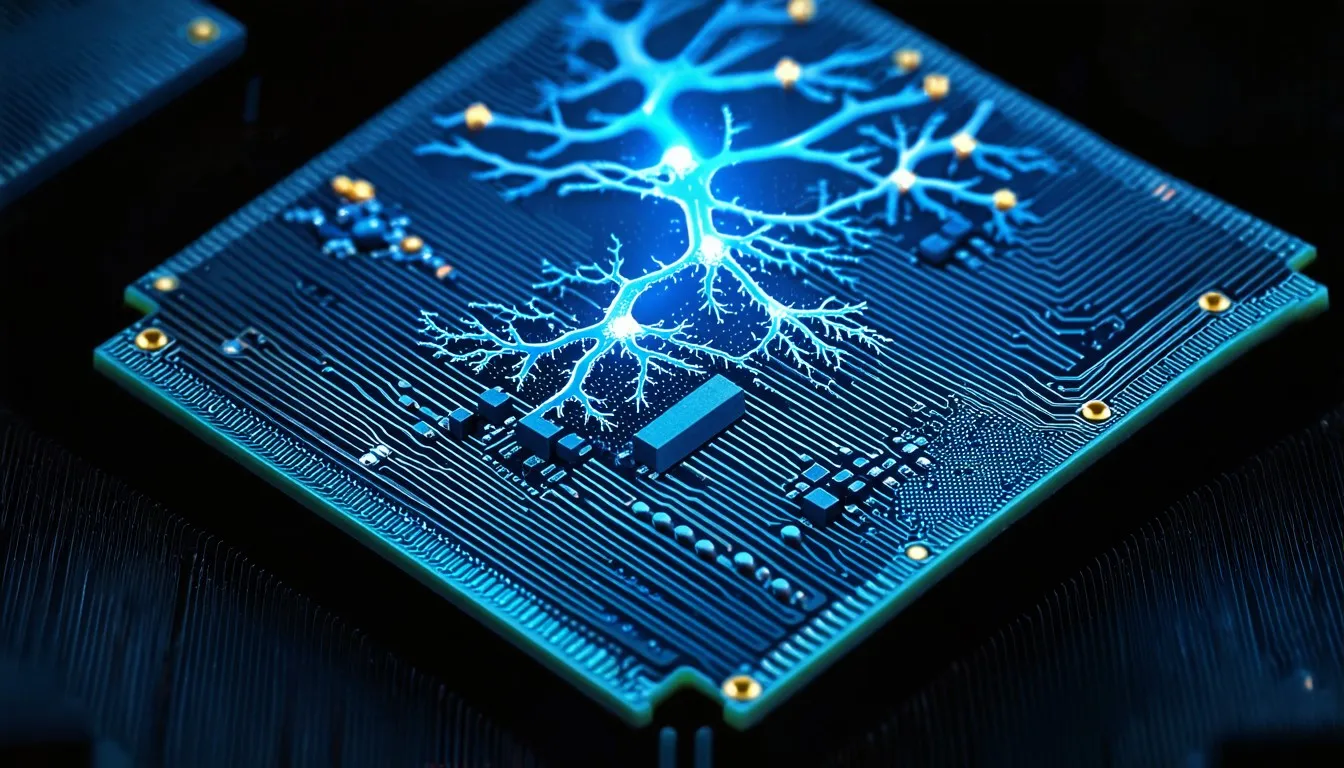
This mechanism enables unsupervised, local learning rules that adjust connection strength based on temporal correlations between pre-synaptic and post-synaptic spikes, effectively encoding causal relationships present in the environment. Elimination of backpropagation through static computational graphs reduces memory overhead and latency significantly because the system avoids the need to store vast intermediate activation states required for calculating gradients in deep networks. Functional architecture comprises dendritic processing units, synaptic arrays, and recurrent microcircuits that work in concert to process continuous streams of temporal data rather than static frames of information. Learning occurs continuously during operation with weight updates driven by local electrochemical signals or their analog equivalents in the hardware, ensuring that the system adapts to changing conditions in real time. Embedding these structures within robotic platforms enables closed-loop sensorimotor connection where the system learns from the direct physical consequences of its actions on the environment. Dendritic trees are branched input structures performing complex signal connection through passive cable properties and active voltage-gated channels, features often lost in traditional artificial neural networks.
Hardware implementation uses multi-terminal transistors or memristive crossbars to emulate the passive cable properties and active ion channels of biological dendrites with high fidelity. Spike-timing-dependent plasticity (STDP) functions as a biological learning rule determining weight change based on action potential timing, which is translated into analog circuits that track spike timing and modulate conductance accordingly. These analog circuits utilize capacitors and transistors to integrate charge over time, representing the precise timing differences required for Hebbian learning and long-term potentiation or depression. Neuromorphic substrates constitute physical computing platforms designed to emulate neural dynamics at the device level rather than simulating them on general-purpose processors through software abstraction. They typically use non-von Neumann architectures with co-located memory and processing to overcome the data movement limitations associated with the separation of logic and memory in traditional computers. Early neuromorphic efforts in the 1980s and 1990s focused on simplified neuron models like integrate-and-fire, which captured basic spiking behavior but missed the sub-threshold dynamics crucial for rich temporal computation.
These early attempts relied on digital emulation, which limited biological fidelity due to the discrete nature of digital logic and the high energy cost of clocked operations attempting to simulate continuous time dynamics. Developments in the 2010s involved analog and mixed-signal implementations that applied the physical properties of current and voltage to perform calculations more naturally and efficiently. Advances in CMOS-compatible memristors and floating-gate transistors drove this efficiency by providing compact, non-volatile elements capable of storing synaptic weights with minimal leakage current and high endurance. A pivot to dendritic computation occurred after 2020 as researchers recognized that ignoring spatial input processing limits adaptive capacity in complex sensory environments requiring real-time feature extraction. This realization led to the development of hardware models that explicitly include dendritic compartments to solve problems like XOR or temporal feature binding at a single neuron level, reducing the network depth required for specific tasks. Intel’s Loihi 2 chip utilizes a 7nm process node to support up to 1 million neurons while maintaining a programmable microcode engine that allows researchers to define custom neuron dynamics beyond standard integrate-and-fire models.
It achieves energy efficiency of approximately 10 picojoules per synaptic event, making it orders of magnitude more efficient than standard GPUs for event-based workloads. BrainChip’s Akida platform employs a 22nm process for edge-based learning and focuses specifically on low-power consumption for always-on applications in internet-of-things devices. It demonstrates event-driven processing with energy consumption often below 1 milliwatt in standby modes, which is essential for battery-operated sensors requiring continuous monitoring capabilities. Performance benchmarks emphasize energy per spike and learning latency as the primary metrics of success, distinguishing these systems from traditional FLOPS-based measurements used in digital computing. Top systems achieve sub-millisecond response times for sensory processing tasks such as vision or auditory classification, enabling real-time interaction with the physical world unavailable to frame-based systems. Dominant architectures rely on crossbar arrays of memristors or floating-gate transistors to implement dense synaptic connectivity where the intersection of rows and columns defines a synaptic weight accessed via Ohm’s law and Kirchhoff’s current law.
CMOS-based neuron circuits handle spike generation and dendritic summation by working with currents from the crossbar array until a threshold voltage is reached, triggering a reset event analogous to an action potential. Appearing challengers explore 3D stacked neuromorphic chips and photonic synapses to overcome the planar limitations of standard lithography, which restricts connectivity density. Ferroelectric transistors offer non-volatile weight updates with lower write energy compared to standard flash memory, allowing for more frequent on-chip learning without degrading the device through oxide breakdown. Critical materials include hafnium oxide for memristors and silicon-germanium for high-mobility transistors, which are essential for achieving the desired electrical characteristics at nanoscale geometries required for high-density connection. Specialized photoresists are required for nanoscale patterning to achieve the feature densities necessary for brain-scale setup while maintaining alignment between multiple metal layers. These materials are subject to semiconductor supply chain volatility, which can disrupt the production schedules of specialized neuromorphic chips reliant on specific chemical compositions for memristive behavior.
Reliance on advanced fabrication nodes ties production to a limited set of foundries capable of manufacturing these complex devices with high yield rates. Packaging and testing infrastructure remains underdeveloped for analog signal integrity requirements because traditional digital testing equipment does not adequately characterize the stochastic behavior and mismatch built-in in analog neural elements. Intel and BrainChip lead in commercial neuromorphic hardware with strong IP portfolios that cover key aspects of spiking network architecture and on-chip learning rules necessary for mass production. Academic spin-offs like SynSense and GrAI Matter Labs focus on niche applications such as tactile sensing and low-latency control where conventional digital processors struggle to meet power budgets. These companies apply custom ASIC designs for tactile sensing and low-latency control to address specific market needs that general-purpose AI cannot satisfy efficiently due to latency constraints. Large cloud providers remain focused on digital AI accelerators because their existing infrastructure is heavily invested in binary computation models fine-tuned for batch processing of large datasets.

They view neuromorphic approaches as complementary rather than competitive since neuromorphic chips excel at edge processing while digital accelerators dominate training large language models in data centers. Physical constraints include thermal noise in nanoscale analog circuits, which can introduce variability in spike timing and weight updates that may degrade computational accuracy if not managed properly. Device variability in memristive arrays affects reliability because each memristor may have slightly different switching characteristics due to manufacturing imperfections at the atomic scale. Limited fan-in and fan-out in dendritic emulation result from wiring density issues inherent in two-dimensional planar fabrication processes, which restrict the number of synapses that can physically connect to a single neuron unit. Economic barriers involve high fabrication costs for custom chips, which require significant volume to amortize the non-recurring engineering expenses associated with designing complex analog-digital hybrid systems. A lack of standardized design tools hinders progress compared to conventional AI accelerators because developers must often write low-level code or hardware description languages to implement neural algorithms rather than using high-level abstractions.
Flexibility is limited by power density and interconnect constraints, which restrict the size of the network that can be active simultaneously on a single chip without exceeding thermal dissipation limits. Current systems support millions of neurons, which is far below biological brain scale, necessitating continued scaling efforts to reach human levels of cognition. Efficiency per operation exceeds digital counterparts, despite the scale difference, because neuromorphic chips only consume power when spikes occur, unlike digital systems that consume power during clock cycles regardless of activity. Rising demand for autonomous systems in unstructured environments necessitates cloud-independent intelligence to ensure reliability when communication links are unavailable or jammed by interference. Disaster response and precision agriculture require systems that adapt without retraining cycles to handle novel situations encountered in the field where labeled data is unavailable. Economic pressure to reduce operational costs drives the need for ultra-low-power computation to extend battery life in remote sensors and autonomous drones deployed for long durations.
Societal expectations for safe AI require systems that learn incrementally to adjust to new behaviors without forgetting previous knowledge or exhibiting catastrophic interference during operation. Local plasticity rules offer transparency compared to opaque gradient-based updates because changes in synaptic strength can be traced directly to specific local events rather than global error gradients spread across millions of parameters. Software stacks must shift from batch-oriented training to event-driven programming models to fully exploit the temporal dynamics and energy efficiency potential of neuromorphic hardware. Asynchronous programming models respect temporal dynamics and resource constraints by allowing different parts of the network to operate at their own natural speeds without a global synchronizing clock. Infrastructure for edge deployment requires new power delivery and cooling protocols designed for bursty workloads rather than constant thermal loads typical of general-purpose processors. Communication protocols need optimization for sparse and bursty data flows to minimize bandwidth usage while maximizing the throughput of relevant spike information across networks.
Open-source tools facilitate algorithm development by providing accessible platforms for testing spiking neural network algorithms without requiring expensive proprietary hardware licenses. These tools currently lack support for full-stack hardware-software co-design, which creates a gap between software simulation and physical implementation, leading to performance discrepancies during deployment. Biomimetic neural structures will provide a substrate capable of real-time, energy-constrained cognition necessary for autonomous agents operating in the physical world alongside humans. Superintelligent systems will use these structures as peripheral controllers for embodied agents handling low-level reflexes and sensorimotor coordination, while higher-level planning occurs elsewhere. Centralized digital cores will handle abstract reasoning, while biomimetic cores manage physical interaction, creating a division of labor similar to the cerebellum and cerebral cortex observed in mammalian biology. Fully embodied superintelligence could eventually arise from scaled biomimetic substrates once the density and complexity of neural connections approach or exceed biological norms found in mammalian brains.
These systems will integrate perception, action, and metacognition through lifelong plasticity, allowing the agent to continuously refine its internal model of the world throughout its operational lifespan. Superintelligence will dynamically reconfigure its own neural topology in response to task demands, using hardware mechanisms for synaptic growth and pruning implemented via reconfigurable interconnects. The distinction between hardware and software will blur in such systems as the physical configuration of the substrate becomes the direct representation of the algorithm executing upon it. Setup of neuromodulatory circuits will enable goal-directed plasticity without external supervision by modulating the learning rate based on internal states representing reward or novelty, similar to dopamine release in biological brains. Self-repairing substrates using reconfigurable interconnects will extend operational lifespan by routing around damaged components, similar to biological recovery after injury or neural degeneration. Hybrid systems will combine biomimetic cores with symbolic reasoning modules to merge the pattern recognition strengths of neural networks with the logic handling capabilities of symbolic AI for strong decision making.
Convergence with quantum sensing will enable ultra-precise environmental feedback, providing the neural controller with high-fidelity data about physical forces and magnetic fields. Synergy with soft robotics will allow morphological computation where the body mechanics themselves contribute to the computational output through passive deformation and material properties. Body mechanics and neural control will co-adapt in these advanced systems, leading to improved locomotion strategies that are impossible to design manually through explicit programming. Setup with edge AI networks will enable distributed learning across robot swarms, allowing groups of agents to share knowledge locally without centralized oversight or reliance on cloud connectivity. Core limits will arise from thermal noise in analog devices at the nanoscale, which imposes a floor on the energy required for reliable switching events and signal transmission. Wiring density will cap dendritic branching complexity until the 3D setup matures because two-dimensional layouts cannot accommodate the massive interconnectivity required for high-level cognition without excessive signal delay.
Energy per synaptic update will approach thermodynamic limits defined by Landauer’s principle, dictating the minimum energy required to erase information or change a state irreversibly. Future gains will come from architectural innovation rather than device scaling, as Moore’s law slows down and the benefits of shrinking transistors diminish relative to rising fabrication costs. Calibration will require aligning plasticity rules with long-term goals to ensure that local learning does not lead to globally undesirable behaviors or instability over extended periods of operation. Embedded value systems or environmental reward structures will guide this alignment by constraining the search space of viable neural configurations toward those that satisfy safety criteria. Superintelligent systems will prioritize stability under change to maintain coherent operation despite fluctuations in input data or internal hardware degradation occurring over time. Adaptation will occur without compromising core objectives or safety constraints, ensuring that the system remains beneficial even as it learns and evolves in response to novel environmental challenges.