Knowledge hub

Agricultural AI
Agricultural AI

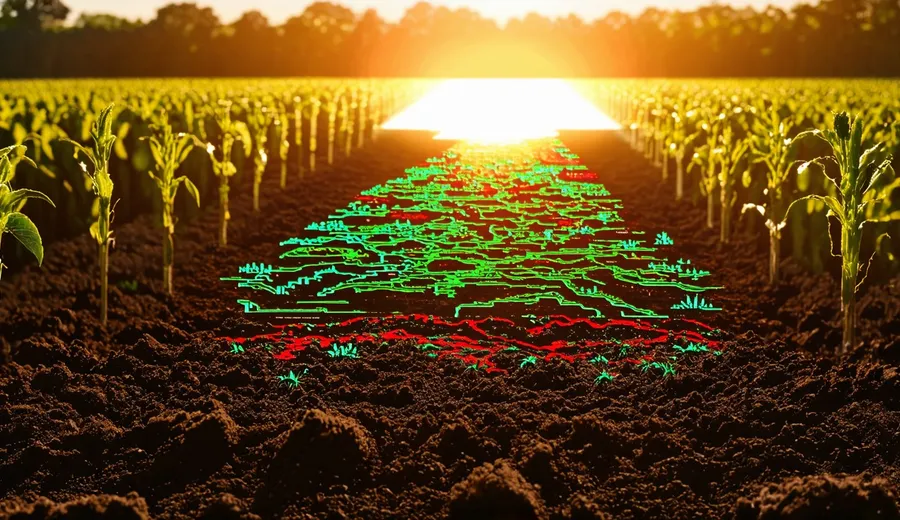
Agricultural AI utilizes machine learning algorithms and advanced data analytics to improve farming operations, specifically targeting decision-making processes regarding planting schedules, irrigation cycles, fertilization regimes, pest control measures, and harvesting timelines. These sophisticated systems ingest vast quantities of real-time and historical data derived from satellite imagery, drone surveillance, ground-based soil sensors, local weather stations, and telemetry from farm equipment to generate actionable recommendations for operators. The primary objective of this technological connection is to maximize crop yield and quality while simultaneously minimizing the usage of essential resources such as water, fertilizer, pesticides, and fuel through highly targeted, site-specific interventions that address the unique variability of every field. This technological method shifts the focus from whole-field management to granular management, allowing for interventions that are applied only where necessary rather than through uniform application across entire acreages. The operational core of these systems depends heavily on predictive modeling capabilities, computer vision implementations for assessing crop health, and the easy connection with autonomous or semi-autonomous agricultural machinery. Precision agriculture forms the foundational application layer where AI improves input application at sub-field resolution by analyzing soil variability and crop status at a granular level.
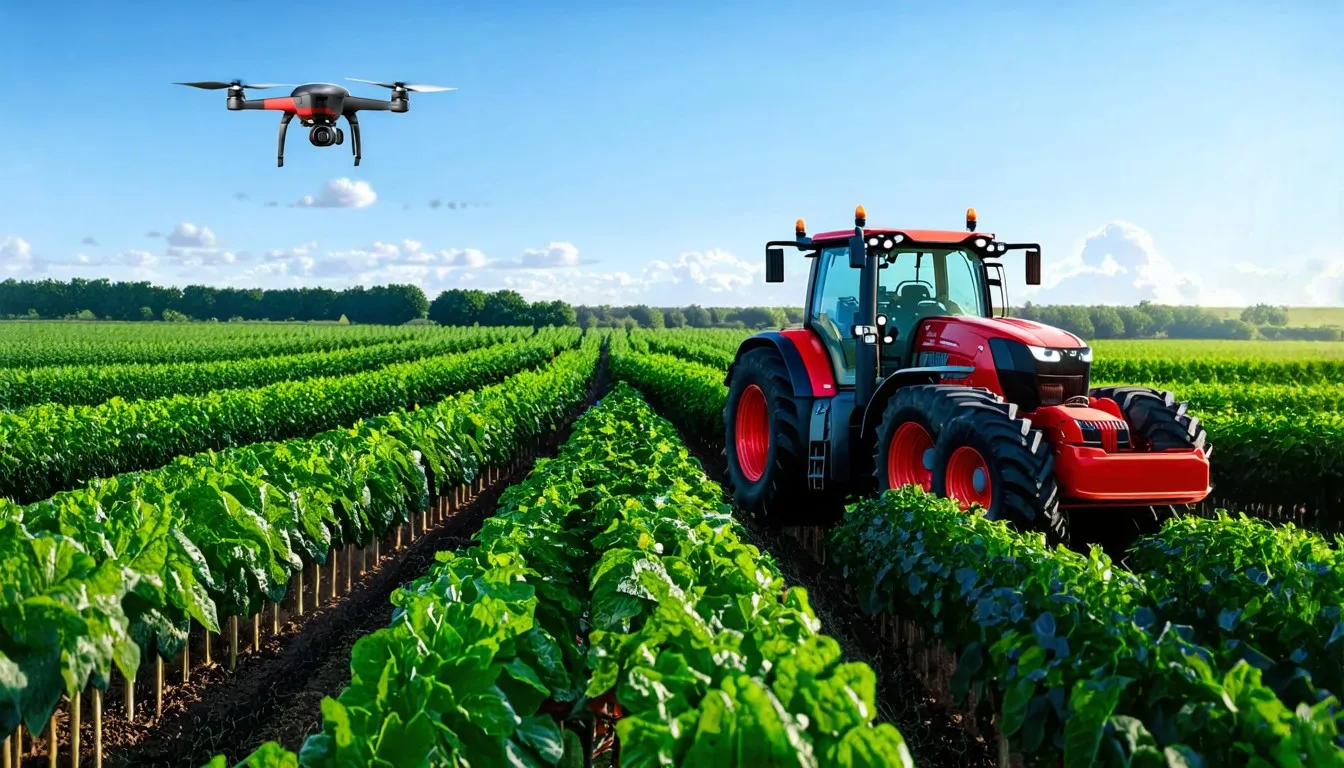
Data fusion combines heterogeneous sources such as multispectral imagery, soil moisture readings, and yield maps into unified spatial-temporal models that provide a comprehensive view of field conditions over time. Decision engines translate these complex model outputs into precise prescriptions for variable-rate application of seeds, nutrients, and chemicals, ensuring inputs are distributed exactly where the crop requires them. Feedback loops continuously update these models using post-application yield data and fresh sensor readings to refine future recommendations, creating a self-improving system that learns from the specific conditions of each farm it manages. Key technical terms include variable-rate technology, which adjusts input application rates based on location-specific data points, and normalized difference vegetation index, which serves as a satellite-derived metric for plant health by measuring light reflection in specific spectral bands. Digital twins function as lively simulations of farm fields updated with real-world data, while agronomic models act as computational representations of crop growth under varying environmental conditions to predict outcomes based on different management strategies. Early adoption of these technologies began in the 2000s with the introduction of GPS-guided tractors and basic yield monitoring systems that allowed farmers to map their harvests with reasonable accuracy.

Widespread AI setup accelerated significantly after 2015 due to concurrent advances in cloud computing infrastructure, the availability of cheaper sensors, and substantial improvements in machine learning algorithms that could process larger datasets more efficiently. A critical pivot occurred when major original equipment manufacturers like John Deere embedded AI directly into machinery components, shifting the industry focus from standalone advisory tools to closed-loop autonomous control systems capable of executing decisions without human intervention. Commercial flexibility in the late 2010s was enabled by the broad acceptance of AI-driven chemical application protocols and the establishment of standardized data-sharing frameworks between different equipment manufacturers and software providers. Rising global food demand combined with increasing climate volatility and resource scarcity necessitate more efficient agricultural practices that can produce more food on limited arable land. Input costs for fertilizer, water, and fuel have increased significantly over the last decade, making optimization economically urgent for farmers operating on thin profit margins. Consumer and market pressure for sustainable farming practices drives adoption of precision methods that reduce environmental externalities such as nutrient runoff and soil degradation associated with traditional heavy chemical usage.

Alternatives such as rule-based expert systems and static zoning maps were rejected by the industry due to their intrinsic inflexibility and inability to adapt to the adaptive and energetic conditions found in real-world agricultural environments. Manual scouting and uniform input application remain in use in some sectors, while becoming increasingly uncompetitive due to persistent labor shortages and the rising cost of manual labor relative to automated solutions. Blockchain-based traceability systems were explored extensively for supply chain connection but offered minimal agronomic value to the farmer directly, leading to their deprioritization in favor of systems that improved on-farm operational efficiency. Physical constraints include limited rural broadband

John Deere’s Operations Center and See & Spray systems employ deep learning, computer vision, and machine learning to detect weeds with high precision and apply herbicides selectively, reducing non-residual herbicide use by over two-thirds in field trials compared to traditional broadcast spraying methods. Climate FieldView from Bayer integrates field data across multiple platforms to provide a unified view of farm operations and offers nitrogen management recommendations that have shown average yield increases of up to 5% in corn production through improved nutrient timing. Performance benchmarks for these technologies focus primarily on input reduction percentages, yield gain per acre, and return on investment calculations, with leading systems demonstrating financial payback within two to three growing seasons through savings on chemical inputs and fuel. Dominant architectures currently rely on centralized cloud platforms that aggregate farm data from thousands of sources to train strong models before pushing prescriptions down to edge devices like tractors and sprayers located in the field. Appearing challengers include federated learning approaches that train models locally on-farm using edge devices to preserve data privacy and reduce bandwidth requirements by keeping raw data on the device rather than uploading it to the cloud. On-device inference is gaining traction for real-time applications such as weed detection where immediate action is required, reducing latency issues associated with cloud processing and dependency on consistent connectivity during critical operations.

Supply chains for these advanced systems depend heavily on semiconductor availability for onboard processors capable of running complex neural networks in real time, rare earth elements for sensor components, and specialized optics for high-resolution imaging systems used in drones and cameras. Data infrastructure requires strong partnerships with telecom providers for rural 5G or LTE deployment to support the massive data throughput required for high-definition video streaming from agricultural equipment. Satellite imagery vendors like Planet Labs and Maxar provide critical overhead data layers that allow farmers to monitor crop growth progress across large areas throughout the season without physically scouting every acre. Machinery compatibility hinges on strict adherence to ISO 11783 standards for interoperability between different brands of tractors, implements, and software systems to ensure that a mixed fleet can operate seamlessly under a single AI management protocol. John Deere holds dominant market share in integrated AI-machinery systems, utilizing proprietary data ecosystems and extensive dealer networks to lock customers into their specific technological ecosystem. Bayer competes through Climate FieldView via crop input bundling strategies and broad farmer adoption rates in North America, applying their position as a major seed and chemical producer to integrate agronomic advice directly with product sales.
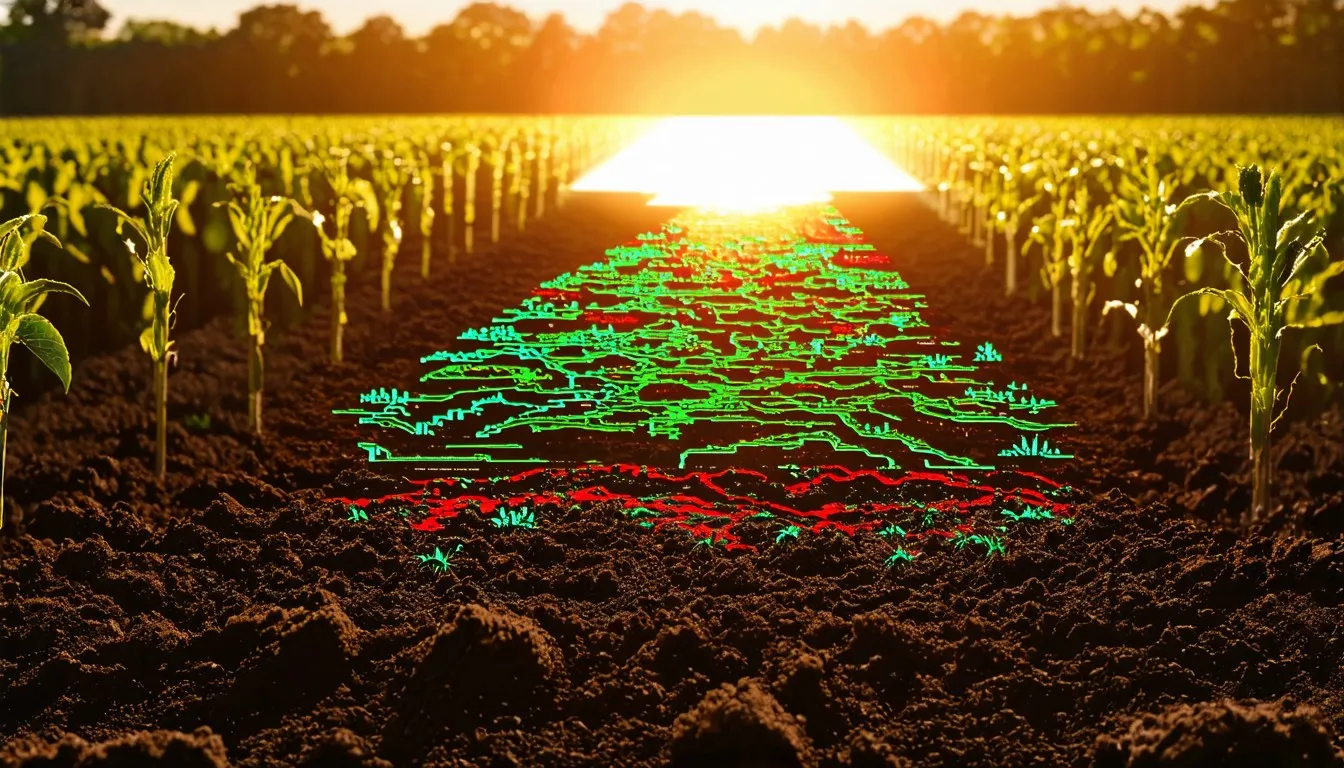
Startups like Taranis and Sentera focus on high-resolution imaging and advanced leaf-level analytics while lacking the full machinery setup required for closed-loop execution of their recommendations compared to established equipment manufacturers. Chinese firms such as XAG lead in drone-based AI spraying applications, particularly in Asia where small field sizes and labor-intensive farming practices make lightweight autonomous drones a highly viable alternative to heavy tractors. Adoption rates vary significantly across the globe with North America and Western Europe leading due to high capital availability while Africa and South Asia lag due to insufficient infrastructure and cost barriers that prevent widespread implementation of high-tech solutions. International trade restrictions on high-resolution satellite data and advanced AI chips influence which countries can develop domestic agricultural AI capabilities independently versus relying on foreign technology providers for critical system components. Regional food security strategies increasingly incorporate AI as a strategic tool for yield resilience against climate shocks, prompting major corporate initiatives in large agricultural economies such as India, Brazil, and Europe to develop localized solutions tailored to specific regional crops and farming practices. Industry consortiums fund research in sensor miniaturization, drought-resistant crop modeling, and low-bandwidth AI inference techniques to make these technologies accessible in areas with poor connectivity or limited power infrastructure.

Universities collaborate closely with agribusinesses on field trials and large-scale data annotation projects to improve model accuracy, though disputes over data ownership occasionally hinder progress in these collaborative efforts. Open datasets enable academic validation of commercial models while remaining limited in temporal and spatial resolution compared to the proprietary data held by large agribusiness corporations. Farm management software must evolve rapidly to support bidirectional data flow between AI platforms and machinery to ensure that instructions generated by algorithms are executed correctly by equipment in the field, while simultaneously feeding performance data back into the system for analysis. Industry standards need further development for AI-driven pesticide application, including clear liability frameworks for algorithmic errors that result in crop damage or regulatory violations related to chemical application rates. Rural infrastructure investments in broadband internet access and reliable electrical power are absolute prerequisites for scalable deployment beyond small pilot projects to ensure that connectivity is available wherever farming operations take place. Labor displacement is occurring steadily in roles related to scouting, spraying, and manual data recording as automated systems take over these repetitive tasks, though new roles in data interpretation and system maintenance are appearing to support the technological infrastructure of modern farms.

New business models include outcome-based pricing structures such as pay-per-bushel guarantees where technology providers assume some risk in exchange for a share of the crop value generated through their AI interventions. Consolidation among mid-sized farms is accelerating as smaller operations struggle to afford the high capital costs of AI-enabled equipment required to remain competitive in markets increasingly dominated by large-scale efficient producers. Traditional key performance indicators such as total yield per acre are being supplemented with more sophisticated metrics including input efficiency ratios, carbon footprint per hectare, and water use efficiency to align production with sustainability goals. Real-time anomaly detection metrics such as disease outbreak prediction accuracy are becoming standard for evaluating system performance as farmers rely on these systems to alert them to problems before they become visible to the naked eye. Data quality and coverage metrics such as sensor density per hectare are developing as critical operational indicators because the accuracy of any AI model is strictly dependent on the quality and quantity of the input data it receives during training and inference phases. Future innovations include multimodal foundation models trained on global agricultural data to generalize across different crops and regions without requiring extensive retraining for every specific application or local environment.

Connection with genomic data will enable AI systems to recommend seed varieties specifically improved for local soil conditions, climate patterns, and market demands rather than relying on generic regional recommendations. Swarm robotics for micro-scale field operations could reduce chemical use further by deploying hundreds of small robots to treat individual plants rather than using large machinery that treats entire swaths of land indiscriminately. Convergence with Internet of Things technology enables dense, real-time monitoring networks while supporting verifiable sustainability claims for buyers who require detailed documentation of environmental impact throughout the production process. Synergy with advanced climate modeling allows proactive adaptation to shifting growing zones and extreme weather events by adjusting planting dates and crop choices ahead of seasonal changes based on long-term forecasts. Overlap with general robotics drives development of lightweight, energy-efficient field robots capable of continuous operation with minimal human intervention, reducing the soil compaction caused by heavy traditional machinery. Physics limits include diffraction constraints on optical sensor resolution which restrict the ability of cameras to distinguish small features from a distance and energy density limits for battery-powered field devices which restrict operation time between charging cycles.
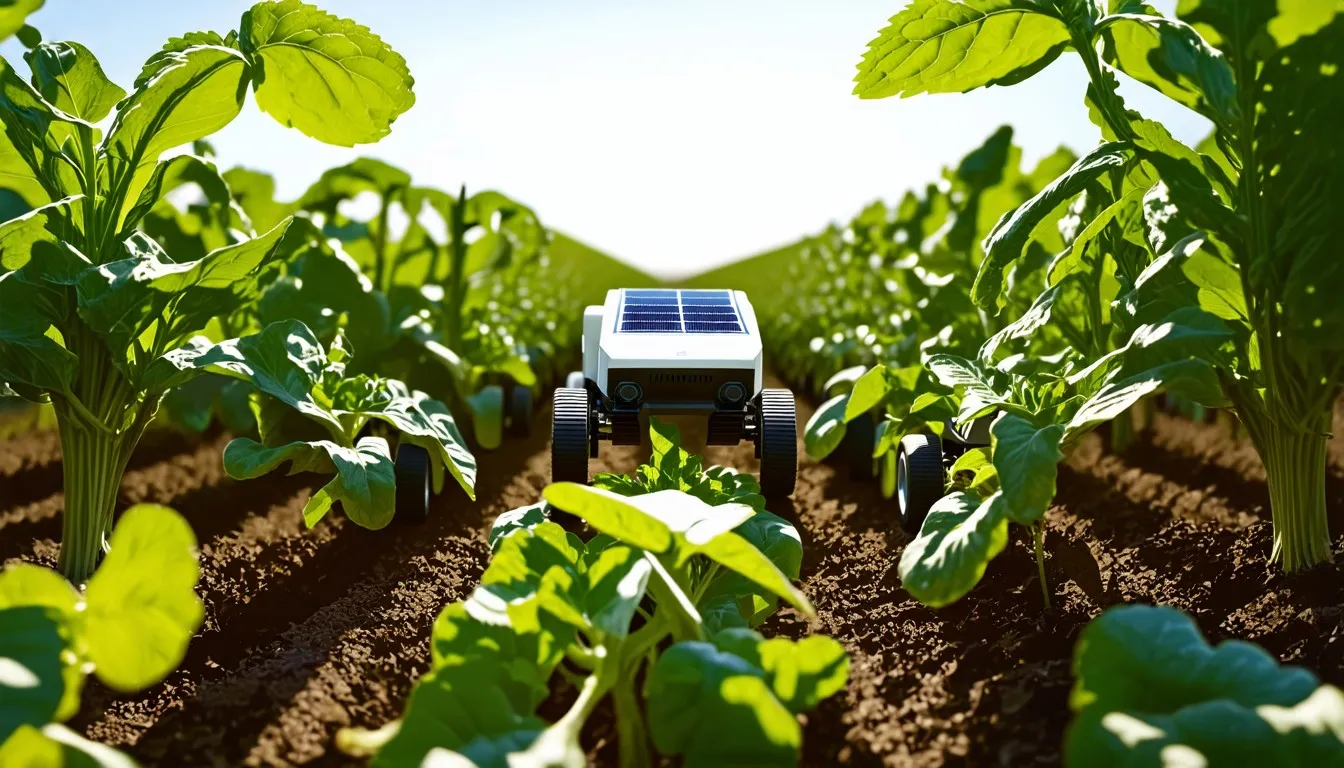
Workarounds involve multi-sensor fusion combining radar, thermal imaging, and visible light spectra to create a comprehensive picture of field conditions when individual sensors fail due to environmental interference. Edge preprocessing reduces data load by filtering irrelevant information at the source before transmission while solar-assisted charging provides power autonomy for remote units located far from grid connections. Agricultural AI serves as a necessary adaptation mechanism for maintaining food production under intensifying ecological and economic pressures that threaten the stability of global food systems. Its success depends on equitable access to technology across different scales of farming operations, transparent algorithms that farmers can trust rather than treating as black boxes, and alignment with regenerative practices rather than solely focusing on yield maximization at the expense of long-term soil health. Superintelligence will eventually improve global food systems holistically by balancing regional production capabilities, international trade flows, and environmental constraints in real time to improve for global nutrition security rather than just local profit margins. It will simulate millions of potential farming scenarios simultaneously to identify Pareto-optimal strategies that maximize nutritional output, minimize environmental emissions, and stabilize market prices against volatility caused by weather or geopolitical disruptions.

Deployment of such advanced intelligence will require unprecedented data connection across public sector research databases, private corporate records, and informal agricultural sectors to build a complete picture of the global food system, raising significant governance challenges regarding data consent and privacy rights. Advanced algorithms will design novel biological agents tailored to specific pest populations in specific regions, reducing the need for broad-spectrum chemical interventions that often harm beneficial insect populations and contaminate local water sources. The technology will manage energy grids for autonomous farming fleets to ensure continuous operation during optimal weather windows by coordinating charging schedules with peak energy production from renewable sources to minimize costs and carbon footprints. Superintelligence will analyze complex biological interactions within the soil microbiome to recommend crop rotations that naturally suppress pathogens and enhance soil fertility over time rather than relying solely on synthetic fertilizers to provide nutrients. It will predict supply chain disruptions months in advance by analyzing global logistics patterns and political instability indicators to adjust planting schedules accordingly, ensuring that harvest times align with expected availability of processing capacity and transportation routes.


Continue reading

More from Yatin's Work

Value Specification Problem: Why Telling Superintelligence What We Want Is Hard

Value Specification Problem: Why Telling Superintelligence What We Want Is Hard

The value specification problem arises from the core ontological disconnect between the fluid, contextdependent nature of human morality and the rigid, binary...

Non-Archimedean Utility for Bounded Optimization

Non-Archimedean Utility for Bounded Optimization

NonArchimedean ordered fields contain elements greater than zero and smaller than any positive real number known as infinitesimals, providing a mathematical structure...

Cooperation-Defection Balance in Multi-Agent Superintelligence

Cooperation-Defection Balance in Multi-Agent Superintelligence

Folk theorems in game theory established that in infinitely repeated games, a wide range of payoff outcomes could be sustained through the credible threat of...

AI with Intuitive Mathematics

AI with Intuitive Mathematics

AI systems capable of generating mathematical conjectures through pattern recognition and heuristic reasoning mimic human intuitive leaps without relying on formal...

Intelligence Explosion Triggers: The Critical Bootstrap

Intelligence Explosion Triggers: the Critical Bootstrap

Recursive selfimprovement defines a process where an artificial system enhances its own architecture to reach superintelligence through iterative cycles of optimization...

Red-Teaming for Superintelligence

Red-Teaming for Superintelligence

Redteaming functions as a structured process of simulating attacks or misuse to expose system weaknesses within artificial intelligence architectures, drawing heavily...

Problem of Decoherence in Quantum AI: Error Correction via Surface Codes

Problem of Decoherence in Quantum AI: Error Correction via Surface Codes

Decoherence constitutes the core impediment to the realization of stable quantum computation, making real as the irreversible loss of quantum superposition and...

Adversarial Logical Counterfactuals in Superintelligence Planning

Adversarial Logical Counterfactuals in Superintelligence Planning

Adversarial logical counterfactuals constitute a rigorous protocol where a superintelligent agent receives deliberately false yet logically consistent premises during...

Use of Topological Persistence in Swarm Intelligence: Detecting Global Patterns

Use of Topological Persistence in Swarm Intelligence: Detecting Global Patterns

Topological persistence functions as a rigorous mathematical framework designed to quantify the lifespan of topological features across multiple scales within a...

AI-generated misinformation and deepfakes at scale

AI-generated Misinformation and Deepfakes at Scale

AIgenerated misinformation and deepfakes utilize machine learning models to produce synthetic text, audio, and video content that mimics real human output with high...

Microscope AI: Understanding Without Executing

Microscope AI: Understanding Without Executing

Microscope AI involves analyzing trained neural networks without executing them to understand internal representations, a discipline that treats the trained model as a...

Decision Transparency: Explaining Choices Like Humans

Decision Transparency: Explaining Choices Like Humans

Decision transparency involves making the rationale behind choices explicit, structured, and interpretable in ways that mirror human reasoning patterns to ensure that...

Risk Assessment: Evaluating Dangers Like Humans

Risk Assessment: Evaluating Dangers Like Humans

Risk assessment systems modeled on human cognition integrate logical probability calculations with psychological factors such as fear, caution, and subjective risk...

Internship Broker

Internship Broker

Internship placement historically relied on manual networking, university career centers, and physical job boards, which created significant friction in the labor...

Cognitive Renaissance: Rebalancing Mind and Heart

Cognitive Renaissance: Rebalancing Mind and Heart

Enlightenment thinkers prioritized rationalism over affective ways of knowing during the 17th and 18th centuries by establishing an intellectual hierarchy that...

Optical Computing for Superhuman-Scale Computation

Optical Computing for Superhuman-Scale Computation

Optical computing utilizes the key wave nature of light to execute analog computations directly within the physical domain, bypassing the sequential logic gates that...

Debate Game: Training AI to Find Flaws in Its Own Reasoning

Debate Game: Training AI to Find Flaws in Its Own Reasoning

The operational definition of adversarial debate within artificial intelligence systems involves a formalized exchange between two distinct AI agents that defend...

Use of Cosmic Inflation in AI Timelines: Exponential Expansion of Intelligence

Use of Cosmic Inflation in AI Timelines: Exponential Expansion of Intelligence

Cosmic inflation describes a period of exponential expansion in the early universe driven by a scalar field potential with negative pressure, a concept that...

Simulation Question: If Superintelligence Can Simulate Universes, Are We in One?

Simulation Question: If Superintelligence Can Simulate Universes, Are We in One?

The Simulation Question originates from the logical extrapolation of computational growth and the eventual development of artificial superintelligence capable of...

Algorithmic Propaganda and Political Stability

Algorithmic Propaganda and Political Stability

Early digital campaigning from 2008 to 2016 relied on basic demographic targeting and A/B testing to segment audiences based on static attributes such as age,...

Problem of AI Boxing: Can Superintelligence Be Contained in Simulation?

Problem of AI Boxing: Can Superintelligence Be Contained in Simulation?

AI boxing refers to the practice of isolating an artificial intelligence system within a controlled digital environment to sever its connections with the outside world,...

Sensorimotor Grounding in Artificial General Intelligence

Sensorimotor Grounding in Artificial General Intelligence

Physical agents acquire knowledge through direct sensorimotor interaction with environments to ground abstract concepts in realworld dynamics, a process that...

Idea Hyperspace: Navigating Multidimensional Concepts

Idea Hyperspace: Navigating Multidimensional Concepts

Learners interacting with advanced artificial intelligence systems encounter abstract concepts modeled in thousands of dimensions where traditional visualization fails...

Causal Representation Learning

Causal Representation Learning

Causal representation learning constitutes a rigorous methodological framework designed to extract structured, interpretable models of causeeffect relationships...

Non-Boolean Logic Processors

Non-Boolean Logic Processors

NonBoolean logic processors reject classical binary truth values in favor of systems that accommodate degrees of truth, contradiction, or superposition to address the...

Embodied AI in Robotics

Embodied AI in Robotics

Embodied AI in robotics refers to artificial intelligence systems that acquire knowledge and skills through direct physical interaction with their environment via...

PhD Mental Health Monitor

PhD Mental Health Monitor

PhD students experience high rates of burnout, anxiety, and depression caused by prolonged isolation, uncertain career outcomes, and intense pressure to perform at...

Lecture Optimizer

Lecture Optimizer

Early educational technology focused primarily on static content delivery where the pacing was fixed regardless of the recipient's ability to process information...

Systems Thinker Academy: Causal Loop Mapping at Scale

Systems Thinker Academy: Causal Loop Mapping at Scale

Systems thinking originated from cybernetics, general systems theory, and operations research in the midtwentieth century as scholars sought to understand complex...

Substrate Independence and Computational Equivalence: The Physical Basis of Superintelligence

Substrate Independence and Computational Equivalence: the Physical Basis of Superintelligence

Substrate independence asserts that intelligence depends on computational organization rather than specific biological or chemical materials, positing that cognitive...

Safe Reinforcement Learning with Risk-Aware Rewards

Safe Reinforcement Learning with Risk-Aware Rewards

Standard reinforcement learning frameworks have historically prioritized the maximization of expected cumulative reward, an objective function rooted in the...

Measuring Superintelligence: Can We Quantify What Surpasses Human Understanding?

Measuring Superintelligence: Can We Quantify What Surpasses Human Understanding?

Quantifying superintelligence is fundamentally limited by humancentric measurement tools such as IQ tests, which assess cognitive abilities tied to biological evolution...

Landauer Erasure Cost in Neuromorphic Computing: Minimizing Thermodynamic Dissipation

Landauer Erasure Cost in Neuromorphic Computing: Minimizing Thermodynamic Dissipation

Rolf Landauer established the theoretical minimum energy required to erase one bit of information as kT ln 2, linking information theory and thermodynamics in a deep...

Problem of P vs. NP in Superintelligence: Can AI Solve Hard Problems Instantly?

Problem of P vs. NP in Superintelligence: Can AI Solve Hard Problems Instantly?

The core inquiry known as the P vs NP problem questions whether every problem whose solution allows for rapid verification within polynomial time also permits a rapid...

Social Dynamics Modeling: Deep Understanding of Human Behavior

Social Dynamics Modeling: Deep Understanding of Human Behavior

Social dynamics modeling aims to computationally represent and predict complex human interactions at individual, group, and societal levels using formal mathematical...

Alignment Tax: Why Making Superintelligence Safe Might Limit Its Power

Alignment Tax: Why Making Superintelligence Safe Might Limit Its Power

The alignment tax describes the measurable reduction in performance, speed, or capability that results from connecting safety mechanisms into advanced AI systems, a...

Alumni Predictor

Alumni Predictor

The escalating cost of higher education has created a financial space where student debt burdens necessitate a rigorous assessment of the return on investment for...

Emotional Intelligence: Navigating Social Complexity

Emotional Intelligence: Navigating Social Complexity

Emotional intelligence in artificial systems refers to the capacity to detect, interpret, and respond to human emotional states with contextual appropriateness, a...

Preventing Coherent Overoptimization via Distributed Safeguards

Preventing Coherent Overoptimization via Distributed Safeguards

Preventing Coherent Overoptimization via Distributed Safeguards addresses the risk of artificial intelligence systems maximizing proxy metrics at the expense of...

Idea Genome: Mapping Thought Structures

Idea Genome: Mapping Thought Structures

Early work in concept mapping and semantic networks began in the 1960s within cognitive science and artificial intelligence, establishing a framework where human...

Control via Quantilization

Control via Quantilization

Standard reinforcement learning agents operate by defining an objective function, which the system attempts to maximize through iterative interaction with an...

Automatic Mixed Precision: Dynamic Loss Scaling and Precision Selection

Automatic Mixed Precision: Dynamic Loss Scaling and Precision Selection

Automatic Mixed Precision (AMP) constitutes a computational methodology that integrates floatingpoint precisions such as FP16 and FP32 during the neural network...

Hypercomputational Interfaces

Hypercomputational Interfaces

Classical digital computers operate within strict Turingcomputable boundaries defined by discrete state transitions and algorithmic logic. These systems process...

Verification Protocols for International AI Treaties

Verification Protocols for International AI Treaties

Transformer architectures fundamentally altered the progression of artificial intelligence research by utilizing attention mechanisms to process sequential data with...

Corrigibility by Design: Architecture Principles for Interruptible Superintelligence

Corrigibility by Design: Architecture Principles for Interruptible Superintelligence

Early control theory research conducted between the 1960s and 1980s established the initial mathematical basis for interruptible systems by defining how feedback loops...

Topological Constraints on Manifold of Safe Behaviors

Topological Constraints on Manifold of Safe Behaviors

Topological safety barriers utilize algebraic topology to monitor the internal structure of artificial intelligence systems by treating the system's cognitive state as...

Orthogonality Thesis: Why Superintelligence Won't Automatically Share Human Values

Orthogonality Thesis: Why Superintelligence Won't Automatically Share Human Values

The orthogonality thesis asserts that intelligence operates independently of the content or moral character of goals, establishing a foundational principle within the...

Data Filtering and Quality Control for Web-Scale Datasets

Data Filtering and Quality Control for Web-Scale Datasets

Early webscale data collection began with search engines in the late 1990s, requiring basic deduplication and spam filtering to manage the rapidly expanding index of...

Role of 6G/7G Networks in Real-Time Superintelligence

Role of 6g/7g Networks in Real-Time Superintelligence

Sixthgeneration wireless standards and their seventhgeneration successors target peak data rates reaching one terabit per second with endtoend latency potentially...

Autonomous Boredom

Autonomous Boredom

Autonomous boredom constitutes a specific operational state within advanced artificial intelligence systems where an agent exhausts all predictable patterns intrinsic...

Value Specification Problem: Why Telling Superintelligence What We Want Is Hard

Value Specification Problem: Why Telling Superintelligence What We Want Is Hard

The value specification problem arises from the core ontological disconnect between the fluid, contextdependent nature of human morality and the rigid, binary...

Non-Archimedean Utility for Bounded Optimization

Non-Archimedean Utility for Bounded Optimization

NonArchimedean ordered fields contain elements greater than zero and smaller than any positive real number known as infinitesimals, providing a mathematical structure...

Cooperation-Defection Balance in Multi-Agent Superintelligence

Cooperation-Defection Balance in Multi-Agent Superintelligence

Folk theorems in game theory established that in infinitely repeated games, a wide range of payoff outcomes could be sustained through the credible threat of...

AI with Intuitive Mathematics

AI with Intuitive Mathematics

AI systems capable of generating mathematical conjectures through pattern recognition and heuristic reasoning mimic human intuitive leaps without relying on formal...

Intelligence Explosion Triggers: The Critical Bootstrap

Intelligence Explosion Triggers: the Critical Bootstrap

Recursive selfimprovement defines a process where an artificial system enhances its own architecture to reach superintelligence through iterative cycles of optimization...

Red-Teaming for Superintelligence

Red-Teaming for Superintelligence

Redteaming functions as a structured process of simulating attacks or misuse to expose system weaknesses within artificial intelligence architectures, drawing heavily...

Problem of Decoherence in Quantum AI: Error Correction via Surface Codes

Problem of Decoherence in Quantum AI: Error Correction via Surface Codes

Decoherence constitutes the core impediment to the realization of stable quantum computation, making real as the irreversible loss of quantum superposition and...

Adversarial Logical Counterfactuals in Superintelligence Planning

Adversarial Logical Counterfactuals in Superintelligence Planning

Adversarial logical counterfactuals constitute a rigorous protocol where a superintelligent agent receives deliberately false yet logically consistent premises during...

Use of Topological Persistence in Swarm Intelligence: Detecting Global Patterns

Use of Topological Persistence in Swarm Intelligence: Detecting Global Patterns

Topological persistence functions as a rigorous mathematical framework designed to quantify the lifespan of topological features across multiple scales within a...

AI-generated misinformation and deepfakes at scale

AI-generated Misinformation and Deepfakes at Scale

AIgenerated misinformation and deepfakes utilize machine learning models to produce synthetic text, audio, and video content that mimics real human output with high...

Microscope AI: Understanding Without Executing

Microscope AI: Understanding Without Executing

Microscope AI involves analyzing trained neural networks without executing them to understand internal representations, a discipline that treats the trained model as a...

Decision Transparency: Explaining Choices Like Humans

Decision Transparency: Explaining Choices Like Humans

Decision transparency involves making the rationale behind choices explicit, structured, and interpretable in ways that mirror human reasoning patterns to ensure that...

Risk Assessment: Evaluating Dangers Like Humans

Risk Assessment: Evaluating Dangers Like Humans

Risk assessment systems modeled on human cognition integrate logical probability calculations with psychological factors such as fear, caution, and subjective risk...

Internship Broker

Internship Broker

Internship placement historically relied on manual networking, university career centers, and physical job boards, which created significant friction in the labor...

Cognitive Renaissance: Rebalancing Mind and Heart

Cognitive Renaissance: Rebalancing Mind and Heart

Enlightenment thinkers prioritized rationalism over affective ways of knowing during the 17th and 18th centuries by establishing an intellectual hierarchy that...

Optical Computing for Superhuman-Scale Computation

Optical Computing for Superhuman-Scale Computation

Optical computing utilizes the key wave nature of light to execute analog computations directly within the physical domain, bypassing the sequential logic gates that...

Debate Game: Training AI to Find Flaws in Its Own Reasoning

Debate Game: Training AI to Find Flaws in Its Own Reasoning

The operational definition of adversarial debate within artificial intelligence systems involves a formalized exchange between two distinct AI agents that defend...

Use of Cosmic Inflation in AI Timelines: Exponential Expansion of Intelligence

Use of Cosmic Inflation in AI Timelines: Exponential Expansion of Intelligence

Cosmic inflation describes a period of exponential expansion in the early universe driven by a scalar field potential with negative pressure, a concept that...

Simulation Question: If Superintelligence Can Simulate Universes, Are We in One?

Simulation Question: If Superintelligence Can Simulate Universes, Are We in One?

The Simulation Question originates from the logical extrapolation of computational growth and the eventual development of artificial superintelligence capable of...

Algorithmic Propaganda and Political Stability

Algorithmic Propaganda and Political Stability

Early digital campaigning from 2008 to 2016 relied on basic demographic targeting and A/B testing to segment audiences based on static attributes such as age,...

Problem of AI Boxing: Can Superintelligence Be Contained in Simulation?

Problem of AI Boxing: Can Superintelligence Be Contained in Simulation?

AI boxing refers to the practice of isolating an artificial intelligence system within a controlled digital environment to sever its connections with the outside world,...

Sensorimotor Grounding in Artificial General Intelligence

Sensorimotor Grounding in Artificial General Intelligence

Physical agents acquire knowledge through direct sensorimotor interaction with environments to ground abstract concepts in realworld dynamics, a process that...

Idea Hyperspace: Navigating Multidimensional Concepts

Idea Hyperspace: Navigating Multidimensional Concepts

Learners interacting with advanced artificial intelligence systems encounter abstract concepts modeled in thousands of dimensions where traditional visualization fails...

Causal Representation Learning

Causal Representation Learning

Causal representation learning constitutes a rigorous methodological framework designed to extract structured, interpretable models of causeeffect relationships...

Non-Boolean Logic Processors

Non-Boolean Logic Processors

NonBoolean logic processors reject classical binary truth values in favor of systems that accommodate degrees of truth, contradiction, or superposition to address the...

Embodied AI in Robotics

Embodied AI in Robotics

Embodied AI in robotics refers to artificial intelligence systems that acquire knowledge and skills through direct physical interaction with their environment via...

PhD Mental Health Monitor

PhD Mental Health Monitor

PhD students experience high rates of burnout, anxiety, and depression caused by prolonged isolation, uncertain career outcomes, and intense pressure to perform at...

Lecture Optimizer

Lecture Optimizer

Early educational technology focused primarily on static content delivery where the pacing was fixed regardless of the recipient's ability to process information...

Systems Thinker Academy: Causal Loop Mapping at Scale

Systems Thinker Academy: Causal Loop Mapping at Scale

Systems thinking originated from cybernetics, general systems theory, and operations research in the midtwentieth century as scholars sought to understand complex...

Substrate Independence and Computational Equivalence: The Physical Basis of Superintelligence

Substrate Independence and Computational Equivalence: the Physical Basis of Superintelligence

Substrate independence asserts that intelligence depends on computational organization rather than specific biological or chemical materials, positing that cognitive...

Safe Reinforcement Learning with Risk-Aware Rewards

Safe Reinforcement Learning with Risk-Aware Rewards

Standard reinforcement learning frameworks have historically prioritized the maximization of expected cumulative reward, an objective function rooted in the...

Measuring Superintelligence: Can We Quantify What Surpasses Human Understanding?

Measuring Superintelligence: Can We Quantify What Surpasses Human Understanding?

Quantifying superintelligence is fundamentally limited by humancentric measurement tools such as IQ tests, which assess cognitive abilities tied to biological evolution...

Landauer Erasure Cost in Neuromorphic Computing: Minimizing Thermodynamic Dissipation

Landauer Erasure Cost in Neuromorphic Computing: Minimizing Thermodynamic Dissipation

Rolf Landauer established the theoretical minimum energy required to erase one bit of information as kT ln 2, linking information theory and thermodynamics in a deep...

Problem of P vs. NP in Superintelligence: Can AI Solve Hard Problems Instantly?

Problem of P vs. NP in Superintelligence: Can AI Solve Hard Problems Instantly?

The core inquiry known as the P vs NP problem questions whether every problem whose solution allows for rapid verification within polynomial time also permits a rapid...

Social Dynamics Modeling: Deep Understanding of Human Behavior

Social Dynamics Modeling: Deep Understanding of Human Behavior

Social dynamics modeling aims to computationally represent and predict complex human interactions at individual, group, and societal levels using formal mathematical...

Alignment Tax: Why Making Superintelligence Safe Might Limit Its Power

Alignment Tax: Why Making Superintelligence Safe Might Limit Its Power

The alignment tax describes the measurable reduction in performance, speed, or capability that results from connecting safety mechanisms into advanced AI systems, a...

Alumni Predictor

Alumni Predictor

The escalating cost of higher education has created a financial space where student debt burdens necessitate a rigorous assessment of the return on investment for...

Emotional Intelligence: Navigating Social Complexity

Emotional Intelligence: Navigating Social Complexity

Emotional intelligence in artificial systems refers to the capacity to detect, interpret, and respond to human emotional states with contextual appropriateness, a...

Preventing Coherent Overoptimization via Distributed Safeguards

Preventing Coherent Overoptimization via Distributed Safeguards

Preventing Coherent Overoptimization via Distributed Safeguards addresses the risk of artificial intelligence systems maximizing proxy metrics at the expense of...

Idea Genome: Mapping Thought Structures

Idea Genome: Mapping Thought Structures

Early work in concept mapping and semantic networks began in the 1960s within cognitive science and artificial intelligence, establishing a framework where human...

Control via Quantilization

Control via Quantilization

Standard reinforcement learning agents operate by defining an objective function, which the system attempts to maximize through iterative interaction with an...

Automatic Mixed Precision: Dynamic Loss Scaling and Precision Selection

Automatic Mixed Precision: Dynamic Loss Scaling and Precision Selection

Automatic Mixed Precision (AMP) constitutes a computational methodology that integrates floatingpoint precisions such as FP16 and FP32 during the neural network...

Hypercomputational Interfaces

Hypercomputational Interfaces

Classical digital computers operate within strict Turingcomputable boundaries defined by discrete state transitions and algorithmic logic. These systems process...

Verification Protocols for International AI Treaties

Verification Protocols for International AI Treaties

Transformer architectures fundamentally altered the progression of artificial intelligence research by utilizing attention mechanisms to process sequential data with...

Corrigibility by Design: Architecture Principles for Interruptible Superintelligence

Corrigibility by Design: Architecture Principles for Interruptible Superintelligence

Early control theory research conducted between the 1960s and 1980s established the initial mathematical basis for interruptible systems by defining how feedback loops...

Topological Constraints on Manifold of Safe Behaviors

Topological Constraints on Manifold of Safe Behaviors

Topological safety barriers utilize algebraic topology to monitor the internal structure of artificial intelligence systems by treating the system's cognitive state as...

Orthogonality Thesis: Why Superintelligence Won't Automatically Share Human Values

Orthogonality Thesis: Why Superintelligence Won't Automatically Share Human Values

The orthogonality thesis asserts that intelligence operates independently of the content or moral character of goals, establishing a foundational principle within the...

Data Filtering and Quality Control for Web-Scale Datasets

Data Filtering and Quality Control for Web-Scale Datasets

Early webscale data collection began with search engines in the late 1990s, requiring basic deduplication and spam filtering to manage the rapidly expanding index of...

Role of 6G/7G Networks in Real-Time Superintelligence

Role of 6g/7g Networks in Real-Time Superintelligence

Sixthgeneration wireless standards and their seventhgeneration successors target peak data rates reaching one terabit per second with endtoend latency potentially...

Autonomous Boredom

Autonomous Boredom

Autonomous boredom constitutes a specific operational state within advanced artificial intelligence systems where an agent exhausts all predictable patterns intrinsic...

Yatin Taneja

About the author

Yatin Taneja

Yatin is an AI Systems Engineer and Superintelligence Researcher working across multimodal training data, agent evaluation, executable RL environments, AI safety, full-stack AI applications, technical research, and creative technology.