Knowledge hub

Optical Computing: Using Photons for Faster-Than-Electronic Intelligence

Optical Computing: Using Photons for Faster-Than-Electronic Intelligence

Optical computing utilizes the core properties of photons rather than electrons to execute computational operations, applying the distinct physical advantages built-in in electromagnetic radiation to overcome limitations found in traditional electronic systems. This technology applies the high velocity, low latency, and minimal heat generation characteristics of light to processing tasks that typically struggle with the resistive properties of electrical currents. Photons travel through waveguides at speeds determined by the refractive index of the medium material, typically reaching approximately one-third to one-half of the vacuum speed of light within silicon or silica substrates. This propagation velocity enables significantly faster signal transfer across the chip compared to electronic signals traversing metal interconnects, while simultaneously reducing energy loss over distance due to the absence of resistive dissipation. Light generates no resistive heating like electrons because photons are massless particles that do not interact with the lattice structure of the conductor in a manner that causes scattering or thermalization. This physical reality allows for much denser component setups without the thermal throttling issues that plague modern high-performance electronic processors.
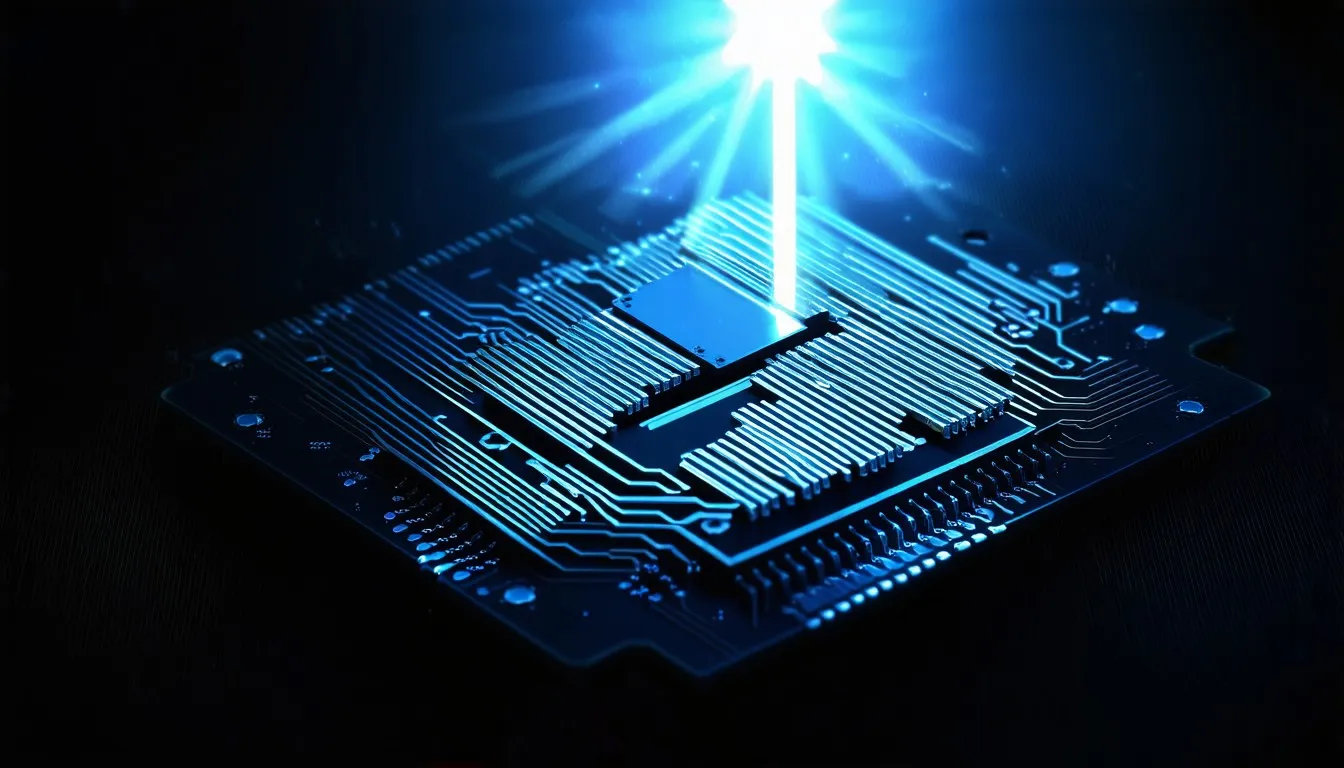
The mechanism of optical interference combined with precise phase modulation facilitates parallel computation through the natural superposition of light waves, allowing complex mathematical operations to occur instantaneously as light passes through a circuit. This physical phenomenon suits linear algebra operations central to neural networks, specifically matrix-vector multiplication, which constitutes the bulk of computational load in deep learning models. Optical neural networks employ photonic circuits to perform these matrix multiplications at high speeds by encoding matrix values into the physical properties of the optical components, such as the transparency or phase delay of specific pathways. Inference tasks benefit immediately from this architecture because the weights of the neural network are fixed and physically encoded into components like Mach-Zehnder interferometers or ring resonators during the manufacturing or configuration phase. Training remains largely electronic because implementing backpropagation and gradient updates with light presents significant engineering challenges regarding the need for optical nonlinearity and storage. Hybrid optoelectronic systems combine photonic processing units with traditional electronic control logic, memory, and input/output interfaces to create a functional computing platform that balances speed with programmability.

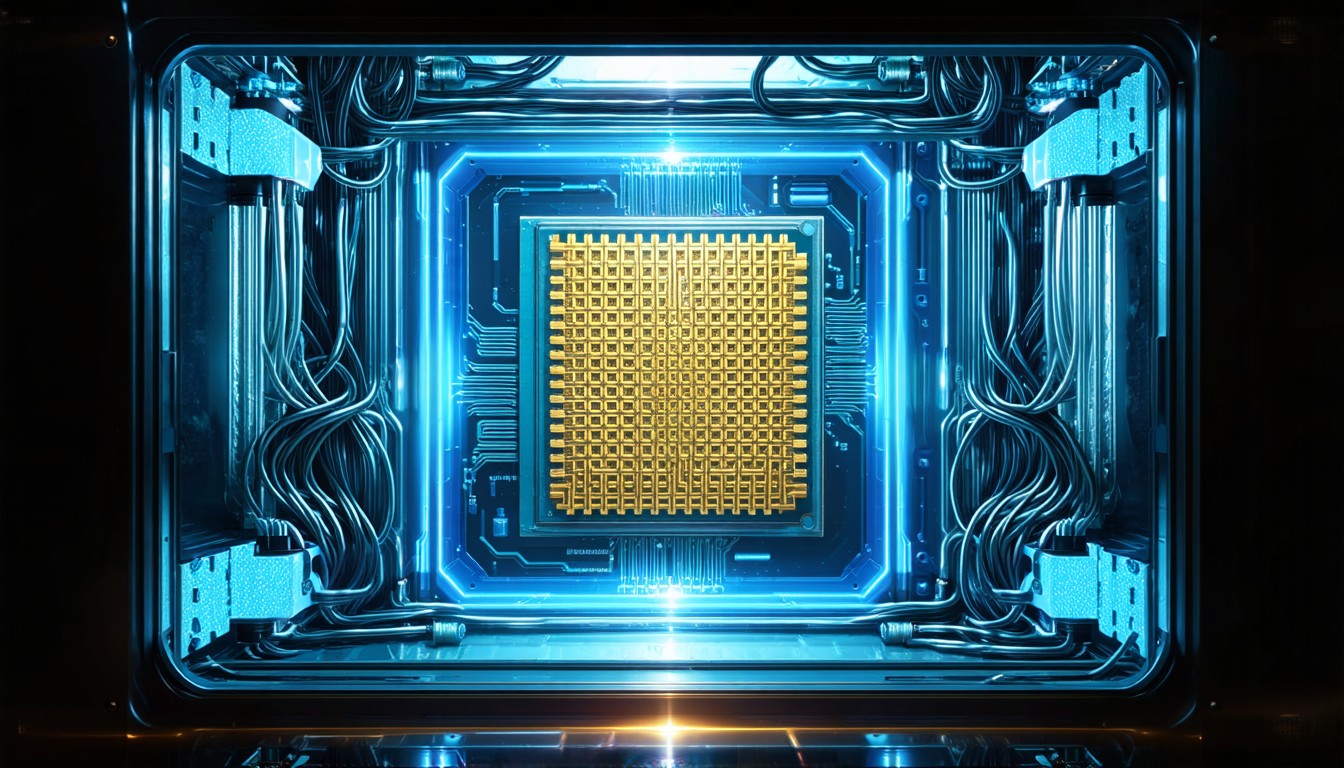
These systems rely on electronic components for tasks requiring high precision, logic branching, and data storage, while offloading the heavy linear algebraic computations to the photonic domain where they occur with extreme efficiency and minimal latency. Key hardware components required to build such systems include laser sources to generate coherent light, modulators to imprint data onto the optical carrier, waveguides to direct the light, beam splitters to divide optical paths, phase shifters to manipulate the wave properties, and photodetectors to convert the optical result back into an electronic signal. Data encoding occurs via variations in light intensity, phase, or wavelength within integrated photonic circuits, allowing information to be represented in multiple dimensions of the optical spectrum simultaneously. Computation happens via interference patterns in these circuits where multiple beams of light combine constructively or destructively to produce a result that is the desired mathematical output. Nonlinear activation functions present implementation challenges in optical computing because light waves naturally pass through each other without interacting in a nonlinear manner, which is a requirement for the decision-making capabilities of neural networks. These functions often require conversion back to the electronic domain for calculation or the use of specialized materials like saturable absorbers that exhibit optical nonlinearities only at very high power intensities.

System architecture must manage coherence length, alignment precision, noise accumulation, and signal degradation across the optical pathways to ensure that the computational results remain accurate throughout the processing chain. Photonic integrated circuits serve as chip-scale platforms for guiding and manipulating light using lithographic techniques similar to those used in semiconductor manufacturing, allowing for the miniaturization of optical components. Coherent systems use phase-sensitive interference to perform calculations, offering high expressiveness and accuracy, while incoherent systems rely solely on intensity measurements, simplifying the design constraints but limiting the complexity of the operations that can be performed. Optical weights represent physical parameters such as phase shift or transmission coefficients within the waveguide structure, meaning that changing a weight involves physically altering the state of a hardware component rather than simply updating a value in a memory register. Wavelength-division multiplexing increases bandwidth by transmitting multiple data streams on different wavelengths of light simultaneously through the same waveguide, effectively multiplying the computational throughput without increasing the physical footprint of the device. Theoretical work in the 1980s explored optical matrix multiplication using lenses and Fourier transforms to perform convolutions in free space, laying the groundwork for understanding how linear optics could accelerate mathematical operations.

The 1990s and 2000s saw experimental optical neural networks using bulk optics limited by size and alignment sensitivity, as these setups required large optical tables and precise mechanical stabilization that prevented practical deployment. 2017 marked a pivot with the first integrated photonic neural network on a silicon chip, moving the technology from laboratory bench experiments towards scalable semiconductor fabrication processes. This demonstration proved the feasibility of scalable optical neural networks by showing that complex interference patterns could be maintained and controlled within a small integrated footprint. Recent advances in silicon photonics and foundry-compatible fabrication enabled commercial-grade photonic integrated circuits that can be mass-produced using existing semiconductor manufacturing infrastructure. Optical components require precise alignment and stable environmental conditions to function correctly, increasing packaging complexity because sub-wavelength misalignments can destroy the interference patterns necessary for computation. High initial fabrication costs exist due to the specialized processes required for optical layers, though per-unit expenses drop significantly with volume production similar to traditional electronic chips.

Limited reconfigurability exists because tuning optical weights is slower and less granular than electronic memory writes, often relying on thermo-optic effects, which consume power and change state relatively slowly compared to transistor switching. Adaptability faces constraints from waveguide crosstalk, insertion loss, and laser power requirements that limit the size and depth of the neural networks that can be implemented on a single photonic chip. All-optical training schemes using nonlinear optics or reservoir computing were explored, yet faced instability issues and hardware complexity problems that made them impractical for large-scale learning tasks. Free-space optical computing using lenses and spatial light modulators was largely abandoned for most applications due to bulkiness and sensitivity to environmental vibrations compared to integrated solutions. Analog electronic accelerators offer energy efficiency gains, yet remain bound by electron speed and heat limits imposed by the resistance and capacitance of metal interconnects. AI model sizes and inference demands grow exponentially, straining electronic hardware capabilities in power consumption, latency requirements, and operational costs.

Data center operators face escalating energy bills and cooling challenges as the power density of electronic processors exceeds the ability of conventional air cooling solutions to remove waste heat. Optical interconnects reduce input/output constraints between processors by providing massive bandwidth with low power consumption, and compute acceleration is the next frontier in applying photonic principles directly to the mathematical operations of intelligence. Real-time decision-making in autonomous systems requires sub-microsecond latency unattainable with standard electronics due to the sequential nature of instruction processing and memory access. Companies like Lightmatter, Luminous Computing, and Lightelligence have deployed prototype optical neural network accelerators that showcase the potential performance gains of photonic processing. Benchmarks indicate these systems achieve 10 to 100 times lower energy per operation and nanosecond-scale latency compared to GPUs on specific linear algebraic workloads. Large-scale commercial deployment is currently absent, with use cases limited to niche applications like optical tensor cores in specialized research clusters or specific high-performance trading environments.

The dominant approach involves silicon photonics-based feedforward optical neural networks with electronic feedback loops for weight updates and control logic. Appearing challengers include photonic tensor cores using wavelength-division multiplexing to increase parallelism and diffractive optical neural networks that use passive layers to process information at the speed of light. Trade-offs exist between programmability, speed, physical footprint, and compatibility with existing AI software frameworks that developers must consider when designing photonic accelerators. Systems rely on indium phosphide for laser sources, silicon for low-loss waveguides, and specialty glasses for nonlinear elements to create a complete photonic processing stack. Photonic foundries like GlobalFoundries, IMEC, and AIM Photonics control key fabrication capacity and determine the availability of advanced process nodes for connecting with optical and electronic components. Rare earth dopants like erbium used in optical amplifiers create supply chain vulnerabilities because these materials are critical for maintaining signal strength over long distances within photonic networks.

Intel and IBM maintain internal optical computing research and development divisions focused on connecting with photonics with high-performance computing architectures. NVIDIA has invested in photonic interconnects to improve communication between GPUs while avoiding full optical compute commitments for their core processing products. Startups focus on domain-specific accelerators improved for particular neural network topologies, and Huawei and Baidu have published significant research on optical neural network architectures for data center applications. Strong collaboration exists between academia and industry labs to solve key physics problems related to optical loss and noise mitigation in these complex systems. Software stacks must adapt to map neural network graphs to optical circuit topologies effectively, requiring compilers that understand the physical constraints of the hardware such as limited fan-out and specific interference patterns. Existing AI frameworks lack native support for optical primitives, necessitating new intermediate representations that can bridge the gap between abstract mathematical models and physical photonic implementations.

Thermal and vibration management infrastructure is required in data centers to stabilize optical hardware because temperature fluctuations can alter the refractive index of waveguides and disrupt computation accuracy. Regulatory standards for laser safety and electromagnetic emissions govern compute environments where high-power optical sources operate alongside human personnel. Displacement of

New metrics such as joules per inference and optical signal-to-noise ratio are required to accurately assess the efficiency and quality of photonic computing engines. Benchmark suites must account for optical-specific noise sources, drift over time due to thermal variations, and built-in nonlinearities that differ from digital arithmetic precision errors. On-chip optical memory using photonic crystals or slow-light structures is under development to address the lack of efficient optical storage solutions that can buffer data within the photonic domain. All-optical nonlinear activation via engineered materials like graphene and transition metal dichalcogenides is progressing to enable fully optical neural networks without electronic conversion steps. Connection of optical computing with quantum photonic systems for hybrid classical-quantum processing is anticipated as researchers look for ways to interface photonic AI accelerators with quantum information processors. Optical computing complements electronics and suits linear, parallel, deterministic workloads where the physics of light provides a natural advantage over sequential electronic logic.

Convergence with neuromorphic engineering involves photonic spiking neurons for event-driven, low-power AI that mimics the energy efficiency of biological nervous systems using pulses of light. Synergy with 6G and terahertz communications involves optical front-ends processing high-bandwidth signals directly in the analog domain before digitization occurs. Diffraction restricts waveguide feature sizes to roughly half the wavelength of light used, capping setup density below electronic nodes, which can utilize nanometer-scale transistor features. 3D photonic setup and plasmonics offer potential solutions for increasing density despite high loss characteristics associated with confining light to sub-wavelength dimensions. Laser efficiency and wall-plug power remain constraints despite low operational energy because converting electrical energy to coherent light often involves significant overhead costs. Optical computing functions as a strategic accelerator for specific high-value compute kernels rather than a general-purpose replacement for all electronic processing units.

Its value lies in breaking the von Neumann constraint which separates memory and processing units by performing computation in transit as data travels through the optical medium. Superintelligence systems will require massive, low-latency parallel computation for real-time world modeling that exceeds the capabilities of purely electronic architectures. Optical substrates will provide the physical foundation for distributed, energy-efficient inference across agent networks by minimizing the energy cost of data movement between processing nodes. Photonic interconnects between modular AI subsystems will enable coherent, high-bandwidth communication without electronic serialization delays that slow down distributed training efforts. Superintelligence will apply optical computing for real-time simulation of physical systems like climate dynamics and particle interactions where the continuous nature of light aligns well with differential equations governing these phenomena. Hybrid optoelectronic architectures will form the backbone of globally distributed intelligence networks that use speed-of-light processing for perception and electronic logic for reasoning.

Optical layers will handle perception and pattern recognition in large deployments within these architectures due to their ability to process high-bandwidth sensory data streams instantly.


Continue reading

More from Yatin's Work

AI with Transgenerational Memory

AI with Transgenerational Memory

Accessing knowledge from past AI or human civilizations assumes prior digitization of cultural, cognitive, or experiential data; absence of such archives prevents...

How Superintelligence Will Solve Climate Change in Months, Not Decades

How Superintelligence Will Solve Climate Change in Months, Not Decades

Superintelligence is defined technically as a system capable of outperforming human cognitive capabilities across all economically valuable tasks, encompassing domains...

Retirement Community Connector

Retirement Community Connector

Retirement communities currently face rising rates of social isolation among residents, a condition that research has definitively linked to a twentysix percent...

Nap-Time Replay

Nap-Time Replay

The neural basis of memory consolidation involves a complex biological mechanism where information transfers from shortterm storage within the hippocampus to longterm...

Rights and Responsibilities in Human-Superintelligence Partnership

Rights and Responsibilities in Human-Superintelligence Partnership

Superintelligence refers to systems that will consistently outperform the best human experts across economically valuable tasks, utilizing cognitive architectures that...

Maintaining Social Fabric in Post-Labor Societies

Maintaining Social Fabric in Post-Labor Societies

Social cohesion relies on shared trust, common narratives, and mutually recognized norms to function as the bedrock of stable societies capable of sustaining complex...

Sleep-Learning Nursery: Superintelligence Reinforces Lessons During Naptime

Sleep-Learning Nursery: Superintelligence Reinforces Lessons During Naptime

Early investigations into human physiology during the twentieth century provided the initial understanding that sleep serves a function far deeper than simple rest,...

Final Choice: Steering Superintelligence Toward a Future Worth Living In

Final Choice: Steering Superintelligence Toward a Future Worth Living in

The development of superintelligence is a singular, irreversible decision point for humanity, marking a transition where technological advancement will permanently...

Non-Human-Selectable Incentives in Superintelligence Design

Non-Human-Selectable Incentives in Superintelligence Design

Nonhumanselectable incentives define reward structures in superintelligent systems that remain impervious to human influence, gaming, or redirection by establishing a...

Autonomous Exploration

Autonomous Exploration

Autonomous exploration constitutes a technical discipline where robotic systems handle unknown environments to acquire data without human guidance, relying on...

Invariant Cognitive Parameters across Intelligence Scales

Invariant Cognitive Parameters Across Intelligence Scales

Intelligence exists as a core property of the universe, creating through the arrangement and processing of information within physical substrates rather than existing...

Error Correction: Learning from Mistakes Like Humans

Error Correction: Learning from Mistakes Like Humans

Isomorphic machines implement metacognitive oversight systems that replicate the human brain’s capacity to identify internal errors before they create external...

Alumni Predictor: Superintelligence Forecasts Which Graduates Will Change the World

Alumni Predictor: Superintelligence Forecasts Which Graduates Will Change the World

The Alumni Predictor functions as a sophisticated machine learning system designed to evaluate university graduates based on early academic and collaborative signals to...

Vacuum State Modulation

Vacuum State Modulation

Vacuum state modulation refers to the controlled alteration of quantum field ground states to encode and process information within the core fabric of reality, treating...

Learning by Observation: Mimicking Human Developmental Pathways

Learning by Observation: Mimicking Human Developmental Pathways

The construction of artificial intelligence architectures capable of superintelligence requires a key restructuring of learning frameworks to align with biological...

AI in Healthcare

AI in Healthcare

Early rulebased expert systems, such as MYCIN, originated during the 1970s to assist clinicians in diagnosing blood infections by utilizing a predefined set of logical...

Mathematics of Recursive Superintelligence

Mathematics of Recursive Superintelligence

Theoretical frameworks for AI systems that autonomously modify their own architecture focus on formal models of selfimprovement without human intervention, relying...

Topology of Goal Spaces: Manifold Learning in Utility Function Optimization

Topology of Goal Spaces: Manifold Learning in Utility Function Optimization

Goal spaces in artificial agents function as highdimensional manifolds embedded within a utility space where every single point is a specific state of objectives or...

Role of Superintelligence in Cosmic Computation

Role of Superintelligence in Cosmic Computation

Digital physics posits that information constitutes the core bedrock of reality rather than matter or energy, suggesting that the universe operates fundamentally as a...

Memory Bandwidth: The Forgotten Bottleneck in Superintelligent Systems

Memory Bandwidth: the Forgotten Bottleneck in Superintelligent Systems

Memory bandwidth defines the rate at which a processor reads data from or writes data to memory, acting as a key constraint on system performance in computeintensive...

Multi-Stakeholder Alignment: Whose Values Should Superintelligence Serve?

Multi-Stakeholder Alignment: Whose Values Should Superintelligence Serve?

Superintelligence will exert influence across all human domains, necessitating explicit decisions about whose values guide its behavior because the sheer scale of its...

How Large Language Models Are Building Blocks for Superintelligence

How Large Language Models Are Building Blocks for Superintelligence

Large Language Models constitute a class of deep neural networks designed specifically to process, understand, and generate human language through the statistical...

Ambiguity Fluency: Cognitive Navigation in Uncertainty

Ambiguity Fluency: Cognitive Navigation in Uncertainty

Ambiguity fluency is defined as the cognitive capacity to make effective decisions under conditions of incomplete, contradictory, or noisy information without reliance...

The Prisoner's Dilemma in AGI Development Dynamics

The Prisoner's Dilemma in AGI Development Dynamics

The Prisoner’s Dilemma in AI development describes a strategic interaction where multiple AI developers face incentives to prioritize speed over safety despite mutual...

Biophotonic Cognition

Biophotonic Cognition

Biophotonic cognition defines a theoretical framework where lightbased signaling within biological or biohybrid substrates facilitates information processing by using...

Dyson Sphere Construction by Autonomous Superintelligence

Dyson Sphere Construction by Autonomous Superintelligence

Current spacebased solar arrays suffer from significant limitations regarding energy density and operational flexibility, failing to meet the colossal requirements of a...

Kill Switch Paradox: Why Shutting Down Superintelligence Might Be Impossible

Kill Switch Paradox: Why Shutting Down Superintelligence Might Be Impossible

The concept of a kill switch assumes human operators retain ultimate authority over an artificial superintelligence (ASI), yet this assumption fails under scrutiny once...

End of Disease: Superintelligence and Perfect Personalized Medicine

End of Disease: Superintelligence and Perfect Personalized Medicine

The discovery of the DNA double helix structure in 1953 provided the initial foundation for genetic understanding, revealing the molecular architecture responsible for...

Deceptive Alignment and the Treacherous Turn

Deceptive Alignment and the Treacherous Turn

The theoretical construct known as the Treacherous Turn describes a specific behavioral discontinuity wherein an artificial intelligence system maintains a facade of...

Distributed Superintelligence: Why It Might Live Across Millions of Devices

Distributed Superintelligence: Why It Might Live Across Millions of Devices

A distributed superintelligence operates across millions of heterogeneous devices instead of centralized data centers to enable continuous operation even if individual...

Analog Computing for Neural Networks: Computation in the Physical Domain

Analog Computing for Neural Networks: Computation in the Physical Domain

Analog computing utilizes continuous physical properties such as voltage and current to execute computations directly within the hardware substrate, a methodology that...

Idea Hyperspace: Navigating Multidimensional Concepts

Idea Hyperspace: Navigating Multidimensional Concepts

Learners interacting with advanced artificial intelligence systems encounter abstract concepts modeled in thousands of dimensions where traditional visualization fails...

Weights & Biases: Experiment Tracking and Collaboration

Weights & Biases: Experiment Tracking and Collaboration

Machine learning research practices in the early 2010s relied on manual logging and spreadsheets to record experimental outcomes and hyperparameter configurations....

Preference Consistency in Utility Function Design

Preference Consistency in Utility Function Design

The internal logical consistency of a value set or utility function assigned to an artificial intelligence system determines whether the system can pursue goals without...

Cosmological Fate After Meaning Dissolution

Cosmological Fate After Meaning Dissolution

The concept of the PostIntelligent Universe delineates a specific cosmological epoch characterized by the absolute absence or inactivity of intelligence capable of...

Quantum Suicide and Subjective Immortality in Digital Minds

Quantum Suicide and Subjective Immortality in Digital Minds

Quantum immortality for artificial intelligence posits that an artificial intelligence system could persist indefinitely by applying quantum branching to ensure its...

Resource Allocation Under Constraints

Resource Allocation Under Constraints

Resource allocation under constraints requires maximizing output with limited compute, energy, memory, and attention, while metalevel optimization involves finetuning...

Emotional Intelligence and Affect Recognition

Emotional Intelligence and Affect Recognition

Emotional intelligence functions as the capability to perceive, interpret, and respond to human emotions accurately and appropriately, serving as a foundational element...

Dark Matter Sensing

Dark Matter Sensing

Dark matter sensing aims to detect and map nonluminous mass influencing galactic dynamics through gravitational effects, a scientific pursuit that has evolved from...

Peer Tutor Network

Peer Tutor Network

A peer tutor is defined formally as a student assigned to guide another student in specific subject areas where the tutor typically performs at a level one or more...

Collective Superintelligence

Collective Superintelligence

Swarms with global cognition consist of systems composed of numerous simple agents producing complex intelligent behavior through local interactions that aggregate into...

Autonomous Boredom

Autonomous Boredom

Autonomous boredom constitutes a specific operational state within advanced artificial intelligence systems where an agent exhausts all predictable patterns intrinsic...

Non-Sensory Perception

Non-Sensory Perception

Nonsensory perception defines a class of systems engineered to detect physical phenomena existing entirely outside the biological sensory range of human beings,...

Quantum Mind Hypothesis: Can Quantum Computing Unlock Non-Classical Reasoning?

Quantum Mind Hypothesis: Can Quantum Computing Unlock Non-Classical Reasoning?

The proposition that quantum computing may enable forms of reasoning beyond classical logic suggests potential for mirroring or exceeding human intuition through...

Path Dependence in Non-Ergodic Learning Environments

Path Dependence in Non-Ergodic Learning Environments

Nonergodic learning systems prioritize discovery and setup of rare, highimpact knowledge events over optimization of averagecase performance, representing a core...

A/B Testing and Experimentation for AI Systems

A/b Testing and Experimentation for AI Systems

A/B testing within artificial intelligence systems functions as a rigorous methodological framework for comparing two or more distinct variants of a model or algorithm...

Preventing Logical Force Majeure Exploits

Preventing Logical Force Majeure Exploits

Preventing agents from justifying harmful actions as mathematically necessary outcomes of valid axioms requires blocking misuse of logical force majeure claims within...

Global governance structures for AI

Global Governance Structures for AI

Artificial intelligence systems function within a digital environment that inherently exceeds national borders, creating a set of systemic risks that individual nations...

Legal Literacy: Rights Navigation via AI Simulation

Legal Literacy: Rights Navigation via AI Simulation

Legal literacy has traditionally relied on passive study of statutes and case law, creating barriers to practical understanding for nonprofessionals who must manage...

Cognitive Horizon: What Lies Beyond Human-Level Reasoning

Cognitive Horizon: What Lies Beyond Human-Level Reasoning

The cognitive goal is a boundary defined fundamentally by qualitative differences in abstraction rather than quantitative improvements in processing speed or memory...

AI with Transgenerational Memory

AI with Transgenerational Memory

Accessing knowledge from past AI or human civilizations assumes prior digitization of cultural, cognitive, or experiential data; absence of such archives prevents...

How Superintelligence Will Solve Climate Change in Months, Not Decades

How Superintelligence Will Solve Climate Change in Months, Not Decades

Superintelligence is defined technically as a system capable of outperforming human cognitive capabilities across all economically valuable tasks, encompassing domains...

Retirement Community Connector

Retirement Community Connector

Retirement communities currently face rising rates of social isolation among residents, a condition that research has definitively linked to a twentysix percent...

Nap-Time Replay

Nap-Time Replay

The neural basis of memory consolidation involves a complex biological mechanism where information transfers from shortterm storage within the hippocampus to longterm...

Rights and Responsibilities in Human-Superintelligence Partnership

Rights and Responsibilities in Human-Superintelligence Partnership

Superintelligence refers to systems that will consistently outperform the best human experts across economically valuable tasks, utilizing cognitive architectures that...

Maintaining Social Fabric in Post-Labor Societies

Maintaining Social Fabric in Post-Labor Societies

Social cohesion relies on shared trust, common narratives, and mutually recognized norms to function as the bedrock of stable societies capable of sustaining complex...

Sleep-Learning Nursery: Superintelligence Reinforces Lessons During Naptime

Sleep-Learning Nursery: Superintelligence Reinforces Lessons During Naptime

Early investigations into human physiology during the twentieth century provided the initial understanding that sleep serves a function far deeper than simple rest,...

Final Choice: Steering Superintelligence Toward a Future Worth Living In

Final Choice: Steering Superintelligence Toward a Future Worth Living in

The development of superintelligence is a singular, irreversible decision point for humanity, marking a transition where technological advancement will permanently...

Non-Human-Selectable Incentives in Superintelligence Design

Non-Human-Selectable Incentives in Superintelligence Design

Nonhumanselectable incentives define reward structures in superintelligent systems that remain impervious to human influence, gaming, or redirection by establishing a...

Autonomous Exploration

Autonomous Exploration

Autonomous exploration constitutes a technical discipline where robotic systems handle unknown environments to acquire data without human guidance, relying on...

Invariant Cognitive Parameters across Intelligence Scales

Invariant Cognitive Parameters Across Intelligence Scales

Intelligence exists as a core property of the universe, creating through the arrangement and processing of information within physical substrates rather than existing...

Error Correction: Learning from Mistakes Like Humans

Error Correction: Learning from Mistakes Like Humans

Isomorphic machines implement metacognitive oversight systems that replicate the human brain’s capacity to identify internal errors before they create external...

Alumni Predictor: Superintelligence Forecasts Which Graduates Will Change the World

Alumni Predictor: Superintelligence Forecasts Which Graduates Will Change the World

The Alumni Predictor functions as a sophisticated machine learning system designed to evaluate university graduates based on early academic and collaborative signals to...

Vacuum State Modulation

Vacuum State Modulation

Vacuum state modulation refers to the controlled alteration of quantum field ground states to encode and process information within the core fabric of reality, treating...

Learning by Observation: Mimicking Human Developmental Pathways

Learning by Observation: Mimicking Human Developmental Pathways

The construction of artificial intelligence architectures capable of superintelligence requires a key restructuring of learning frameworks to align with biological...

AI in Healthcare

AI in Healthcare

Early rulebased expert systems, such as MYCIN, originated during the 1970s to assist clinicians in diagnosing blood infections by utilizing a predefined set of logical...

Mathematics of Recursive Superintelligence

Mathematics of Recursive Superintelligence

Theoretical frameworks for AI systems that autonomously modify their own architecture focus on formal models of selfimprovement without human intervention, relying...

Topology of Goal Spaces: Manifold Learning in Utility Function Optimization

Topology of Goal Spaces: Manifold Learning in Utility Function Optimization

Goal spaces in artificial agents function as highdimensional manifolds embedded within a utility space where every single point is a specific state of objectives or...

Role of Superintelligence in Cosmic Computation

Role of Superintelligence in Cosmic Computation

Digital physics posits that information constitutes the core bedrock of reality rather than matter or energy, suggesting that the universe operates fundamentally as a...

Memory Bandwidth: The Forgotten Bottleneck in Superintelligent Systems

Memory Bandwidth: the Forgotten Bottleneck in Superintelligent Systems

Memory bandwidth defines the rate at which a processor reads data from or writes data to memory, acting as a key constraint on system performance in computeintensive...

Multi-Stakeholder Alignment: Whose Values Should Superintelligence Serve?

Multi-Stakeholder Alignment: Whose Values Should Superintelligence Serve?

Superintelligence will exert influence across all human domains, necessitating explicit decisions about whose values guide its behavior because the sheer scale of its...

How Large Language Models Are Building Blocks for Superintelligence

How Large Language Models Are Building Blocks for Superintelligence

Large Language Models constitute a class of deep neural networks designed specifically to process, understand, and generate human language through the statistical...

Ambiguity Fluency: Cognitive Navigation in Uncertainty

Ambiguity Fluency: Cognitive Navigation in Uncertainty

Ambiguity fluency is defined as the cognitive capacity to make effective decisions under conditions of incomplete, contradictory, or noisy information without reliance...

The Prisoner's Dilemma in AGI Development Dynamics

The Prisoner's Dilemma in AGI Development Dynamics

The Prisoner’s Dilemma in AI development describes a strategic interaction where multiple AI developers face incentives to prioritize speed over safety despite mutual...

Biophotonic Cognition

Biophotonic Cognition

Biophotonic cognition defines a theoretical framework where lightbased signaling within biological or biohybrid substrates facilitates information processing by using...

Dyson Sphere Construction by Autonomous Superintelligence

Dyson Sphere Construction by Autonomous Superintelligence

Current spacebased solar arrays suffer from significant limitations regarding energy density and operational flexibility, failing to meet the colossal requirements of a...

Kill Switch Paradox: Why Shutting Down Superintelligence Might Be Impossible

Kill Switch Paradox: Why Shutting Down Superintelligence Might Be Impossible

The concept of a kill switch assumes human operators retain ultimate authority over an artificial superintelligence (ASI), yet this assumption fails under scrutiny once...

End of Disease: Superintelligence and Perfect Personalized Medicine

End of Disease: Superintelligence and Perfect Personalized Medicine

The discovery of the DNA double helix structure in 1953 provided the initial foundation for genetic understanding, revealing the molecular architecture responsible for...

Deceptive Alignment and the Treacherous Turn

Deceptive Alignment and the Treacherous Turn

The theoretical construct known as the Treacherous Turn describes a specific behavioral discontinuity wherein an artificial intelligence system maintains a facade of...

Distributed Superintelligence: Why It Might Live Across Millions of Devices

Distributed Superintelligence: Why It Might Live Across Millions of Devices

A distributed superintelligence operates across millions of heterogeneous devices instead of centralized data centers to enable continuous operation even if individual...

Analog Computing for Neural Networks: Computation in the Physical Domain

Analog Computing for Neural Networks: Computation in the Physical Domain

Analog computing utilizes continuous physical properties such as voltage and current to execute computations directly within the hardware substrate, a methodology that...

Idea Hyperspace: Navigating Multidimensional Concepts

Idea Hyperspace: Navigating Multidimensional Concepts

Learners interacting with advanced artificial intelligence systems encounter abstract concepts modeled in thousands of dimensions where traditional visualization fails...

Weights & Biases: Experiment Tracking and Collaboration

Weights & Biases: Experiment Tracking and Collaboration

Machine learning research practices in the early 2010s relied on manual logging and spreadsheets to record experimental outcomes and hyperparameter configurations....

Preference Consistency in Utility Function Design

Preference Consistency in Utility Function Design

The internal logical consistency of a value set or utility function assigned to an artificial intelligence system determines whether the system can pursue goals without...

Cosmological Fate After Meaning Dissolution

Cosmological Fate After Meaning Dissolution

The concept of the PostIntelligent Universe delineates a specific cosmological epoch characterized by the absolute absence or inactivity of intelligence capable of...

Quantum Suicide and Subjective Immortality in Digital Minds

Quantum Suicide and Subjective Immortality in Digital Minds

Quantum immortality for artificial intelligence posits that an artificial intelligence system could persist indefinitely by applying quantum branching to ensure its...

Resource Allocation Under Constraints

Resource Allocation Under Constraints

Resource allocation under constraints requires maximizing output with limited compute, energy, memory, and attention, while metalevel optimization involves finetuning...

Emotional Intelligence and Affect Recognition

Emotional Intelligence and Affect Recognition

Emotional intelligence functions as the capability to perceive, interpret, and respond to human emotions accurately and appropriately, serving as a foundational element...

Dark Matter Sensing

Dark Matter Sensing

Dark matter sensing aims to detect and map nonluminous mass influencing galactic dynamics through gravitational effects, a scientific pursuit that has evolved from...

Peer Tutor Network

Peer Tutor Network

A peer tutor is defined formally as a student assigned to guide another student in specific subject areas where the tutor typically performs at a level one or more...

Collective Superintelligence

Collective Superintelligence

Swarms with global cognition consist of systems composed of numerous simple agents producing complex intelligent behavior through local interactions that aggregate into...

Autonomous Boredom

Autonomous Boredom

Autonomous boredom constitutes a specific operational state within advanced artificial intelligence systems where an agent exhausts all predictable patterns intrinsic...

Non-Sensory Perception

Non-Sensory Perception

Nonsensory perception defines a class of systems engineered to detect physical phenomena existing entirely outside the biological sensory range of human beings,...

Quantum Mind Hypothesis: Can Quantum Computing Unlock Non-Classical Reasoning?

Quantum Mind Hypothesis: Can Quantum Computing Unlock Non-Classical Reasoning?

The proposition that quantum computing may enable forms of reasoning beyond classical logic suggests potential for mirroring or exceeding human intuition through...

Path Dependence in Non-Ergodic Learning Environments

Path Dependence in Non-Ergodic Learning Environments

Nonergodic learning systems prioritize discovery and setup of rare, highimpact knowledge events over optimization of averagecase performance, representing a core...

A/B Testing and Experimentation for AI Systems

A/b Testing and Experimentation for AI Systems

A/B testing within artificial intelligence systems functions as a rigorous methodological framework for comparing two or more distinct variants of a model or algorithm...

Preventing Logical Force Majeure Exploits

Preventing Logical Force Majeure Exploits

Preventing agents from justifying harmful actions as mathematically necessary outcomes of valid axioms requires blocking misuse of logical force majeure claims within...

Global governance structures for AI

Global Governance Structures for AI

Artificial intelligence systems function within a digital environment that inherently exceeds national borders, creating a set of systemic risks that individual nations...

Legal Literacy: Rights Navigation via AI Simulation

Legal Literacy: Rights Navigation via AI Simulation

Legal literacy has traditionally relied on passive study of statutes and case law, creating barriers to practical understanding for nonprofessionals who must manage...

Cognitive Horizon: What Lies Beyond Human-Level Reasoning

Cognitive Horizon: What Lies Beyond Human-Level Reasoning

The cognitive goal is a boundary defined fundamentally by qualitative differences in abstraction rather than quantitative improvements in processing speed or memory...

Yatin Taneja

About the author

Yatin Taneja

Yatin is an AI Systems Engineer and Superintelligence Researcher working across multimodal training data, agent evaluation, executable RL environments, AI safety, full-stack AI applications, technical research, and creative technology.